
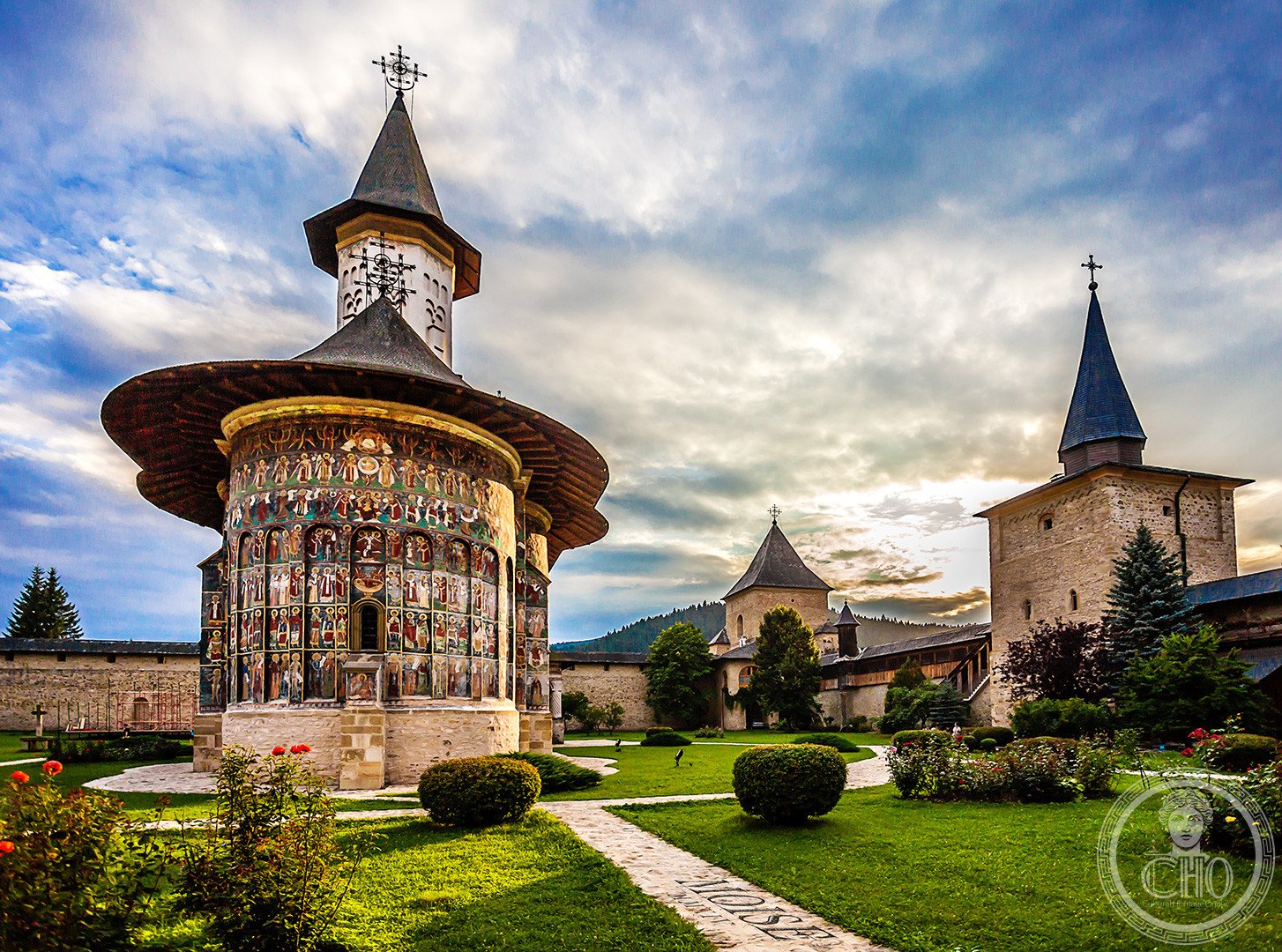
A fortified Eastern Orthodox convent in Bukovina whose interior and exterior walls blaze with biblical murals—painted around 1601 in the distinctive Moldavian style that defined the region’s artistic legacy.
At a glance
Sucevița is both monastery and fortress, its nearly square interior court (100 by 104 meters) ringed by imposing stone walls 6 meters high and buttressed by four corner towers. Founded in 1585 by three brothers of the Movilă princely family—Ieremia, Gheorghe, and Simion—it served as both a spiritual center and a fortified residence, reflecting the complex politics of 16th-century Moldavia.
History
The monastery rose during the reign of the Movilă princes, powerful figures who wielded spiritual and temporal authority across northwestern Moldavia. Built as an act of piety and statecraft, Sucevița became a hub of intellectual life: a manuscript workshop and later a printing center where monks produced and illuminated sacred texts. The tombs of Ieremia and Simion Movilă—their covers richly embroidered in silver thread—remain within the monastery, monuments to the family’s devotion and wealth.
What you see
The church merges Byzantine and Gothic idioms with local Moldavian tradition. Every interior and exterior surface swims with mural paintings of extraordinary detail, depicting Old and New Testament narratives in vivid color and gold. Dating to around 1601, these frescoes rank among the latest examples of Moldavia’s celebrated exterior painted-church tradition. The defensive ensemble—thick walls, corner towers, and narrow passages—gives the complex a martial presence unusual for a convent.
Cultural significance
Sucevița epitomizes the Painted Churches of Moldavia, a UNESCO-recognized artistic tradition that flourished in the 15th and 16th centuries. Its murals constitute a visual Bible for the faithful and a masterwork of Renaissance devotional art. The monastery’s library and archive testify to its role as a preservation center during centuries of Ottoman and Cossack incursions that threatened the region.
Key facts
- Country: Romania
- Location: Village of Sucevița, 18 km from Rădăuţi, Suceava County
- Founded: 1585 by Ieremia, Gheorghe, and Simion Movilă
- Murals: circa 1601
- Coordinates: 47.7782°N, 25.7112°E
- UNESCO World Heritage Site: 2010 (Painted Churches of Moldavia)
Practical information & getting there
Sucevița lies in Suceava County in northeastern Romania, roughly 18 kilometers south of Rădăuţi. The monastery is accessible by road and forms part of the Via Transilvanica heritage trail, ranking as its second major landmark after Putna Monastery. A museum within the walls displays ecclesiastical silverware, illuminated manuscripts, and other artifacts from the monastic collection. Detailed visiting hours and admission information are best confirmed in advance.
Sources & resources
Find it on the map
See this place and what’s around it →📷 Become a Cultural Heritage Online photographer
Share your photos of places: they stay published under your name as the author. The more they're seen, the more you get noticed — and soon a contest will reward the most appreciated photos.
Log in or sign up free to add a photoIs this page about you?
This page is read by travellers and heritage enthusiasts who find it on Google. Tell us how you are connected to this place and we will take it from there.