
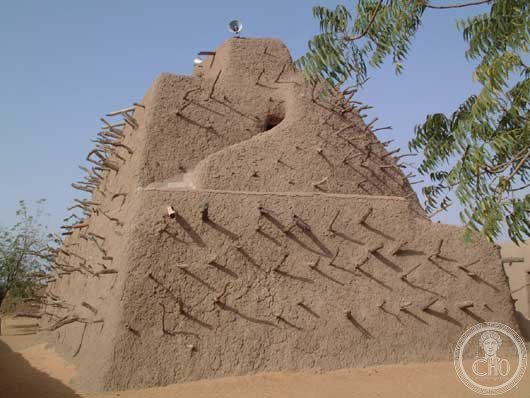
Tomb of Askia
A monumental mud-brick pyramid and sacred complex commemorating Askia Muhammad I, the Songhai Empire’s most prolific ruler, and a masterwork of West African Sahelian architecture.
At a glance
The Tomb of Askia rises 17 metres above Gao’s landscape, anchoring a sacred compound that includes two mosques, a cemetery, and an assembly ground. Built at the end of the fifteenth century, it remains the largest pre-colonial architectural monument in the city and continues to function as an active place of worship and public cultural centre.
History
Askia Muhammad I ruled the Songhai Empire during its period of greatest territorial expansion and cultural influence. Though he is the sole individual entombed within the pyramid itself, several successor Askias were interred in the surrounding courtyard, creating a dynastic burial ground that reflects the political importance of Gao as an imperial centre. The complex has been protected by national and local law and remains integral to the city’s identity.
What you see
The dominant feature is the pyramidal tomb, constructed in the mud-building tradition characteristic of the West African Sahel. Its monumental form and precise geometry exemplify Sudano-Sahelian architectural principles, a style that would subsequently influence building practices throughout the region. The integrated complex—tomb, mosques, cemetery, and gathering space—demonstrates how sacred and civic functions were woven into a single unified design.
Cultural significance
UNESCO recognizes the tomb as a fine example of monumental mud-building traditions unique to the Sahel. It stands as testimony to the Songhai Empire’s sophistication and to Gao’s historical prominence as a centre of Islamic learning and political power. The site embodies centuries of continuous spiritual and communal use, linking medieval African statecraft to contemporary cultural practice.
Key facts
- Location: Gao, Mali
- Coordinates: 16.29°N, 0.04°W
- Built: Late fifteenth century
- Height: 17 metres (56 feet)
- UNESCO World Heritage Site: Yes
Practical information & getting there
The tomb complex is publicly accessible and functions as a cultural centre for Gao. The site remains protected under both national and local legislation. For current visiting hours and access details, contact local tourism authorities in Gao or consult recent travel resources, as conditions in Mali have varied.
Sources & resources
- Tomb of Askia – Wikipedia
- Cultural Heritage Online
Find it on the map
See this place and what’s around it →📷 Diventa un fotografo di Cultural Heritage Online
Condividi le tue foto dei luoghi: restano pubblicate con la tua firma come autore. Più vengono viste, più ti fai conoscere — e presto un concorso premierà le foto più apprezzate.
Accedi o registrati gratis per aggiungere una foto