
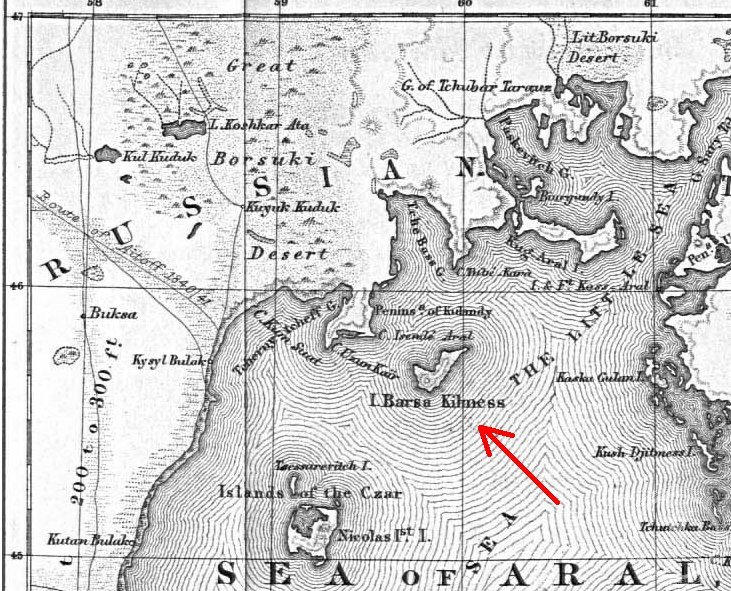
Once the Aral Sea’s largest island, Barsa-Kelmes—whose name means “the place of no return”—vanished beneath rising waters in the 1990s, leaving behind a nature reserve steeped in legend and ecological mystery.
At a glance
Barsa-Kelmes was an island spanning 133 square kilometres in the 1980s, with a highest elevation of 113 metres. As the Aral Sea receded and became shallower, the island gradually expanded until it ceased to be an island in the 1990s. Today it encompasses the Barsa-Kelmes Nature Reserve.
History
The island’s evocative name—literally meaning “if you go there you won’t come back”—derives from Central Asian folklore. Locals reported that visitors who ventured to Barsa-Kelmes would vanish for years or decades, yet believed only 2 or 3 days had passed upon their return. Whether rooted in the island’s geographical isolation, unusual atmospheric conditions, or pure legend, these stories became woven into its identity. The transformation of Barsa-Kelmes from island to peninsula reflected the dramatic environmental changes affecting the Aral Sea throughout the late 20th century.
What you see
As a nature reserve rather than a built site, Barsa-Kelmes preserves its natural landscape and native salt deposits. The varied terrain and elevation changes across its former island expanse create distinct ecological zones within the reserve.
Cultural significance
Barsa-Kelmes embodies the intersection of Central Asian mythology and environmental history. Its haunting name and the legends attached to it represent how isolated places generate stories of temporal displacement and mystery. The reserve now documents both the ecological character of the Aral region and the cultural imagination it has long inspired.
Key facts
- Country: Kazakhstan
- Location: Aral Sea
- Area: 133 km² (1980s)
- Highest elevation: 113 m
- Status: Nature Reserve (former island, ceased being island in 1990s)
- Coordinates: 45.633°N, 59.867°E
Practical information & getting there
Barsa-Kelmes lies within the Aral Sea region of Kazakhstan. The reserve’s salt deposits mean that visitors should close their eyes during dust storms and strong winds to protect against salt particles. Access details and visiting arrangements should be confirmed locally, as the site remains ecologically sensitive.
Sources & resources
Find it on the map
See this place and what’s around it →
📷 Become a Cultural Heritage Online photographer
Share your photos of places: they stay published under your name as the author. The more they're seen, the more you get noticed — and soon a contest will reward the most appreciated photos.
Log in or sign up free to add a photo