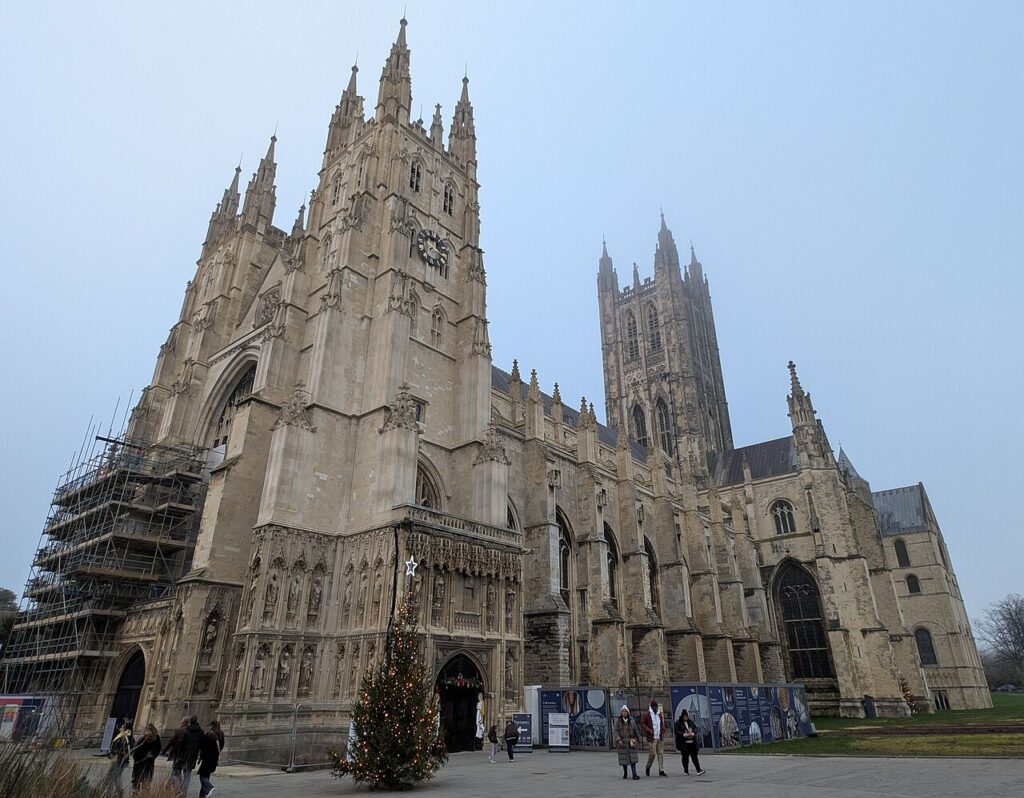
Canterbury Cathedral, St Augustine’s Abbey, and St Martin’s Church — inscribed by UNESCO in 1988 — form the cradle of English Christianity in Canterbury, Kent: three sites that together represent the founding of the Christian Church in England from the late 6th century CE, with St Martin’s Church (the oldest church in continuous use in the English-speaking world), St Augustine’s Abbey (founded 597 CE by Augustine of Canterbury, the first Archbishop of Canterbury, sent by Pope Gregory the Great to Christianise the Anglo-Saxon kingdoms), and Canterbury Cathedral (seat of the Archbishop of Canterbury, the mother church of the Anglican Communion worldwide, rebuilt in the Romanesque and Gothic styles from 1070 CE onward, and the site of the martyrdom of Archbishop Thomas Becket in 1170 CE).
Canterbury Cathedral: from Augustine’s foundation to Becket’s martyrdom and the Perpendicular Gothic nave Trinity Chapel (Thomas Becket’s shrine and tomb) · Norman crypt (the largest surviving Norman crypt in England) · Bell Harry Tower (1494–1500 CE) · St Gabriel’s Chapel (12th-century frescoes) — within the inscription
Canterbury Cathedral (the Cathedral and Metropolitical Church of Christ at Canterbury, dedicated to Christ — the ancient English title “Christchurch” referring to this dedication) was founded on the site where Augustine of Canterbury established the first cathedral of the Church in England in 597 CE, in the former Roman city of Durovernum Cantiacorum (Canterbury). The present cathedral building is primarily the result of two major medieval construction campaigns: the Norman rebuilding under Archbishop Lanfranc (circa 1070–1077 CE, following the destruction of the pre-Conquest building by fire in 1067 CE) and its successor Archbishop Anselm (who rebuilt the quire, 1096–1126 CE, in the elaborate Romanesque style now visible in the Norman crypt — the largest surviving Norman crypt in England, approximately 60 metres long, with elaborately decorated capitals on its columns representing the most significant surviving Norman sculptural programme in Britain); and the Gothic rebuilding of the quire and Trinity Chapel following the fire of 1174 CE (repaired by the master builders William of Sens and William the Englishman in the newly imported French Gothic style — pointed arches, ribbed vaults, and flying buttresses — making the rebuilt Canterbury quire one of the earliest Gothic buildings in England and the direct model for the subsequent development of English Gothic architecture). The cathedral’s nave (the main body of the building, where congregants worship) was rebuilt in the Perpendicular Gothic style by Master Henry Yevele in approximately 1378–1405 CE — the Perpendicular style (characterised by strong vertical lines in the window tracery and vaulting, an English development of the mature Gothic style not found on the European continent) is at its most grand and serene in the Canterbury nave, whose stone vaulting and large windows create the characteristic English cathedral effect of weightlessness and filtered light. The Bell Harry Tower (the central tower of the cathedral, approximately 72 metres high, completed 1494–1500 CE by John Wastell, who also worked on the fan vaulting at King’s College Chapel, Cambridge) is the dominant visual element of Canterbury Cathedral’s exterior, visible for many kilometres across the flat Kent landscape and defining the skyline of Canterbury city. The most historically significant feature of the cathedral is the Trinity Chapel (at the eastern end of the building, beyond the high altar): the site of the shrine of St Thomas Becket, the Archbishop of Canterbury murdered in the cathedral on 29 December 1170 CE on the orders of King Henry II and subsequently canonised (1173 CE), whose miraculous healing powers attracted pilgrims from across Europe for the subsequent 300 years and made Canterbury the most important pilgrimage destination in England and one of the most important in northern Europe — the pilgrimage immortalised by Geoffrey Chaucer in “The Canterbury Tales” (approximately 1387–1400 CE). The shrine itself was destroyed by Henry VIII’s dissolution of the monasteries (1538 CE), but the Purbeck marble platform on which it stood and the mosaic pavement of the Trinity Chapel (with its exceptional programme of 13th-century geometric and figural tile patterns) survive, as does the adjacent Chaucer Window (a modern stained glass window depicting Chaucer’s pilgrims) and the tombs of the Black Prince (Edward of Woodstock, died 1376 CE, with his funeral achievements — the replica helmet, gauntlets, and surcoat originally hung above the tomb) and King Henry IV (died 1413 CE, the only English king buried at Canterbury).
St Augustine’s Abbey (approximately 300 metres east of the cathedral precinct) was founded in 597 CE by Augustine himself — initially as an extra-mural monastery (outside the Roman city walls) to provide a burial place for the early archbishops and the kings of Kent, since Augustine’s papal instructions prohibited burying the dead inside established churches or city limits. The abbey’s remains (substantial Romanesque and early Gothic foundations, visible in the English Heritage-managed site) include the foundations of multiple superimposed buildings representing the Saxon, Norman, and Gothic phases of the monastery’s development, with the most impressive standing remains being the late medieval Norman gateway (the Fyndon Gate, circa 1390 CE) and the fragments of the Norman abbey church. St Martin’s Church (approximately 500 metres east of the cathedral precinct, at the eastern edge of the medieval city) is the oldest church in the English-speaking world in continuous use: built on the site of a Roman building (Roman brick is visible in the lower courses of the chancel walls), it was used by Queen Bertha of Kent (a Frankish Christian princess who had arrived in Canterbury approximately 560 CE before Augustine’s mission, bringing her own chaplain Liudhard to maintain Christian worship) and was given to Augustine as his first place of worship on his arrival in Canterbury in 597 CE. St Martin’s continues to function as an active Church of England parish church, without a resident congregation since the early 20th century but open to visitors as a place of prayer and reflection.
Practical information
Canterbury is located in Kent, approximately 90 km southeast of London, with frequent high-speed trains from London St Pancras International (Southeastern Highspeed, approximately 1 hour) and regular trains from London Victoria and London Charing Cross (approximately 1.5–2 hours). The cathedral is in the historic city centre, a 10-minute walk from Canterbury West railway station and 15 minutes from Canterbury East. Entry to the cathedral requires a ticket (advance booking recommended in summer and on days with special events); the cloisters, the crypt, and the main nave are included in the standard ticket. St Augustine’s Abbey (English Heritage, entry fee) is approximately 300 metres east of the cathedral; St Martin’s Church (free, donations welcome) is approximately 500 metres further east. Allow 2–3 hours for the cathedral (including the crypt and the Trinity Chapel) and 1 hour for St Augustine’s Abbey. The medieval city centre (within the surviving circuit of city walls, including the West Gate — the largest surviving medieval city gate in England) repays an hour’s walking. Best season: year-round; December can be atmospheric for the cathedral’s Christmas choral tradition. Note: Thomas Becket’s martyrdom is commemorated on 29 December each year with a special liturgy; the translation of his relics is commemorated on 7 July (the original feast day of St Thomas of Canterbury, from when Chaucer’s “Canterbury Tales” pilgrimage takes place in “the month of May” — actually the July feast rather than the December martyrdom).
Frequently Asked Questions
Who was Thomas Becket and why did his murder in Canterbury Cathedral become so significant?
Thomas Becket (born approximately 1119–1120 CE in London, died 29 December 1170 CE in Canterbury) was one of the most important figures in medieval European history and the most significant saint of the medieval English church: a man of middle-class Norman-English origin who rose to be Chancellor of England under King Henry II (the most powerful administrative post in the kingdom), was then appointed Archbishop of Canterbury (the highest ecclesiastical office in England) in 1162 CE, underwent a conversion to radical ascetic piety, and spent the remaining 8 years of his life in an increasingly bitter conflict with Henry II over the question of who held ultimate authority over the clergy — the king (who claimed the right to try clergymen in royal courts for criminal offences) or the Church (which claimed “benefit of clergy,” the exclusive right of ecclesiastical courts to try ordained persons). The dispute was not purely personal: it represented the fundamental medieval conflict between royal and papal authority that dominated European politics throughout the 11th–13th centuries CE (the Investiture Controversy, the Concordat of Worms, the later conflict between Philip IV of France and Boniface VIII all derive from the same structural tension). Thomas Becket was murdered by four knights of Henry II’s household (Reginald FitzUrse, Hugh de Moreville, William de Tracy, and Richard le Bret) in the northwest transept of Canterbury Cathedral on 29 December 1170 CE — almost certainly as a direct result of Henry II’s furious words (“Will no one rid me of this turbulent priest?” or equivalent — the exact words are disputed across the sources), though the knights acted without explicit royal orders. Thomas was canonised by Pope Alexander III on 21 February 1173 CE — less than three years after the murder, an extremely rapid canonisation that reflected the immediate and overwhelming popular veneration of the martyr and the political value to the papacy of the canonisation (a dead archbishop martyred by a king made Thomas a powerful symbol of ecclesiastical independence). Henry II performed public penance at Thomas’s tomb in 1174 CE (walking barefoot to the tomb and being symbolically flogged by the monks) — the most significant public act of royal penance in English history, which both expressed genuine remorse and resolved the immediate political crisis created by the murder.
What are “The Canterbury Tales” and how do they connect to the pilgrimage tradition?
The Canterbury Tales (written approximately 1387–1400 CE, left unfinished at Chaucer’s death in 1400 CE) is the most important work of English literature before Shakespeare: a collection of stories framed as the tales told by a group of approximately 30 pilgrims travelling from the Tabard Inn in Southwark (south London) to the shrine of St Thomas Becket at Canterbury Cathedral. Geoffrey Chaucer (circa 1343–1400 CE), a London customs official with connections to the English court, conceived the Tales as a social panorama of 14th-century England: his pilgrims include representatives of the major social estates of medieval English society (the noble Knight and his son the Squire, the learned Clerk, the corrupt Pardoner and Summoner, the Wife of Bath whose five husbands she describes in elaborate detail, the devout Prioress, the ribald Miller, the learned Sergeant of Law, the swindling Cook) and the stories they tell range across genres (courtly romance, fabliau/ribald comedy, saint’s life, moral allegory, exemplum/moral tale, tragedy) in a demonstration of the full range of narrative modes available to a 14th-century English writer. The frame narrative of the pilgrimage was chosen partly for practical reasons (it provided a natural occasion for strangers to meet and tell stories) and partly because the pilgrimage to Canterbury was the most familiar of English pilgrimage traditions — a journey undertaken annually by thousands of English people of all social classes, making it the most accessible common experience for Chaucer’s intended audience. The specific route of the “Pilgrim’s Way” from London to Canterbury (passing through Rochester, Sittingbourne, Faversham, and entering Canterbury via the Westgate) is documented in the Tales through the pilgrims’ references to specific landmarks and inns along the route, and sections of the historic route can be walked today using the North Downs Way long-distance footpath. The Canterbury Tales is significant not only as a literary masterwork but as the foundational document of the English literary tradition in English (rather than Latin or French, the languages of prestige in 14th-century England) and as a sociological document of extraordinary richness for the social history of late medieval England.
What is the significance of St Martin’s Church as the oldest church in the English-speaking world?
St Martin’s Church in Canterbury (the Church of St Martin, officially, located on St Martin’s Hill approximately 500 metres east of the city walls) holds the distinction of being the oldest church in the English-speaking world in continuous use — a distinction supported by both documentary and archaeological evidence. The church’s Roman brick walls (visible in the lower courses of the chancel) indicate construction or substantial rebuilding in the Roman period (approximately 1st–4th century CE), and the documentary evidence places the church in use for Christian worship before Augustine’s arrival in 597 CE: the Venerable Bede’s Ecclesiastical History of the English People (completed 731 CE) records that Queen Bertha of Kent (a Frankish Christian princess, daughter of King Charibert I of Paris, who had married King Æthelberht of Kent approximately 560–580 CE) used a restored Roman building near Canterbury for Christian worship, with her Frankish bishop Liudhard (whose name appears on a coin or medallion found near Canterbury in the 19th century CE, the “Liudhard medalet,” which is the only physical evidence connecting him to Canterbury). When Augustine arrived in Canterbury in 597 CE, he was initially given St Martin’s Church for his own worship before the formal foundation of the cathedral and the abbey. The church has been in continuous use as a Christian place of worship from approximately 560 CE to the present — approximately 1,460 years — making it genuinely the oldest church in continuous use in the English-speaking world (the English language itself dates from approximately the 5th–6th century CE, making any church that predates English continuous settlement in Britain ineligible for the English-speaking designation). The building has been modified repeatedly (the nave is largely Norman and medieval, the chancel is the oldest part with its Roman brick core) but has never been abandoned, demolished, or converted to non-church use — the continuity that gives it the record. It functions today as an active Church of England parish church for the local Canterbury neighbourhood, with a strong heritage education programme for the many visitors who come specifically because of its record.
EXCERPT: Canterbury Cathedral, St Augustine’s Abbey, and St Martin’s Church (UNESCO 1988) — the founding sites of English Christianity in Canterbury, Kent: St Martin’s Church (the oldest church in continuous use in the English-speaking world), St Augustine’s Abbey (597 CE), and Canterbury Cathedral with its Norman crypt, Gothic choir, and the Trinity Chapel where Thomas Becket was martyred in 1170 CE and canonised in 1173 CE.
META: UNESCO World Heritage Sites near Canterbury UK: Palace of Westminster and Westminster Abbey London 90 km west, Stonehenge Avebury 250 km west — southern England heritage circuit from the medieval pilgrimage cathedral to the Gothic parliamentary palace and the Neolithic sacred landscape.
Sources
- S1 — UNESCO World Heritage Centre — Canterbury Cathedral, St Augustine's Abbey, and St Martin's Church (Ref. 496) — https://web.archive.org/web/20230601000000/https://whc.unesco.org/en/list/496/
- S2 — Canterbury Cathedral Official Visitor Portal — https://www.canterbury-cathedral.org/
Spotted an error? Write to the editors and we correct it the same day.