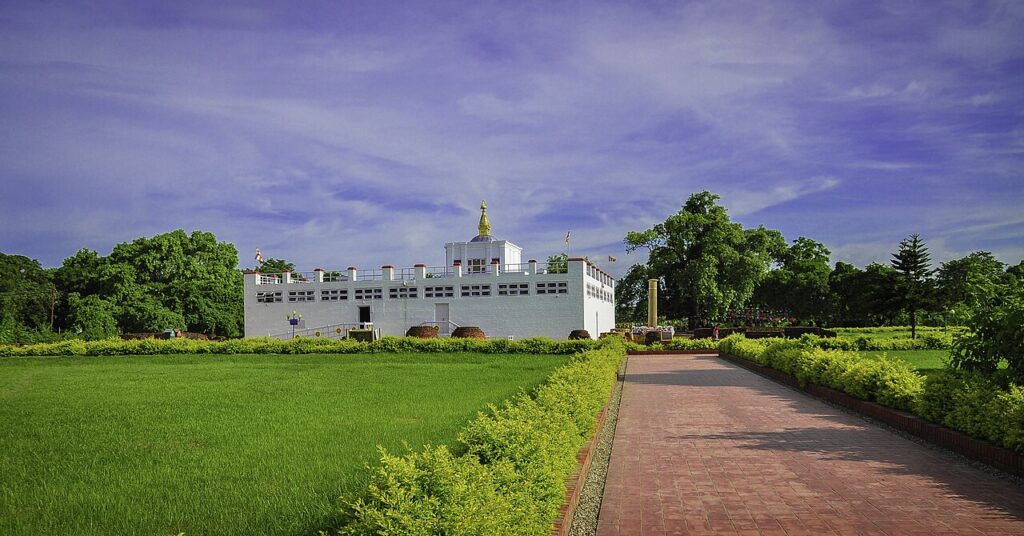
Lumbini (Pali: “Lummini” — the birthplace of Prince Siddhartha Gautama, the historical Buddha, in the Terai lowland plain of what is now the Rupandehi District of Lumbini Province in southern Nepal), inscribed by UNESCO in 1997, is the most sacred site in Buddhism — the location where, in approximately 563 BCE (the date is debated between 563 BCE and 480 BCE depending on the chronological framework used — see FAQ below), Queen Maya Devi of the Shakya republic (the wife of the Shakya ruler Suddhodana, who governed the Kapilavastu kingdom centred on the area now divided between Nepal and the adjacent Indian state of Uttar Pradesh) gave birth to a son who would become the historical Buddha, the founder of the Buddhist religion that today has approximately 500 million adherents worldwide. The UNESCO inscription covers the Lumbini Sacred Garden (the Maya Devi Temple — the modern enclosure building protecting the exact spot of the birth, which contains the “Nativity Marker” stone [a 2nd-century BCE stone slab with a bas-relief frieze showing the birth scene] and the sandstone Ashokan pillar erected approximately 249 BCE by the Maurya Emperor Ashoka to mark his pilgrimage to the birthplace of the Buddha and bearing the inscription “Beloved of the Gods, King Piyadasi [Ashoka’s epithet], in the 20th year of his reign, having come himself and worshipped, erected this pillar because the Exalted One was born here — he reduced the village of Lumbini from tax and required it to pay only one-eighth instead of the usual amount”), the Sacred Pond (Pushkarni — the pond in which Queen Maya Devi is said to have bathed before giving birth), the surrounding archaeological remains of monasteries and stupas from the Ashoka period (approximately 3rd century BCE) through the Gupta period (approximately 4th–6th century CE), and the modern “Lumbini Development Zone” master-planned by the Japanese architect Kenzo Tange in 1978 CE — a 4.8 km × 1.6 km zone containing the Sacred Garden at the centre, flanked by two parallel monastic zones (the east zone for Theravada Buddhist monasteries from countries with Theravada traditions — Thailand, Myanmar, Sri Lanka, Cambodia, Laos — and the west zone for Mahayana and Vajrayana monasteries from countries with those traditions — China, Japan, Korea, Tibet, Bhutan, Vietnam) separated by a central canal, and a southern commercial and pilgrimage support zone.
Lumbini’s sacred garden and the international Buddhist pilgrimage circuit Maya Devi Temple · Ashokan Pillar · International Monastery Zone · Bhairahawa Airport · Chitwan — 0 to 115 km
The Lumbini Sacred Garden (the core of the UNESCO inscription, covering approximately 2 km²) is the most archaeologically significant and spiritually concentrated area of the site — the Maya Devi Temple enclosure building (the current protective structure, built by the Japanese Government 2002–2003 CE to international conservation standards to protect the delicate archaeological deposits from rainfall erosion and foot-traffic damage) covers the approximately 0.6 ha area where the Nativity Marker stone and the archaeological remains of the successive temple structures built over the birth spot from the Ashoka period to the 15th century CE are preserved. Excavations within the Maya Devi Temple enclosure (conducted jointly by the Lumbini Development Trust and the Durham University Archaeology team, 2013–2016 CE) discovered the earliest archaeological remains of the sacred site: a wooden structure approximately 6th–5th century BCE whose post holes align with the later stone structures, and which was interpreted by the excavators as possibly the earliest shrine built to mark the birth spot — a finding that was cited as supporting the earlier (563 BCE) dating for the historical Buddha’s birth and published in the journal Antiquity in 2013 CE with significant international media coverage. The international monastery zone (the east and west zones flanking the central canal and the Sacred Garden) has been developed since approximately 1990 CE and now contains approximately 20–30 completed monastic complexes from different countries, including the World Peace Pagoda (a white stupa built by the Japanese Nipponzan Myohoji order in 2001 CE), the Myanmar Monastery, the Thai Monastery, and the China Monastery — each built in the distinct architectural style of its home country and functioning as a working monastic establishment (with resident monks who perform daily ceremonies) as well as a pilgrimage guest house for visitors from their country. The Ashokan pillar (Emperor Ashoka, approximately 268–232 BCE — the Maurya Emperor who converted to Buddhism after the Battle of Kalinga in approximately 261 BCE and became the first monarch to make state policy of the promotion of Buddhism, sending missionaries to Sri Lanka, Central Asia, and the Mediterranean) is the most important single historical document at Lumbini: the pillar inscription (in Brahmi script, translated in the 19th century CE after the decipherment of Brahmi by the British scholar James Prinsep in 1837 CE) is the oldest known inscription directly identifying Lumbini as the birthplace of the Buddha and the primary archaeological evidence that anchors the historical Buddha’s birth to a specific geographical location.
Practical information
Lumbini is approximately 280 km southwest of Kathmandu (approximately 7 hours by tourist bus via the Terai highway through Chitwan) or accessible by air from Kathmandu to Bhairahawa/Gautam Buddha Airport (GWA — domestic airport, approximately 25 minutes from Kathmandu by Yeti Airlines or Shree Airlines; the airport has a new international terminal opened 2022 CE with connections to India, Thailand, and Malaysia). From Bhairahawa, Lumbini is approximately 22 km by road (40 minutes by taxi or tuk-tuk). The Sacred Garden entrance fee applies (foreigners pay more than Nepali nationals); audio guides are available at the entrance. The Maya Devi Temple is open 06:00–18:00 (with Buddhist prayer ceremonies at the Nativity Marker at 06:30 and 16:30). The main archaeological circuit (Sacred Garden + Ashokan Pillar + Sacred Pond + Eternal Flame) takes approximately 2–3 hours on foot; bicycle hire is available at the main entrance for the monastic zone circuit (approximately 10 km to visit all major international monasteries, 3–4 hours). Best visiting months: October–March (dry and cool — the Terai becomes very hot April–September). Buddha Jayanti (the full moon of the Buddhist month of Vaishakha, approximately April–May in the Gregorian calendar — the traditional anniversary of both the birth and the enlightenment and death of the Buddha) brings the largest annual pilgrimage to Lumbini, with hundreds of thousands of Buddhist pilgrims from Nepal, India, and across Asia.
Frequently Asked Questions
When was the historical Buddha born and why is the date uncertain?
The birth date of the historical Buddha Siddhartha Gautama (also called Shakyamuni — “the sage of the Shakya clan”) is one of the most extensively debated questions in Asian history and Buddhist studies — the precise date cannot be established with certainty, and scholarly opinion has been divided between two primary chronological frameworks since the 19th century CE. The “long chronology” (the traditional Southeast Asian Theravada Buddhist chronology, based on the Sinhalese Pali chronicle Dipavamsa and the Burmese and Thai Buddhist chronicles) dates the Buddha’s birth to approximately 624 BCE and his death/Parinirvana to approximately 544 BCE — a date that is the basis of the traditional Theravada calendar (the “Buddhist Era” — BE — begins from the Parinirvana, so 2024 CE = 2568 BE in the Theravada system). The “short chronology” (derived from the analysis of Greek/Iranian contact dates in the Ashokan inscriptions and the comparison of the Brahmi script with datable epigraphic evidence) dates the Buddha’s birth to approximately 563 BCE and his death to approximately 483 BCE. The “corrected short chronology” (a third scholarly position, adopted by many contemporary scholars) places the birth approximately 480 BCE and the death approximately 400 BCE. The range of scholarly opinion thus spans approximately 200 years (624 BCE to 480 BCE birth dates), which reflects the fundamental difficulty of reconstructing early Indian chronology in the absence of contemporaneous written records (the earliest surviving Indian texts with secure absolute dates are the Ashokan inscriptions, approximately 268–232 BCE — more than 200 years after the most likely date for the historical Buddha). The Ashokan pillar at Lumbini, which is the earliest dateable inscription identifying the site as the Buddha’s birthplace, was erected approximately 249 BCE — a date that provides a terminus ante quem for the Buddhist pilgrimage to Lumbini (the site was important enough for the Maurya emperor to visit personally and erect a pillar within approximately 230 years of the traditional “long chronology” birth date) but does not itself confirm the birth date. The UNESCO inscription of 1997 uses the formulation “in 623 BCE” for the birth date on the official inscription documentation, reflecting the Theravada chronology — a choice that is not universally accepted by Buddhist scholars or by the governments of countries with strong Buddhist studies traditions (Japan, China, and Western Buddhist studies programs tend to use approximately 560–480 BCE). The practical consequence for visitors is that the precise “2,500th anniversary” or “2,600th anniversary” of the birth will be celebrated in different years by different Buddhist communities, with the Theravada communities having celebrated the 2,500th anniversary in 1956 CE and the short-chronology communities expecting it in 2037 CE.
What did Emperor Ashoka’s pilgrimage to Lumbini reveal about early Buddhist history?
Emperor Ashoka’s pilgrimage to Lumbini in approximately 249 BCE (in the 20th year of his reign — the chronological marker in the pillar inscription, which provides the only securely dated external anchor for locating Ashoka’s Lumbini visit in absolute terms) was the single most important event for the subsequent recognition of Lumbini as the authenticated birthplace of the historical Buddha. Before Ashoka’s visit, the oral Buddhist tradition identified “Lummini” (the Pali form of the site name — the current name “Lumbini” is a Sanskritisation of this Pali name) as the birthplace, but there was no permanent marker or monument to distinguish the specific spot. Ashoka erected the inscribed pillar (approximately 6–7 m of the original pillar, whose height before the later breakage of the shaft is estimated at approximately 9–13 m, survives above ground; the pillar was identified and excavated by the German archaeologist Alois Anton Führer in 1896 CE) and — according to the Chinese Buddhist pilgrim Faxian’s account of his Lumbini visit approximately 402 CE — also built a wall around the sacred garden and erected a marker stele identifying the exact spot of the birth. Ashoka’s Lumbini pilgrimage was part of a larger programme of Buddhist holy-site pilgrimage that the Maurya emperor undertook: the Ashokan pillar inscriptions at Sarnath (the location of the First Sermon, the “Dhamma Chakka Pavattana Sutta”), Bodh Gaya (the location of the Enlightenment), and Kushinagar (the location of the Parinirvana/death) document the same royal pilgrimage programme, and together constitute the earliest archaeological evidence for the four “Mahasthanas” (great pilgrimage places) of Buddhism. The significance of Ashoka’s Lumbini visit for the history of Buddhist geography is that it transformed the oral tradition’s identification of “Lummini” as the birthplace into a marked, inscribed, and royally authenticated location — creating the permanent sacred site whose archaeological remains UNESCO inscribed in 1997. Without the Ashokan pillar inscription, the modern identification of the Lumbini sacred garden as the authentic birth site would rest entirely on the much later accounts of Chinese pilgrims (Faxian approximately 402 CE and Xuanzang approximately 633 CE), both of whom describe a pillar with an inscription at the site — making the pillar’s survival to the present day (partially above ground, partially underground, and identified by Führer in 1896 CE with the Faxian description of a pillar “bearing a carving of a horse’s head at the top” — the “horse’s head” is no longer visible but the Buddhist symbol of a horse trampling on a lotus is the likely source of this description) the key evidentiary chain linking the modern archaeological site to the ancient Buddhist tradition.
EXCERPT: Lumbini, Nepal, UNESCO-inscribed 1997, is the birthplace of the historical Buddha (approximately 563 BCE) — the Sacred Garden with the Maya Devi Temple’s 2nd-century BCE nativity stone, the Ashokan pillar inscription of 249 BCE (earliest physical evidence identifying the site), and the international monastery zone where 25+ countries have built national-style Buddhist monasteries flanking a central canal.
META: UNESCO World Heritage Sites near Lumbini Nepal: Royal Chitwan National Park 115 km east (UNESCO 1984), Kathmandu Valley 280 km northeast (UNESCO 1979), Sagarmatha National Park 500 km east (UNESCO 1979) — Lumbini Nepal UNESCO 1997, birthplace historical Buddha Siddhartha Gautama, Maya Devi Temple nativity marker, Emperor Ashoka pillar Brahmi inscription, international monastery zone Bhairahawa airport.
Sources
- S1 — UNESCO World Heritage Centre — Lumbini, the Birthplace of the Lord Buddha (Ref. 666) — https://web.archive.org/web/20230601000000/https://whc.unesco.org/en/list/666/
- S2 — UNESCO World Heritage Centre — Statement of Outstanding Universal Value (Ref. 666) — https://whc.unesco.org/en/list/666/
Spotted an error? Write to the editors and we correct it the same day.