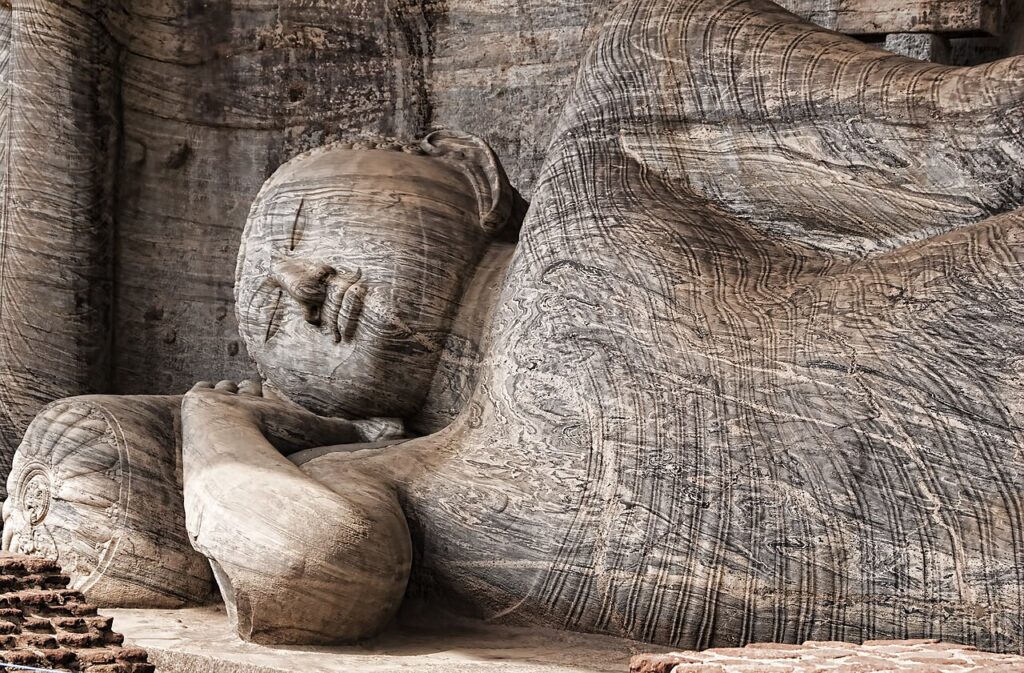
The Ancient City of Polonnaruwa (ශ්රී ලංකා — Sinhala: “Pulatthinagara” — “City of Pulatthi” in medieval Sanskrit/Pali records), inscribed by UNESCO in 1982, is the second ancient capital of Sri Lanka (approximately 1017–1235 CE, the period during which the political centre of the Sinhalese kingdoms moved northeast from Anuradhapura after the Chola conquest) and the location of the outstanding Gal Vihara (“Rock Temple”) — a series of four monumental rock-cut Buddha images carved in the 12th century CE by King Parakramabahu I (1153–1186 CE, the greatest ruler of the Polonnaruwa period and the last Sinhalese king to achieve full control of the entire island) from a single face of granite, including a 15-metre-long reclining Buddha (showing the Buddha at the moment of entering Parinirvana — final liberation from the cycle of rebirth) and a 7-metre-high standing Buddha (thought to be the attendant monk Ananda mourning the Buddha’s passing — one of the most emotionally expressive Buddhist sculptures in Sri Lanka, its height, posture, and the specific treatment of the facial features creating an effect of dignified grief). The Polonnaruwa archaeological zone (approximately 25 km²) contains the ruins of Parakramabahu I’s planned capital city — a compact royal city of palaces, audience halls, Buddhist temples, and monasteries built within a concentrated area of approximately 1 km² (the “Citadel” or inner royal zone) surrounded by a larger sacred/monastic zone, all set within the massive hydraulic landscape of the Parakrama Samudra (“Sea of Parakrama” — the artificial reservoir covering approximately 22 km², built by Parakramabahu I by connecting several earlier tanks, and still functional today as the primary water source for the rice irrigation of the Polonnaruwa District).
Polonnaruwa’s medieval monuments and the Sri Lanka Cultural Triangle Gal Vihara · Vatadage · Lankatilaka · Parakrama Samudra · Sigiriya · Anuradhapura — 0 to 100 km
The Polonnaruwa archaeological zone’s major monument clusters include: the Citadel (the inner royal core, with the Parakramabahu Palace — the principal royal palace, a multi-storey brick building whose external wall survives approximately 9 metres high, originally rising approximately 7 storeys — and the Audience Hall, with its remarkable stone friezes of elephants, horses, lions, and dwarves in continuous horizontal bands around the base of the platform); the Quadrangle (the “Dalada Maluwa” — the sacred precinct where the Tooth of the Buddha was housed during the Polonnaruwa period, containing the Vatadage [circular relic house, with concentric stone walls and a central dagoba, all four cardinal entrances guarded by seated Buddhas], the Hatadage [King Nissanka Malla’s Tooth Temple, built 1187 CE, with elaborately carved stone entrance pillars], and the Atadage [the oldest Tooth Temple structure, 11th century CE, the earliest surviving relic house for the Tooth at Polonnaruwa]); the Northern Group (the large Buddhist monastery and temple complex approximately 1.5 km north of the Citadel, including the Gal Vihara rock sculptures, the Lotus Pond [Nelum Pokuna], and the Tivanka Image House [a large brick Buddha image house with elaborate bas-relief fresco paintings on the interior walls — the Tivanka murals are among the finest surviving examples of 12th-century CE Sinhalese painting]); and the Southern Group (the Thuparama, Potgul Vehera monastery, and the granite statue of Parakramabahu I holding a palm-leaf manuscript [traditionally identified as the king, though some scholars propose it represents the sage Agastya]). The Parakrama Samudra tank (the western boundary of the Polonnaruwa zone, covering approximately 22 km² — the largest ancient irrigation reservoir in Sri Lanka) is best seen from the sunset viewpoint on the western bund, where the silhouette of the Rankot Vehera dagoba (58 m high, the largest dagoba at Polonnaruwa) appears above the waterline of the reservoir at dusk.
Practical information
Polonnaruwa is approximately 215 km northeast of Colombo (5 hours by road) or accessible by train from Colombo Fort Station on the Northern Line to Polonnaruwa station (approximately 5.5 hours). The town of Polonnaruwa (where accommodation is concentrated) is approximately 5 km east of the archaeological zone. The Sri Lanka Central Cultural Fund combined UNESCO triangle ticket is sold at the site entrance (covers Anuradhapura, Sigiriya, Polonnaruwa, Dambulla — valid for one entry per site within a set period). The archaeological zone is best explored by bicycle (hire available at the site entrance and in Polonnaruwa town) — the major monument clusters are spread over approximately 5 km of paved paths within the park. The Archaeological Museum (at the zone entrance) has displayed objects from the site including stone sculptures, bronzes, and inscriptions. Best visiting months: May–September (the North-East Province dry season, when the surrounding landscape is green from recent rains but the site is accessible — December–March is the alternative dry period for this region, as Polonnaruwa is on the “dry zone” rainfall pattern that is the reverse of Colombo’s monsoon). The Polonnaruwa Gal Vihara is most impressive in the early morning light (when the east-facing granite reflects the dawn light onto the sculptures) and in late afternoon (when the reclining Buddha’s face is in shadow and the carving’s depth is most visible).
Frequently Asked Questions
Who was King Parakramabahu I and why is he considered the greatest ruler of medieval Sri Lanka?
King Parakramabahu I (ruled approximately 1153–1186 CE, full regnal title “Parakramabahu Sri Sanghabodhi”, known in the Pali chronicles by his epithet “the Great”) is considered the greatest ruler of the Polonnaruwa period (and by many Sri Lankan historians, of all of medieval Sri Lanka) for the combination of military achievement, administrative capacity, and cultural patronage that characterised his 33-year reign. The military dimension of his achievement is documented in the Culavamsa: at his accession, Sri Lanka was divided among three rival kingdoms (Rajarata in the north with the capital at Polonnaruwa; Ruhuna in the south; and Dakkinadesa in the southwest), and Parakramabahu unified the entire island by military conquest by approximately 1165 CE — a feat that had not been achieved since the rule of King Dutugamunu approximately 1,300 years earlier and would not be achieved again until the British colonial period in the 19th century CE. His administrative achievements included: the commissioning of the Parakrama Samudra reservoir (the unified irrigation system that connected six previously separate tanks into a single hydraulic complex, creating the 22 km² reservoir that transformed the agricultural productivity of the Polonnaruwa District); the repair and restoration of the Sinhalese network of irrigation tanks that had been damaged or silted during the preceding centuries of political instability; and a comprehensive renovation of the Buddhist monastic establishment throughout the island, including the reform of the Three Nikayas (the three Sinhalese Buddhist monastic orders) into a unified, reformed Theravada sangha on the model of the Mahavihara Theravada tradition — a reform that reinstated the Vinaya (monastic rules) in a stricter form and brought in monks from Burma (the Burmese Theravada tradition was considered the most orthodox at this period) to assist with the reforming ordinations. His cultural patronage extended to architecture (the building programme at Polonnaruwa that produced the Gal Vihara, the Lankatilaka, the Tivanka Image House, and the Parakramabahu Palace, among other monuments) and to literature (the Culavamsa itself was partly written during or shortly after his reign in a form that reflects the literary culture of the court). The specific epithet “the Great” that distinguishes Parakramabahu I from the two later kings of the same name (Parakramabahu II and Parakramabahu III, minor rulers) was applied in the medieval Sinhala literary tradition and has been consistently used in Sri Lankan historiography since the 19th century CE.
What is the Gal Vihara and what makes its rock-cut Buddha sculptures exceptional?
The Gal Vihara (“Rock Temple” — from Sinhala “gala” = rock + “vihara” = monastery/temple) is a series of four Buddhist images carved from a single face of granite outcrop approximately 1.5 km north of Polonnaruwa’s citadel, commissioned by King Parakramabahu I approximately 1153–1186 CE. The four images, carved from east to west along a single curved rock face approximately 45 metres long, are: (1) a small seated Buddha in a rock-cut chamber with heavily carved walls (now faded); (2) a large seated Buddha in the open (approximately 4.6 metres high, in the dhyana/meditation mudra — right hand on left with thumbs touching); (3) the standing figure (approximately 7 metres high, arms crossed in a characteristic non-canonical posture — the only large standing Buddha in Sri Lanka with crossed arms, which has led to the traditional identification as Ananda the attendant monk mourning the Buddha’s Parinirvana rather than as a Buddha figure, though this identification is debated in Buddhist iconographic scholarship); (4) the reclining Buddha (approximately 15 metres long, in mahaparinirvana/final liberation posture — right side down, right hand supporting the tilted head, eyes closed, feet together). The specific qualities that make the Gal Vihara sculptures exceptional are: (1) the scale — the three large figures (standing, reclining, large seated) are the largest rock-cut Buddhist sculptures in Sri Lanka and among the largest in South Asia; (2) the single-stone carving — all four figures are carved from the same unbroken rock face without any joints, additions, or separate stone sections; (3) the technical mastery of surface modelling — the treatment of the robes (showing the thin fabric through the body, with careful fold lines) and the facial expressions (particularly the subtle smile of the large seated Buddha, which Sri Lankan Buddhists consider the most spiritually powerful smiling Buddha image on the island) show an extremely high level of sculptural skill; (4) the condition — the Gal Vihara sculptures have survived approximately 800 years without significant deterioration, apart from natural weathering of the granite surface and the loss of the original painted decoration (the sculptures were originally painted in bright colours — traces of pigment have been found in sheltered areas of the carving). The reclining figure’s face — the Parinirvana expression of perfect peace and liberation — is commonly described by Sri Lankan Buddhists as the most moving single image of the Buddha in the entire Buddhist world, surpassing even the Indian and Thai counterparts for the quality of serene emptiness in the facial expression.
EXCERPT: Ancient City of Polonnaruwa, Sri Lanka, UNESCO-inscribed 1982, was the medieval capital (1017–1235 CE) of the Sinhalese kingdom — Gal Vihara’s 15-metre reclining Parinirvana Buddha and 7-metre standing Ananda carved from a single granite face, the 22 km² Parakrama Samudra reservoir still irrigating Polonnaruwa District, and King Parakramabahu I’s unified Buddhist reform.
META: UNESCO World Heritage Sites near Ancient City of Polonnaruwa Sri Lanka: Ancient City of Anuradhapura 100 km northwest (UNESCO 1982), Ancient City of Sigiriya 60 km west (UNESCO 1982), Sacred City of Kandy 120 km south (UNESCO 1988) — Polonnaruwa Sri Lanka UNESCO 1982, Gal Vihara rock-cut Buddha sculptures, Parakramabahu I medieval Sri Lanka, Vatadage Tooth Relic Temple, Parakrama Samudra irrigation reservoir.
Sources
- S1 — UNESCO World Heritage Centre — Ancient City of Polonnaruwa (Ref. 201) — https://web.archive.org/web/20230601000000/https://whc.unesco.org/en/list/201/
- S2 — UNESCO World Heritage Centre — Statement of Outstanding Universal Value (Ref. 201) — https://whc.unesco.org/en/list/201/
Spotted an error? Write to the editors and we correct it the same day.