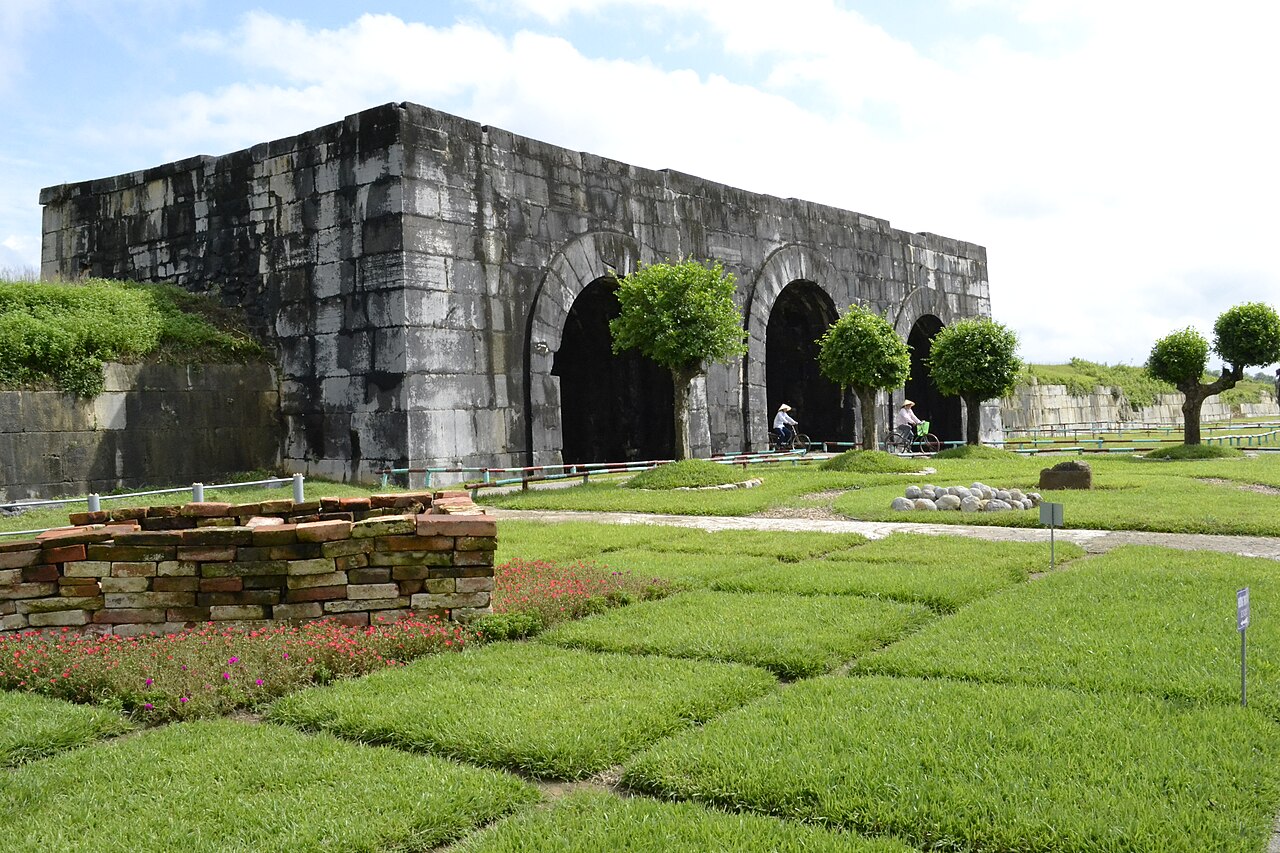
Citadel of the Ho Dynasty — inscribed by UNESCO in 2011 CE — preserves the most remarkably engineered royal fortress in Vietnamese history: a citadel built in just three months in 1397 CE by Hồ Quý Ly (then still the chief minister of the Trần Dynasty, which he was about to overthrow) using enormous blocks of green limestone — some weighing up to 15 tonnes — quarried from nearby mountains and transported without any mortar, assembled with extraordinary dry-stone precision, creating walls 5–6 metres high enclosing a rectangular royal capital at a bend of the Mã River in what is now Thanh Hóa Province, central Vietnam — the largest dry-stone citadel walls in Southeast Asia and one of the finest examples of feudal military engineering in the world.
Hồ Quý Ly’s limestone fortress, the three-month royal construction, and Vietnamese feudal military architecture North Gate (Cổng Bắc — the most intact of the four original city gates, with its massive stone arch and flanking towers, the primary visitor entrance) · South Gate (the main ceremonial entrance, now largely ruined) · East and West Gates · The citadel walls (north wall 900 m, east wall 700 m — the most completely preserved sections, with the characteristic green limestone block courses) · An Tôn ancient capital site (archaeological remains of the 1397 CE royal city within the walls) — Vĩnh Long Commune, Vĩnh Lộc District, Thanh Hóa Province, central Vietnam
Hồ Quý Ly (born approximately 1336 CE — one of the most controversial figures in Vietnamese history, described in traditional Vietnamese historiography as both a reformer and a usurper; the first Vietnamese ruler to introduce paper money, to promote the vernacular Nôm script over classical literary Chinese, and to attempt systematic land reform, but also the man who overthrew the Trần Dynasty that had successfully repelled three Mongol invasions and who lost Vietnam to Chinese occupation within seven years of his seizure of power) rose to dominance in the Trần court through a combination of administrative talent, military ability, and strategic marriage alliances. By the 1390s CE he was the effective ruler of Vietnam in all but name; in 1396–1397 CE he moved the capital from Thăng Long (Hanoi) south to the Thanh Hóa region, closer to his own power base. The 1397 CE construction: Hồ Quý Ly ordered the construction of the new citadel walls in 1397 CE, reputedly completing the main defensive perimeter within three months using a massive corvée labour force drawn from across Vietnam. The construction material and method: green limestone (local quarried blocks of the specific green-tinged limestone found in the mountains approximately 5–7 km from the construction site), shaped into rectangular blocks of varying sizes but fitted together without mortar using the dry-stone technique — the precision fitting of the stone faces allowing gravity and friction alone to hold the wall structure together. The largest blocks weigh approximately 15–20 tonnes; the total estimated volume of stone in the surviving walls is approximately 200,000 cubic metres — delivered, shaped, and laid in three months by a pre-industrial labour force. The walls: the citadel is rectangular, approximately 900 metres (north wall) × 700 metres (east wall), with a total perimeter of approximately 3,200 metres; the surviving walls are 5–6 metres high with a base approximately 6 metres thick; the four gates (north, south, east, west) are each constructed of a single large arch of fitted stone, with flanking towers for archers. The North Gate (the best preserved of the four, with its arch still intact and its flanking walls standing nearly full height) is the primary visitor experience — the weight of the 15-tonne stones fitted with such precision that not a single block has fallen out of position in over 600 years. Hồ Quý Ly’s dynasty was brief: he formally deposed the last Trần emperor in 1400 CE and founded the Hồ Dynasty, then in 1406–1407 CE the Ming Dynasty of China invaded Vietnam in response to a request for assistance from Trần Dynasty loyalists. The Hồ army was defeated, and Hồ Quý Ly was captured and taken to China, where he died in captivity; Vietnam entered a period of Ming Dynasty occupation that lasted 20 years (1407–1427 CE), ending only with the guerrilla campaign of Lê Lợi that founded the Lê Dynasty.
Practical information
The Citadel of the Ho Dynasty is located in Vĩnh Lộc District, Thanh Hóa Province, approximately 150 km south of Hanoi (approximately 3 hours by road or express bus), 50 km northwest of Thanh Hóa city, and approximately 200 km north of Hué. Thanh Hóa city is served by trains on the Reunification Express and by bus from Hanoi. From Thanh Hóa city, the citadel is approximately 50 km by road (approximately 1 hour by hired car or motorbike). The site is open to visitors (entry approximately $3–5 USD, small site museum). The North Gate is the primary photographic subject — the most intact example of the 1397 CE stone arch construction. Allow 1.5–2 hours for the citadel walls, gates, and the museum of archaeological finds. The site combines well with Ninh Bình (approximately 60 km northeast), which offers the Tràng An UNESCO World Heritage landscape and the Hoa Lư ancient capital. Best season: February–May (dry, cooler months).
Frequently Asked Questions
How were the massive stone blocks of the Hồ Dynasty citadel moved and assembled without mortar?
The construction of the Hồ Dynasty citadel’s walls in 1397 CE — using stone blocks of up to 15–20 tonnes each, delivered from quarries 5–7 km away, shaped with great precision, and assembled without mortar in walls that have stood for over 600 years — is one of the most technically impressive pre-industrial construction achievements in Southeast Asia, and the mechanics of how it was accomplished remain partially uncertain. The quarrying: the green limestone was quarried using iron wedges (iron production was well established in 14th-century CE Vietnam) to split the natural limestone beds along their joint planes, producing roughly rectangular blocks. The shaping: quarried blocks were further shaped using iron chisels and abrasive materials to produce the flat faces required for the dry-stone fitting. The transportation: the most widely accepted hypothesis involves a combination of wooden sledges on roller tracks, water transport (several Vietnamese chronicles mention boats and channels), and the corvée labour of tens of thousands of workers providing pulling force via ropes. Experimental archaeology demonstrates that a block of 15 tonnes can be moved on wooden rollers by approximately 100 workers — the total labour force at any one time has been estimated at 50,000–100,000 people. The fitting precision: the dry-stone assembly required careful measurement and progressive adjustment of each block, with experienced stone fitters working from both ends of each course, testing the fit and grinding the contact surfaces until each block sat solidly and level. The “three months” timeline given in Vietnamese chronicles has been questioned by some scholars as physically impossible, but archaeological analysis suggests the core walls could have been completed in approximately three to six months if the labour force was of the scale described — with preparatory quarrying and road-building underway for longer.
Who was Hồ Quý Ly and why does Vietnamese history view him ambiguously?
Hồ Quý Ly (approximately 1336–after 1407 CE — died in Chinese captivity after the 1407 CE Ming conquest) occupies a unique position in Vietnamese historical memory: simultaneously regarded as one of medieval Vietnam’s most intelligent and reform-minded administrators and as the man whose seizure of power opened the way for Chinese reconquest. The reform programme (1370s–1400 CE): currency reform — he introduced paper money, the first in Vietnamese history, to replace bronze coins; land reform — he limited the landholdings of aristocratic families and redistributed excess land to peasant farmers, weakening potential opponents while addressing chronic tenancy problems; education reform — he promoted the vernacular Chữ Nôm script over classical Chinese in official documents, a genuinely radical cultural statement; military reform — he modernised the Vietnamese army, introducing gunpowder weapons. The failure: the Ming Dynasty used the political disorder of Hồ Quý Ly’s usurpation as a pretext to intervene, claiming to restore the Trần Dynasty. The 1406–1407 CE campaign resulted in rapid Vietnamese defeat, with the Ming forces capturing the citadel and taking Hồ Quý Ly prisoner. The 20-year Ming occupation ended only with the guerrilla resistance campaign of Lê Lợi (1418–1427 CE) that expelled the Chinese and founded the Lê Dynasty, which rebuilt Thăng Long and whose Kính Thiên throne hall survives at the Thăng Long Citadel in Hanoi today. Vietnamese historical judgment of Hồ Quý Ly has shifted over time: traditional Confucian histories condemned him as a usurper and regicide (he executed Trần princes who might challenge him); 20th-century nationalist historians gave him more credit for his reform programme and his resistance to Chinese cultural dominance; the modern scholarly consensus acknowledges both his genuine achievements and the catastrophic consequences of his methods.
What makes the Hồ Dynasty citadel architecturally unique among Vietnamese fortifications?
The Citadel of the Hồ Dynasty is unique among Vietnamese military architecture in several respects that distinguish it from both earlier and later Vietnamese defensive works. The material: virtually all other Vietnamese citadels and fortifications were built primarily from earth and brick — the rammed-earth and fired-brick construction that was the standard Vietnamese and East Asian fortification technique. The Trần Dynasty citadel at Thăng Long (Hanoi) was earthwork with brick facing; the Nguyễn Dynasty citadel at Hué (the most extensive surviving example of Vietnamese citadel construction, early 19th century CE) is brick throughout. The choice of large-scale cut limestone is unprecedented in Vietnamese military architecture. The scale of individual stones: the largest blocks (up to 15–20 tonnes) are comparable in scale to the Old Kingdom Egyptian quarrying tradition and the Inca megalithic constructions in Peru — the three global contexts where similar dry-stone megalithic construction was achieved at comparable scales. The engineering quality: the dry-stone fitting precision (blocks weighing tonnes fitted together with tolerances of a few centimetres, without mortar, producing a wall surviving 600 years with minimal structural failure) is exceptional by any global standard. The UNESCO inscription’s statement of outstanding universal value specifically cited “the brilliance of its construction technique and the perfection of its unique stone construction” as the primary basis for recognition — confirmed by the structural integrity of the surviving walls, which show almost no evidence of block displacement or structural deformation after 627 years.
EXCERPT: Citadel of the Ho Dynasty Vietnam (UNESCO 2011) — the finest dry-stone fortress in Southeast Asia: built in 1397 CE by Hồ Quý Ly using 15-tonne limestone blocks assembled without mortar, the royal capital of the Hồ Dynasty that preceded the 20-year Chinese Ming occupation of Vietnam (1407–1427 CE) — Vĩnh Lộc District, Thanh Hóa Province.
META: UNESCO World Heritage Sites near Citadel of the Ho Dynasty Vietnam: Tràng An Landscape Complex 60 km northeast (UNESCO 2014), Imperial Citadel of Thăng Long Hanoi 150 km north (UNESCO 2010) — part of the central Vietnamese heritage corridor linking Hanoi to Hué.
Sources
- S1 — UNESCO World Heritage Centre — Citadel of the Ho Dynasty (Ref. 1358) — https://web.archive.org/web/20230601000000/https://whc.unesco.org/en/list/1358/
- S2 — UNESCO World Heritage Centre — Statement of Outstanding Universal Value (Ref. 1358) — https://whc.unesco.org/en/list/1358/
Spotted an error? Write to editorial@culturalheritageonline.com and we correct it the same day.