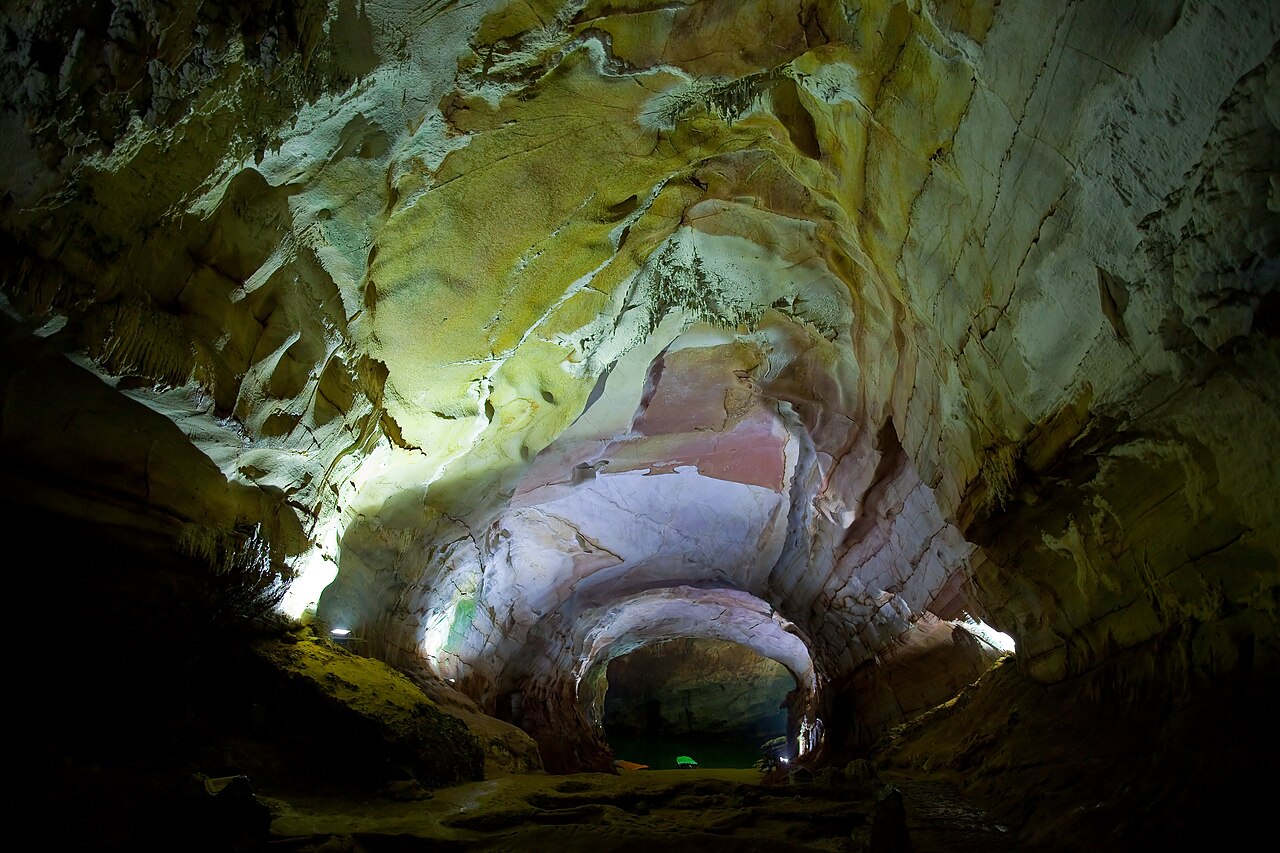
Phong Nha-Kẻ Bàng National Park (Vườn quốc gia Phong Nha-Kẻ Bàng), inscribed by UNESCO in 2003 and extended in 2015, protects the most significant cave and karst landscape in Southeast Asia — an approximately 123,326 hectare national park in Bố Trạch and Minh Hoá districts, Quảng Bình Province, north-central Vietnam, containing the world’s largest cave (Hang Sơn Đoòng, approximately 38.5 km long and 200 m wide and 150 m high at its largest cross-section, with a volume exceeding 1.35 billion cubic metres — large enough to contain an entire 40-storey building in some chambers), more than 300 caves and grottoes in total, and one of the world’s most extensive systems of underground rivers. The inscription’s Outstanding Universal Value rests on three combined properties: the geological significance of the ancient (approximately 400 million year old) limestone formation, which is among the oldest carbonate rock platforms in Asia and produces a cave geomorphology distinct from the younger limestones of Ha Long Bay; the biodiversity significance of the national park’s largely intact forest ecosystem (the Annamite Mountains tropical moist forest biome, home to critically endangered species including the saola (Pseudoryx nghetinhensis), the largest animal discovered in Asia in the 20th century, and the Vietnamese warty pig (Sus bucculentus), thought extinct until confirmed by camera-trap photographs); and the archaeological significance of cave sites within the park (including Hang Tối cave, which contains the earliest evidence of human occupation in the central Vietnamese highlands, approximately 10,000 BCE).
Phong Nha’s cave systems and the Quảng Bình karst landscape Hang Sơn Đoòng · Phong Nha Cave · Paradise Cave (Hang Thiên Đường) — 3 to 65 km
Hang Sơn Đoòng (Sơn Đoòng Cave, literally “Mountain River Cave”, discovered by local guide Hồ Khanh in 1990 CE and first scientifically explored by the British Cave Research Association in 2009 CE) is the defining feature of the Phong Nha-Kẻ Bàng inscription and the world’s largest cave by volume — a superlative that was confirmed only in 2009–2010 CE by systematic laser survey, when the British team measured the cave’s 5.5 km accessible length, maximum 200 m span, maximum 150 m ceiling height, and confirmed the presence of two dolines (roof collapses, called “Watch Out for Dinosaurs” by the British team — because the jungle growing in the sunlit collapse zones below the open roof looks like a Jurassic landscape) and an underground river running through the cave’s deepest section. The cave contains its own internal weather system: clouds form from the temperature differential between the cave’s moist interior air and the cooler air above the doline collapses, producing visible cloud formation inside the cave chamber. The cave walls host formations of calcite pearls (concentric calcium carbonate formations produced by water dripping onto a grain of sand in a small pool), towering stalagmites (the tallest recorded at approximately 70 m, the world’s tallest known cave stalagmite), and extensive cave-adapted ecosystems (cave fish, cave spiders, and invertebrates in the underground river). Access to Sơn Đoòng is severely restricted: the permit system limits visits to 1,000 visitors per year (as of 2023, with proposals to increase the cap contested by conservation groups), all in the form of 6-night/5-day expedition-format tours led by the single licensed operator Oxalis Adventure (the only company licensed to guide inside Sơn Đoòng, by arrangement with Quảng Bình Provincial People’s Committee) at approximately USD 3,000 per person. The Sơn Đoòng permit sells out within hours of annual release, typically 12–18 months in advance. For visitors who cannot access Sơn Đoòng, the Tu Lan Cave System (accessible by day expedition or 2-night camping tour, approximately 65 km from Phong Nha town, the most challenging accessible cave system involving river crossing and swimming through cave passages) and Hang Tối (Dark Cave, approximately 3 km from Phong Nha town on the Son River, accessible by individual kayak and zipline, popular for mud-bathing in the cave’s sediment pools) offer cave experiences calibrated to different budgets and physical abilities. Phong Nha Cave (Động Phong Nha, the most historically significant cave at the site, navigated by boat for approximately 1,500 m on the Nậm Ang underground river, with Buddhist shrines at the cave entrance dating to the Cham period and the cave walls bearing Cham Sanskrit inscriptions from the 9th–10th centuries CE — the earliest recorded evidence of Cham presence in the Quảng Bình region) and Paradise Cave (Hang Thiên Đường, approximately 650 m accessible to standard visitors, with the longest walkway of any cave in the Phong Nha system) offer more accessible cave experiences for the majority of visitors.
The Quảng Bình Province landscape surrounding the Phong Nha-Kẻ Bàng park provides significant heritage context beyond the caves: the Cổng Trời (Gate of Heaven) mountain pass (approximately 50 km north of Phong Nha town), the Đồng Lộc T-junction (approximately 100 km north, now a national monument, the site of a famous 1968 CE North Vietnamese artillery unit commanded by 10 young women who were killed in a US air strike while continuing to repair road damage — a site of pilgrimage for Vietnamese visitors), and the DMZ (Demilitarised Zone, the 17th Parallel boundary established by the 1954 Geneva Accords, approximately 80 km south of Phong Nha town at Đồng Hới city, with former military sites at the Bến Hải River bridge and Vinh Moc tunnels accessible by day trip) connect the natural landscape heritage of Phong Nha with the 20th-century military history that shaped Quảng Bình Province — the region saw the most intensive aerial bombardment of any province in Vietnam during the 1964–1975 period, and the cave systems of Phong Nha-Kẻ Bàng were used extensively as underground shelter, hospital, and supply storage by both the North Vietnamese military and the civilian population during the bombing campaign, a use documented by cave markings and military infrastructure remnants that constitute an unexpected layer of 20th-century heritage within the geological UNESCO inscription.
Practical information
Phong Nha town (Thị Trấn Phong Nha, on the Son River, the visitor base for the national park) is accessible from Đồng Hới (the provincial capital and nearest airport, served by Vietnam Airlines and VietJet from Hanoi and Ho Chi Minh City) by road (approximately 50 km, 1 hour by taxi or local bus). The train from Hanoi stops at Đồng Hới (approximately 9 hours by express), making train + taxi access from Hanoi the most comfortable budget option. For cave tours, the booking structure is: Phong Nha Cave and Paradise Cave are bookable on arrival or in advance through standard tour operators and require no special permits (standard daily visitor limit management); Hang Tối (Dark Cave) and the Tu Lan system require advance booking through licensed operators 1–7 days in advance; Sơn Đoòng requires booking 12–18 months in advance through Oxalis Adventure (the single licensed operator), at approximately USD 3,000 per person for the 6-night expedition. Accommodation in Phong Nha ranges from budget guesthouses along the Son River to upmarket eco-lodges in the national park buffer zone. The best visiting season for cave access is the dry season (February–August); the wet season (September–November) brings flooding that closes some cave systems, particularly the entrance of Phong Nha Cave (the underground river level can rise 4–5 m). The national park forest is best visited November–April for wildlife observation (the forest is denser and muggier in summer but biodiversity is higher; camera-trap wildlife observation requires patience and overnight stays in the park’s ecolodge). For photography: Phong Nha Cave’s river section (accessed by traditional wooden boat, the most atmospheric cave experience in the park accessible to all visitors) offers the best photography conditions, with natural light entering the cave’s entrance section interacting with the cathedral-scale cave chambers in the early morning hours. Check Oxalis and Jungle Boss (the two primary licensed operators for multi-cave expeditions beyond the basic sites) for seasonal availability of the accessible cave expeditions before booking.
Frequently Asked Questions
How do you book access to Hang Sơn Đoòng, the world’s largest cave?
Access to Hang Sơn Đoòng (Sơn Đoòng Cave, the world’s largest cave by volume, located within the Phong Nha-Kẻ Bàng UNESCO World Heritage property) is controlled by a strict permit system established by the Quảng Bình Provincial People’s Committee in cooperation with the national park management authority. The access system works as follows: the provincial government has licensed a single tour operator — Oxalis Adventure (a Đồng Hới-based company, website oxalis.com.vn) — as the sole commercial tour guide for the cave; the annual capacity cap (1,000 visitors per year as of 2023, approximately 10 expeditions of 10 participants each per year) is imposed by the national park management authority based on cave conservation assessments; all visitors must be part of an Oxalis-guided expedition (independent access is not permitted under any circumstances, and the cave’s location is known only to the licensed local guides). The expedition format is fixed: 6 nights/5 days (the minimum time required to reach the cave entrance from the base camp, explore the accessible cave sections including the dolines, cross the underground river, and return), approximately USD 3,000 per person including all camping equipment, food, guide fees, porter fees, and national park access permits. The booking process: Oxalis releases the annual Sơn Đoòng expedition calendar typically in October for the following season (the cave is accessible February–August, with tours suspended during September–November when monsoon flooding makes the approach route unsafe); places sell out within hours of release, typically 12–18 months in advance. The booking must be made directly through Oxalis’s website (no third-party booking is available for the Sơn Đoòng expedition). The physical requirements for the expedition are significant: participants must be able to walk approximately 25 km total over 5 days on uneven terrain, climb a 90-metre rockface with fixed ropes (a “Great Wall of Vietnam”, an internal rockfall within the cave), and wade through underground river sections — no prior caving experience is required but above-average physical fitness is expected. Physical fitness questionnaires and a medical declaration are required at booking. For participants unable to access Sơn Đoòng due to availability, cost, or physical requirements, the Tu Lan Cave System expedition (also through Oxalis, 2-night/3-day format, USD 350–500, involves cave swimming) provides the most immersive alternative cave expedition experience within the same karst system.
What is the saola and why is it important to the Phong Nha-Kẻ Bàng inscription?
The saola (Pseudoryx nghetinhensis, also written sao la, sometimes called the “Asian unicorn” or the “Vu Quang ox” after the area of its first discovery) is a bovid (cattle-related) mammal discovered in the Annamite Mountains on the Vietnam-Laos border in 1992 CE — the largest land animal to be discovered anywhere in the world in the second half of the 20th century, found in the same Annamite forest ecosystem that covers the Phong Nha-Kẻ Bàng national park and the adjacent Vu Quang Nature Reserve in Nghệ An Province. The saola’s discovery was made not through direct sighting of a living animal (which had never been documented by scientists at the time of the 1992 discovery) but through the recovery of skulls and horns with distinctive characteristics from hunters’ collections in Vũ Quang District — the horns are straight and parallel, approximately 50 cm in length, unlike any other bovid in the world, and the skull anatomy clearly identifies a distinct genus (Pseudoryx, meaning “false oryx”) previously unknown to science. The International Union for Conservation of Nature (IUCN) classifies the saola as Critically Endangered, with an estimated population of fewer than 100 animals (possibly fewer than 25) in the wild — it has never been successfully kept in captivity (the few saola captured in the early 1990s died within weeks), and no camera-trap photograph of a living saola in the wild has been confirmed since 2013 CE. The saola’s significance to the Phong Nha-Kẻ Bàng UNESCO inscription is that the inscription’s 2015 extension (which doubled the property’s size) was explicitly motivated by the need to include the most important saola habitat in the national park’s core zone — the extended inscription boundary incorporates the continuous forest corridor connecting the Phong Nha-Kẻ Bàng caves with the Vu Quang Nature Reserve, which wildlife biologists identified as essential for saola population viability. The biodiversity criterion (criterion x — biodiversity) in the inscription’s Outstanding Universal Value is directly linked to the saola and other Annamite endemic species (the Vietnamese warty pig, the Annamite striped rabbit (Nesolagus timminsi), and the large-antlered muntjac (Muntiacus vuquangensis, also discovered in 1994 CE)) that are found nowhere else on Earth.
What is the geological age and significance of the Phong Nha-Kẻ Bàng karst?
The limestone formation underlying the Phong Nha-Kẻ Bàng national park is approximately 400 million years old (Devonian period), making it one of the oldest carbonate rock formations in Southeast Asia — significantly older than the Ha Long Bay limestone (approximately 300–500 million years old, Ordovician to Permian) and much older than the typical Mesozoic limestone that forms most of the world’s major cave systems. The geological age is directly relevant to the cave system’s unusual characteristics: the longer the carbonate rock has been exposed to dissolution, the more developed and extensive the cave network becomes, and the larger the individual cave passages can grow through the accumulation of dissolution over tens of millions of years. The Phong Nha-Kẻ Bàng limestone has been dissolving and cave-forming since at least the Tertiary period (approximately 20–65 million years ago), while the caves of the Ha Long Bay islands (which are marine-level karst towers rather than deep underground systems) represent a geologically younger, shallower dissolution pattern. The result is a cave system at a fundamentally different scale and complexity from younger cave systems: Hang Sơn Đoòng’s maximum 200-metre passage width and 150-metre ceiling height are geological features that require extraordinarily long periods of dissolution to develop from ordinary joints and fractures in the original limestone. The underground river systems of Phong Nha-Kẻ Bàng (the Nậm Ang river, which flows through the Phong Nha Cave system, is one of approximately 15 major underground rivers within the national park area) have been cutting their channels through the limestone since the Miocene (approximately 20 million years ago), during which the cumulative dissolution has produced the cave-passage volumes visible today. The geological survey data collected by the British Cave Research Association expeditions of 2009–2012 CE (including the confirmation of Sơn Đoòng’s record-breaking dimensions) provided the scientific documentation that underpinned the 2015 inscription extension — the BCRA’s survey demonstrated that the Phong Nha-Kẻ Bàng karst system contains significantly more cave volume than was known at the time of the original 2003 inscription, confirming the site’s global geological significance.
Sources
- S1 — UNESCO World Heritage Centre — Phong Nha-Ke Bang National Park (Ref. 951) — https://web.archive.org/web/20230601000000/https://whc.unesco.org/en/list/951/
- S2 — UNESCO World Heritage Centre — Statement of Outstanding Universal Value (Ref. 951) — https://whc.unesco.org/en/list/951/
Spotted an error? Write to editorial@culturalheritageonline.com and we correct it the same day.