The Baekje Historic Areas, inscribed by UNESCO in 2015, protect eight archaeological sites and heritage areas in Gongju, Buyeo, and Iksan (all in the Chungcheong and Jeolla region of South Korea) that preserve the material remains of the late Baekje Kingdom (백제, 18 BCE–660 CE) — one of the three kingdoms of the Korean peninsula during the Three Kingdoms period (삼국시대), alongside Goguryeo and Silla — specifically its final two centuries (475–660 CE) when the capital was successively at Woongjin (Gongju) and Sabi (Buyeo), after the earlier Baekje capital Wiryeseong (modern Seoul/Hanam area) was captured by Goguryeo in 475 CE. The Baekje Kingdom’s cultural significance lies in its role as the primary cultural transmitter between China and Japan in the 4th–6th centuries CE: Baekje craftsmen, monks, scholars, and artists introduced Buddhism to Japan (in 552 or 538 CE, depending on the historical source), transmitted Chinese writing and Confucian scholarship to the Japanese Yamato court, and provided the technical knowledge for Japanese palace construction and sculpture that defined the Asuka-period Japanese cultural revolution. The eight component areas of the inscription cover: Gongsanseong (Gongju, the mountain fortress used as the Woongjin capital’s protective citadel), Songsan-ri Royal Tombs (Gongju, the royal burial mounds including the Muryeong Royal Tomb discovered intact in 1971), Gwanbukli Archaelogical Site and Busosanseong Fortress (Buyeo), Neungsan-ri Royal Tombs (Buyeo), the Jeongnimsaji Five-Story Stone Pagoda (Buyeo), Nakhwaam Rock (Buyeo), and the Wanggung-ri Archaeological Site and Mireuksa Temple Site (Iksan).
The Baekje triangle: Gongju, Buyeo, and Iksan Gongju Gongsanseong · Buyeo Jeongnimsaji · Iksan Mireuksa — 25 to 80 km
In Gongju (공주, approximately 140 km south of Seoul by express bus, 2 hours), Gongsanseong Fortress (공산성, “Gongsanseong”, the mountain citadel on the south bank of the Geum River, continuous occupation from the Baekje period to the Joseon period — original earthwork construction 3rd century CE, stone wall reconstruction 11th century CE) and the Songsan-ri Royal Tombs are the two inscription components that provide the richest archaeological material for the Baekje Kingdom in the Woongjin period (475–538 CE). The Muryeong Royal Tomb (무령왕릉, discovered intact on 8 July 1971 by construction workers accidentally breaking through its sealed entrance, the only Baekje royal tomb ever found unlooted), one of the seven mounds in the Songsan-ri cluster, yielded 2,906 artefacts from the burial of King Muryeong (무령왕, r. 501–523 CE) and his queen — including gold crown ornaments (a filigree gold headband of identical Chinese-influenced southern Liang-dynasty design to objects found in contemporaneous Japanese Kofun-period burials, confirming the direct material cultural exchange between Baekje and Japan), a stone epitaph tablet (the only inscribed tablet found in any Baekje royal tomb, providing the exact birth and death dates of both the king and queen and the specific Chinese calendar date of the burial — eliminating previous debates about the chronology of the Woongjin-period rulers), bronze mirrors of Chinese manufacture, iron swords, gold and silver jewellery, and the remains of three lead coffin ornaments with lotus-blossom design. The Gongju National Museum (공주국립박물관, open Tuesday–Sunday, free admission) houses all 2,906 Muryeong tomb objects in permanent display and is the best single museum for Baekje material culture in Korea. Gongsanseong Fortress is walkable from the Gongju city centre (approximately 15 minutes on foot from the bus terminal), with the 2.66 km wall circuit (open access, admission fee) providing aerial views of the Geum River and the agricultural plain that was the Baekje capital’s economic base.
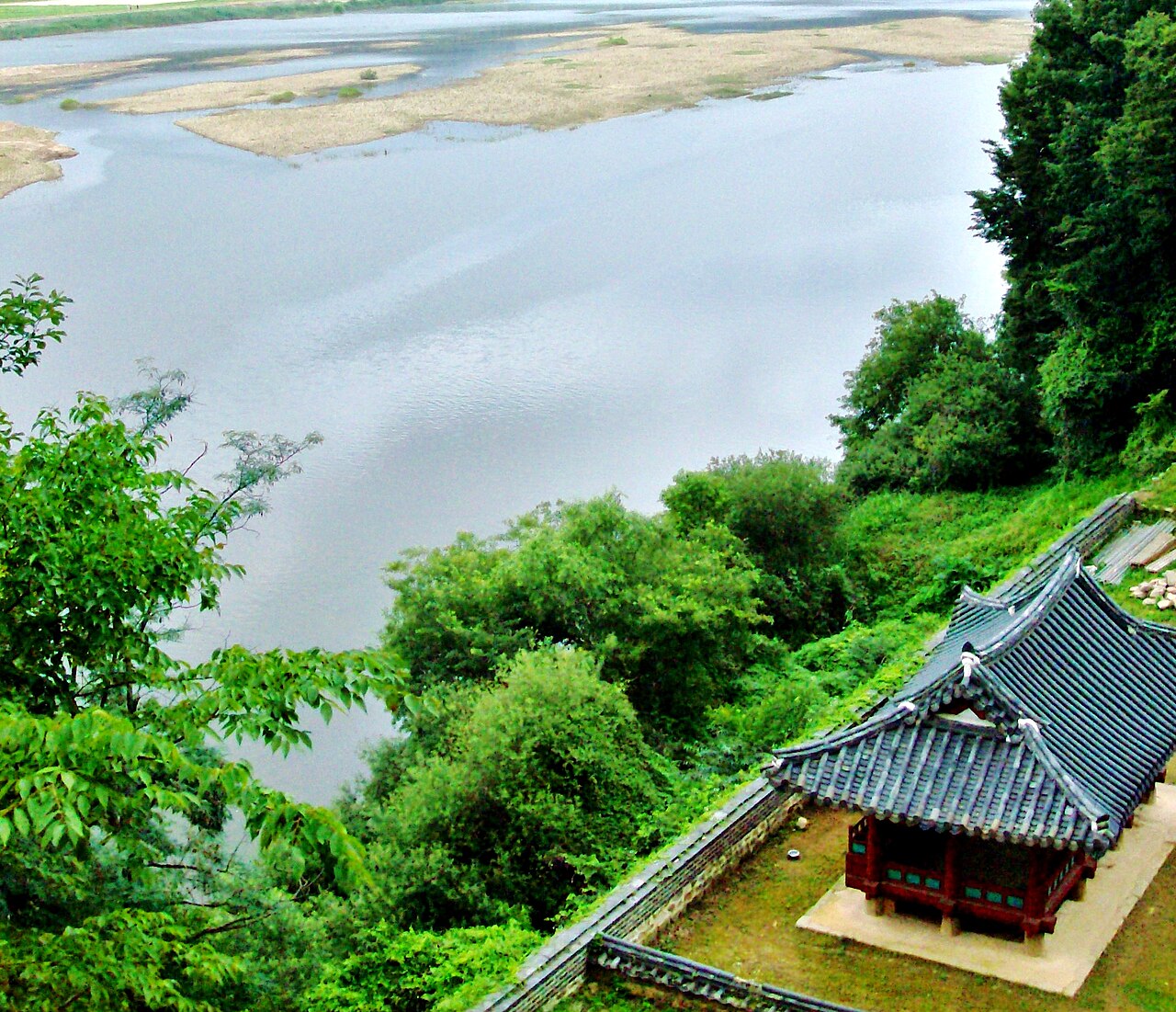
Forty Kilometres southwest of Gongju (approximately 40 minutes by intercity bus), Buyeo (부여, the Sabi capital of late Baekje, 538–660 CE) concentrates four inscription components in and around the small modern city: Busosanseong Fortress (부소산성, the hillfort citadel of the Sabi capital on the forested ridge above the Geum River, with the Nakhwaam Rock “Falling Flowers Rock” on its northern cliff — the legendary site where Baekje palace ladies threw themselves into the Geum River rather than be captured by the Tang-Silla allied force that destroyed Baekje in 660 CE, a national legend that gave the location its poetic name), the Neungsan-ri Royal Tombs (능산리 고분군, the Sabi-period royal burial mounds, whose adjacent temple site yielded the Baekje Incense Burner — now in the National Museum of Korea in Seoul — a gilt-bronze incense burner 61.8 cm tall covered in 74 tiny Buddhist figures, phoenixes, dragons, and mountain peaks, considered the finest single Baekje bronze artefact and one of the masterpieces of East Asian decorative metalwork), and the Jeongnimsaji Five-Story Stone Pagoda (정림사지오층석탑, a 6th-century CE stone pagoda of the Jeongnimsaji temple site — the oldest surviving free-standing stone pagoda in Korea, 8.33 m high, whose elegant proportions directly influenced the Japanese stone-pagoda tradition). Iksan (익산, approximately 40 km south of Buyeo, approximately 80 km from Gongju), the third component area, contains the Mireuksa Temple Site (미륵사지, the largest Buddhist temple site in early Korean history — the Mireuksa was founded by King Mu of Baekje circa 600 CE and covered an area of approximately 42,000 m², three times the area of the Buddhist temple complexes built in the same period by the Tang dynasty in China) and the adjacent Wanggung-ri Archaeological Site (왕궁리 유적, the site of a late Baekje royal palace and a later Unified Silla temple complex). The Mireuksa site’s stone pagoda (the Mireuksa West Stone Pagoda, 미륵사지 석탑, partially surviving at approximately 14.5 m height — originally approximately 30 m, making it the tallest pagoda of its era in East Asia) underwent a 20-year restoration project completed in 2019 CE that removed the Japanese colonial-era concrete reinforcement added in 1915 and revealed, in the process, a sealed stone box containing Buddhist relics and golden artifacts inscribed with the year 639 CE — providing the first direct inscribed evidence of the Mireuksa’s construction date and royal patronage.
Practical information
The Baekje Historic Areas’ three geographic clusters — Gongju (140 km south of Seoul), Buyeo (40 km southwest of Gongju), and Iksan (40 km south of Buyeo) — are best visited over 2 days, with Gongju and Buyeo on day 1 (bus connections approximately every 30 minutes) and Iksan on day 2 (direct bus from Buyeo in approximately 1 hour, or from Daejeon in approximately 40 minutes). Seoul to Gongju: express bus from Seoul Nambu Bus Terminal to Gongju Bus Terminal approximately every 30 minutes, 2 hours; alternatively, KTX to Daejeon (50 minutes) then bus to Gongju (approximately 1 hour). Gongju Gongsanseong: admission fee, open daily; the fortress wall circuit (2.66 km) takes approximately 1 hour. Gongju National Museum: Tuesday–Sunday 09:00–18:00, free; allow 2 hours for the Muryeong tomb gallery. Buyeo Busosanseong / Nakhwaam: open daily, small admission fee for the forest park; the walk from the Busosanseong main gate to the Nakhwaam Rock viewpoint takes approximately 30 minutes. Buyeo National Museum (국립부여박물관, Tuesday–Sunday 09:00–18:00, free): houses the Baekje Incense Burner and the Neungsan-ri tomb artefacts. Iksan Mireuksa Site Museum (미륵사지유물전시관, Tuesday–Sunday 09:00–18:00, free): documents the 20-year restoration project with the 639 CE relic box on display. The Baekje Cultural Land (백제문화단지, a full-scale reconstruction of the Sabi-period Baekje capital in Buyeo, open Tuesday–Sunday, admission fee): provides spatial context for the inscribed sites through a reconstructed royal palace, Buddhist temple complex, and traditional village — useful for first-time visitors to Baekje history who benefit from three-dimensional spatial context before seeing the archaeological sites.
Frequently Asked Questions
How did the Baekje Kingdom transmit Buddhism and Chinese culture to Japan?
The Baekje Kingdom’s role as the cultural intermediary between China and Japan in the 4th–7th centuries CE is one of the most significant cultural-transmission events in East Asian history — the introduction to Japan of writing, Buddhism, Confucian scholarship, advanced metalworking, silk production, medicine, and palace architecture through an organised state-to-state cultural exchange that laid the material and intellectual foundation of the Asuka-period (552–645 CE) Japanese cultural revolution. The transmission began with the diplomatic relationship established between the Baekje king Geunchogo (근초고왕, r. 346–375 CE) and the Japanese Yamato court in the mid-4th century: Korean records and the Nihon Shoki (720 CE Japanese chronicle) document the sending of Baekje scholars to Japan to teach the Chinese characters and Confucian texts, with the scholar Wani (왕인, “Wang In”) credited in the Nihon Shoki with bringing the Thousand Character Classic and the Analects of Confucius to Japan circa 403 CE — the event traditionally marked as the introduction of literacy to Japan (though modern scholars date the introduction of Chinese characters to Japan somewhat earlier). The introduction of Buddhism to Japan is documented in Korean and Japanese sources as a formal state diplomatic act: the Baekje king Seong (성왕, r. 523–554 CE) sent Buddhist monks, scriptures, and an image of the Buddha to the Japanese Yamato court in either 538 or 552 CE (the two dates correspond to different chronicle sources), along with a royal letter to the Japanese emperor recommending the adoption of Buddhism as the state religion. Baekje technical experts — temple architects (사공, sagong), tile makers (와박사, wabaksa), metal casters, and sculptors — accompanied the Buddhist missions and remained in Japan as resident craftsmen, training Japanese apprentices in the construction techniques used for the Baekje temples at Gongju and Buyeo. The architectural influence is directly traceable: the plan of the Horyuji temple complex in Nara (inscribed UNESCO 1993, see the CHO proximity guide for Horyuji) replicates the three-building arrangement (south gate, main hall, pagoda in alignment) of the Mireuksa temple in Iksan, and the proportional system of the Horyuji pagoda directly derives from Baekje stone-pagoda construction principles documented at the Jeongnimsaji site in Buyeo.
What was found in the Muryeong Royal Tomb and why was its discovery significant?
The Muryeong Royal Tomb (무령왕릉), discovered on 8 July 1971 when construction workers accidentally broke through its sealed entrance while draining a flooded tunnel in the Songsan-ri burial mound cluster in Gongju, is the only Baekje royal tomb ever found unlooted in a sealed condition — a fact that makes its 2,906 artefacts the primary archaeological evidence for Baekje royal material culture and for the level of cultural exchange between Baekje, China, and Japan at the height of the kingdom’s power. The discovery was made at 4 PM; the National Museum of Korea dispatched an emergency team that arrived at 11 PM that night and began an excavation that would, in retrospect, be widely criticised for its excessive speed (the entire excavation was completed in 17 hours, between the discovery and the following morning — a pace that, while preserving the find from looting, inevitably compromised the stratigraphic documentation of the artefact positions). The most historically significant object recovered was the stone epitaph tablet (지석, jiseok) — a pair of flat stone tablets carved with inscriptions giving the name, birth year (462 CE), death year (523 CE), and specific calendar date of the burial (523 CE, eighth month, 12th day) of King Muryeong, along with the name and death year of his queen (526 CE), and the date of the queen’s interment in the same tomb seven years after the king’s death (529 CE). This is the only Baekje royal tomb with a name inscription — all other Baekje royal tombs are identified by number and associated with specific kings only by circumstantial argument — and the precise calendar dates it provides anchored the entire Baekje chronology for the Woongjin period (475–538 CE) that had previously been contested among scholars. The gold crown ornaments (금제 관식, a filigree gold headband and gold cap ornament of Chinese southern Liang-dynasty design, indicating that the Baekje royal court was receiving luxury goods directly from the Liang dynasty court in Nanjing — consistent with the historical records of Baekje-Liang diplomatic contact in the early 6th century) were identified as the closest analogues to gold ornaments found in contemporaneous Kofun-period Japanese burial mounds in the Kinai region, providing direct archaeological confirmation of the Baekje-Japan material cultural exchange.
What was the Mireuksa temple and why was the 2019 relic discovery significant?
Mireuksa (미륵사, “Maitreya Temple”) was the largest Buddhist temple complex built in the history of the early Korean peninsula — founded circa 600 CE under King Mu of Baekje (무왕, r. 600–641 CE) on the Wanggung-ri plateau in Iksan, covering an area of approximately 42,000 m², and structured around three separate temple units each with its own main hall and pagoda (a unique triple-parallel-compound plan without precedent in contemporary Chinese or Korean Buddhist architecture). The primary source for Mireuksa’s founding is the Samguk Yusa (삼국유사, “Memorabilia of the Three Kingdoms”, a 13th-century CE Korean historical compilation by the monk Iryeon), which records that King Mu and his queen were travelling from the capital when a vision of Maitreya Buddha (미륵, the Buddha of the Future, who will appear on earth when Buddhist teaching has been forgotten) appeared above a lake on the Wanggung-ri site; the king interpreted this vision as a divine command to drain the lake and build a temple complex of three prayer halls, each dedicated to a different manifestation of Maitreya and each with its own pagoda representing a different pagoda form (the surviving West Pagoda is a stone pagoda; the later reconstructed East Pagoda is also stone; the central pagoda, now lost, was a wooden pagoda). The 2019 discovery of the relic box inside the West Pagoda occurred during the final phase of the 20-year restoration project (1999–2019): when restoration specialists removed the cement reinforcement added by Japanese colonial engineers in 1915 (the original stone pagoda was severely damaged by the 660 CE Baekje collapse and subsequent neglect), they found a sealed square cavity in the first-story foundation stone containing a gold-and-bronze box 10.2 × 10.2 × 5.4 cm in size. Inside the box: silk pouch wrapping, a gold plate inscribed with text in 193 Chinese characters identifying the box’s contents as “śarīra” (Buddhist relics, 舍利) donated by the queen of King Mu in 639 CE (the 14th year of King Mu’s reign) — the inscription names the queen as a member of the Sataek clan (砂宅), contradicting the Samguk Yusa account (which names her as the daughter of a commoner from the Jisan region). This textual contradiction has produced a significant scholarly debate about which queen founded Mireuksa, and whether the Samguk Yusa account is legendary rather than historical. The relic box and the inscription are displayed in the Iksan Mireuksa Site Museum.
Sources
- S1 — UNESCO World Heritage Centre — Baekje Historic Areas (Ref. 1477) — https://web.archive.org/web/20230601000000/https://whc.unesco.org/en/list/1477/
- S2 — UNESCO World Heritage Centre — Statement of Outstanding Universal Value (Ref. 1477) — https://whc.unesco.org/en/list/1477/
Spotted an error? Write to editorial@culturalheritageonline.com and we correct it the same day.