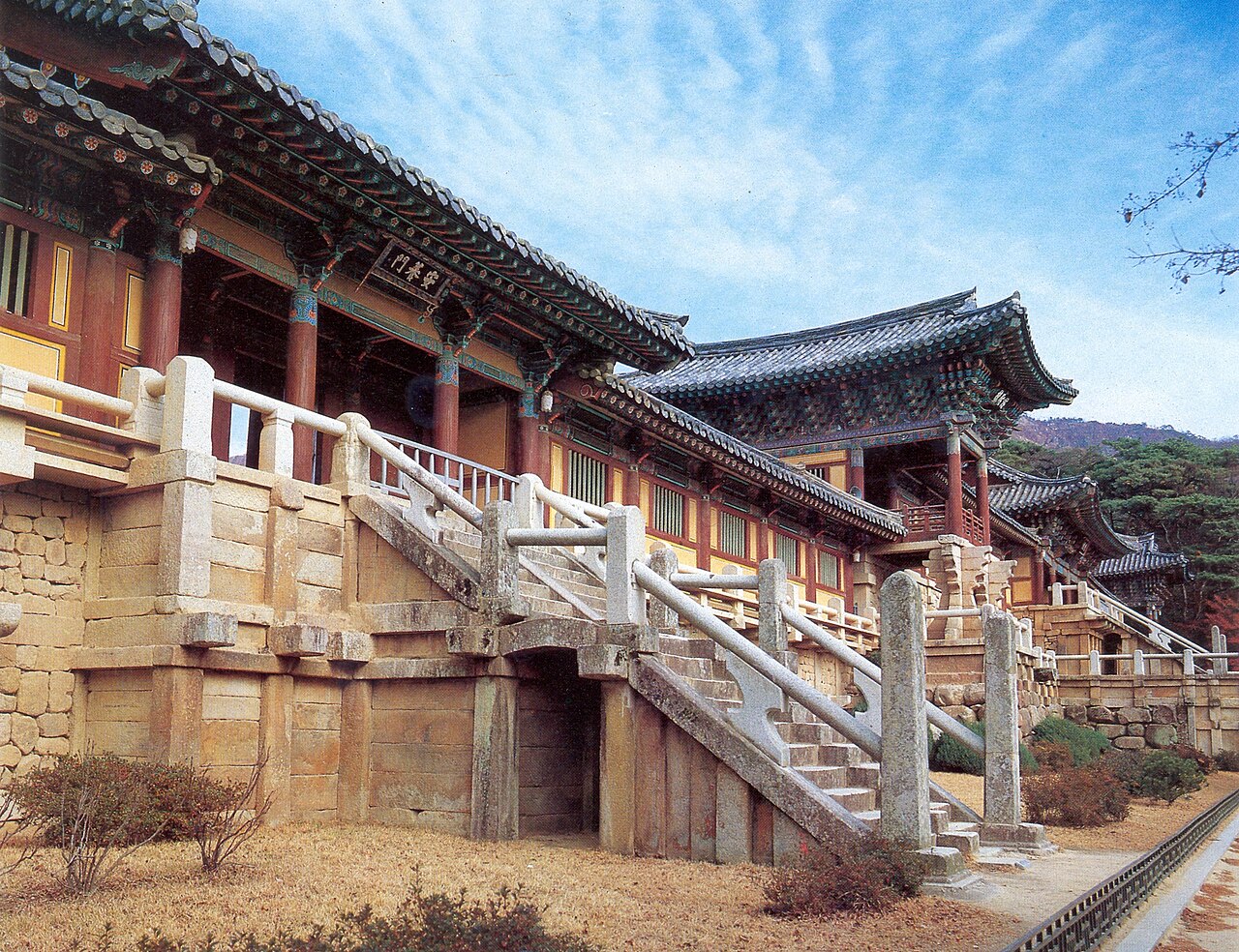
Seokguram Grotto and Bulguksa Temple, inscribed by UNESCO in 1995, preserve the most significant surviving achievements of Unified Silla Buddhist art (668–935 CE) on Mount Toham near Gyeongju, South Korea: Seokguram (석굴암) is an 8th-century artificial granite cave enclosing a 3.45-metre seated Buddha in a perfectly hemispherical main chamber, designed as a symbolic representation of the Hindu cosmological mount Sumeru with the Buddha at its centre, representing the apex of Korean Buddhist sculptural achievement and containing geometric proportions — the dome radius, the Buddha’s seated height, and the chamber diameter — arranged in precise mathematical ratios derived from Tang Chinese Buddhist architectural theory; Bulguksa (불국사, “Temple of the Buddha Land”, 3 km west on the same mountain) is the earthly expression of the Pure Land Buddhist paradise, its twin granite staircase bridges — the 33-step Cheongun Bridge (Blue Cloud Bridge) and the 16-step Baega Bridge leading to Anyangmun Gate, and the separate 10-step Chilbogyo (Seven Treasure Bridge) and 17-step Yeonhwagyo (Lotus Flower Bridge) leading to Geuknak-jeon Hall — designating the transition from the secular world below to the sacred precinct above as a physical act of crossing from earth to the Buddha realm.
The Gyeongju Silla heritage zone Gyeongju Historic Areas · National Gyeongju Museum · Anapji Pond — 5 to 20 km
Five Kilometres west of Bulguksa Temple by road (approximately 20 minutes by bus or taxi from Bulguksa to Gyeongju city centre), the Gyeongju Historic Areas (경주역사유적지구, inscribed UNESCO 2000) represent the broader urban and landscape context of Silla Buddhist culture. The inscription covers five zones: the Namsan District (the southern mountain of Gyeongju, with 150 Buddhist stone carvings, 57 Buddhist stupas, 64 granite Buddha figures, and 16 royal tombs carved into and built on the mountain’s forested slopes), the Wolseong District (the royal palace site of the Silla dynasty, now a forested earthwork visible as an elongated platform above the Namcheon stream), the Tumuli Park District (Daereungwon, the large royal burial mound park containing 23 tumuli including Cheonmachong, the “Heavenly Horse Tomb” opened in 1973, which yielded 11,500 grave goods including the oldest surviving painting on birch bark in Korea — a painted horse on a saddle mud-guard that gave the tomb its name), the Hwangnyongsa District (the foundations of the Hwangnyongsa Temple, the great state temple of the Silla period, reportedly 9 storeys and 80 metres in height, burned by the Mongols in 1238 CE — the largest Buddhist building ever constructed in Korea, now fully excavated as an open archaeological site), and the Sanseong District (mountain defensive fortresses on the hills surrounding Gyeongju). The 5-km cycling route between Bulguksa and the Tumuli Park district (along the Gyeongju cycling path through the Bomun Lake resort area) is the recommended connection between the two UNESCO inscriptions for visitors with time for a half-day circuit.
Twenty Kilometres northeast of Bulguksa Temple across the Tohamsan range, the East Sea coast of the Gyeongju National Park (경주국립공원) contains the Mireukgol Buddhist temple valley and the Gameunsa Temple site — the twin pagodas of Gameunsa (감은사, 682 CE, the temple built by the Unified Silla king Sinmun to honor his father Munmu, who had decreed that his ashes be scattered in the East Sea so that his spirit could protect Korea as a dragon), whose twin three-storey granite pagodas are among the earliest surviving granite pagodas in Korea. The Manpa-sik rock underwater tomb of King Munmu (문무왕 수중릉) is located in the coastal water approximately 200 metres from Bonggil Beach (봉길리 해변), marked by a rectangular group of rocks visible at low water — the only underwater royal tomb in Korean history, resulting from Munmu’s 681 CE instruction that his body be cremated and the ashes scattered in the East Sea so that he could become a protective dragon for the Korean kingdom. The combination of Bulguksa / Seokguram (mountain Buddhist cosmology) with the Gameunsa East Sea coast (royal maritime tomb and dragon-king legend) constitutes a full circuit of Unified Silla spiritual geography within a 30-km range. From Gyeongju city centre, Gameunsa and Bonggil Beach are accessed by local bus or rental bicycle (approximately 45 minutes).
Practical information
Bulguksa Temple is located on Mount Toham, approximately 15 km southeast of Gyeongju city centre. Direct buses from Gyeongju Bus Terminal and Gyeongju Station to Bulguksa run frequently (approximately 35–40 minutes). The temple complex opens at 07:00–18:00 (summer) and 08:00–17:00 (winter); admission fee applies. The twin staircase bridges (Cheongun-gyo/Baegun-gyo and Yeonhwagyo/Chilbogyo) are no longer used as functional staircases by visitors (they are roped off for preservation, as the 8th-century stone steps are worn and structurally delicate) — visitors enter the temple through a ground-level gate to the north of the staircase bases, reaching the main courtyard via a modern corridor. The original approach using the stone bridges was part of the temple’s cosmological meaning (the act of climbing the 33 steps from earth to the Buddha realm), so the rope barriers fundamentally alter the ritual experience intended by the 8th-century designers. Seokguram Grotto is 3 km northeast of Bulguksa by a mountain forest road (accessible by shuttle bus from Bulguksa car park, approximately 15 minutes; or hiking the Tohamsan path, approximately 45 minutes). At Seokguram, the granite Buddha and the grotto interior are viewable through a glass screen rather than by entering the chamber (UNESCO conservation guidelines in the 1960s established that body heat and humidity from visitors were damaging the granite), so the meditative intimacy of the original design is partially lost. Best visiting time: early morning (before tour buses arrive at Bulguksa by 09:30) and in late afternoon (when tour groups have departed and the mountain light on the stone staircases is most dramatic).
Frequently Asked Questions
Why was Seokguram built as an artificial cave and how was its Buddha designed?
Seokguram (석굴암, “Stone Cave Hermitage”) was constructed on the eastern slope of Mount Toham in the 8th century CE during the reign of Unified Silla King Gyeongdeok (r. 742–765 CE), with its construction attributed to the minister Kim Daeseong (701–774 CE), who according to the Samguk Yusa (“Memorabilia of the Three Kingdoms”, 13th century CE) built Bulguksa for his parents in the present life and Seokguram for his parents from his previous life — a biographical attribution that may be legendary but accurately reflects the dual function of the two buildings as a unified Buddhist cosmological project. The choice to build an artificial cave rather than a natural cave reflects the Korean landscape’s geology: Mount Toham’s granite bedrock does not produce natural Buddhist cave formations of the type found in sandstone cliffs (like the Ajanta and Ellora caves in India or the Yungang and Longmen caves in China), and the Silla builders created a hemispherical artificial dome chamber from precisely fitted granite blocks — the dome’s interior surface is a perfect hemisphere with a radius of approximately 3.63 metres, and the main Buddha figure is positioned at the dome’s centre point at a height (3.45 metres seated) that places the ushnisha (cranial protuberance, symbol of enlightenment) at exactly the dome’s highest interior point. The Buddha’s design follows the Unified Silla canon of Buddhist iconography with exceptional precision: the mudra (hand gesture) is the bhumisparsha (earth-touching gesture, commemorating the moment of enlightenment under the Bodhi tree), the face shows the “Silla smile” (a subtle upward curvature of the lips unique to the Gyeongju workshop’s sculptural tradition), and the figure’s measurements (shoulder width, face width, body proportions) are in ratios derived from Tang Chinese Buddhist iconometric treatises. The surrounding wall of the hemispherical chamber bears 40 additional relief figures including Bodhisattvas, the Ten Disciples, the Four Heavenly Kings, and the Eight Guardian Deities arranged in a cosmological order that places the main Buddha at the centre of the entire Buddhist universe.
What happened to Bulguksa during the Japanese invasion of 1592 and what has been rebuilt?
Bulguksa was burned during the first Japanese invasion of Korea (壬辰倭亂, Imjin War, 1592–1598 CE), a conflict initiated by the Japanese warlord Toyotomi Hideyoshi that devastated much of the Korean peninsula and destroyed a significant proportion of Joseon-period built heritage. The Japanese forces occupied Gyeongju in 1592 and burned the city and its Buddhist temples, including Bulguksa; the 8th-century wooden hall buildings were destroyed and only the stone structures (the two granite pagodas — Dabotap and Seokgatap — and the twin staircase bridges) survived because their stone construction was fire-resistant. The post-Imjin reconstruction of Bulguksa was incomplete and episodic: the main halls were rebuilt in reduced form in the 17th–18th centuries (the current Daeungjeon main hall is the 1765 CE reconstruction, approximately two-thirds the size of the pre-1592 original according to foundation stone evidence), but the full scope of the 8th-century complex (which according to the Samguk Yusa included over 2,000 rooms of monastic buildings) was never reconstructed. The most significant modern intervention was a major government restoration conducted between 1969 and 1973 CE, when the Daeungjeon and several subsidiary halls were partially dismantled and rebuilt on their historical foundations — a restoration that increased the complex’s structural integrity but also involved some reconstruction of presumed-original elements that are not well documented and have been criticised by conservation historians as speculative. The twin stone pagodas (Dabotap, “Multi-Treasure Pagoda”, completed 751 CE, multi-storey with elaborate decorative stonework; and Seokgatap, “Shakyamuni Pagoda”, same date, simpler three-storey form) survived the 1592 burning undamaged; the Seokgatap was partially dismantled in 1966 CE by the Korean government to repair earthquake cracks, and a Goryeo-period sarira (relic) reliquary hidden in the upper storey was discovered during the dismantling — it is now in the National Museum of Korea in Seoul.
How do the Bulguksa stone bridges connect to Buddhist cosmology?
The Bulguksa staircase bridges implement a spatial metaphor that is unique in Korean Buddhist architecture and among the most literal architectural expressions of Buddhist cosmological theory in East Asian religious building. The Blue Cloud Bridge (Cheongun-gyo, 청운교, lower section, 18 steps) and White Cloud Bridge (Baeun-gyo, 백운교, upper section, 16 steps, total 33 steps to the Jaha Gate above) represent the 33 heavens of the Buddhist cosmological system — the 33 levels of the Trayastrimsa heaven, the second of the six heavens in the desire realm of Buddhist cosmology, which sits on the summit of Mount Sumeru and is the heaven presided over by Indra/Sakra in Buddhist mythology. In the Bulguksa design, the secular world below the bridges (the open plaza where visitors stand) represents the ordinary human world, and the temple precinct above the Jaha Gate represents the Pure Land Buddha realm — the act of climbing the 33 steps is the act of ascending through the 33 heavens to the presence of the Buddha. The lower approach to Geuknak-jeon (the Hall of Supreme Happiness, the secondary hall containing the Amitabha Buddha of the Western Pure Land) uses a parallel stair bridge sequence: the 10-step Seven Treasure Bridge (Chilbogyo, 칠보교) and the 17-step Lotus Flower Bridge (Yeonhwagyo, 연화교) reach the Anyangmun Gate (Anyangmun, 안양문, “Gate of Peace and Nourishment”), with Anyang being the Korean term for the Western Pure Land (Sukhavati). The pairing of two separate bridge sequences — one leading to the main Buddha hall (Daeungjeon, containing Shakyamuni Buddha), one to the Amitabha hall (Geuknak-jeon, containing Amitabha) — creates a cosmological double axis: two different roads to two different Buddha realms, one reached by climbing to the eastern summit of cosmic space (Sumeru, Shakyamuni, enlightenment-by-knowledge), the other by crossing west to the Pure Land of infinite light (Amitabha, enlightenment-by-faith). The architectural realisation of this dual cosmology in stone staircases that visitors physically climb is the reason Bulguksa’s design is considered the most complete surviving example of architectural Buddhist cosmology in Korea.
Sources
- S1 — UNESCO World Heritage Centre — Seokguram Grotto and Bulguksa Temple (Ref. 736) — https://web.archive.org/web/20230601000000/https://whc.unesco.org/en/list/736/
- S2 — UNESCO World Heritage Centre — Statement of Outstanding Universal Value (Ref. 736) — https://whc.unesco.org/en/list/736/
Spotted an error? Write to editorial@culturalheritageonline.com and we correct it the same day.