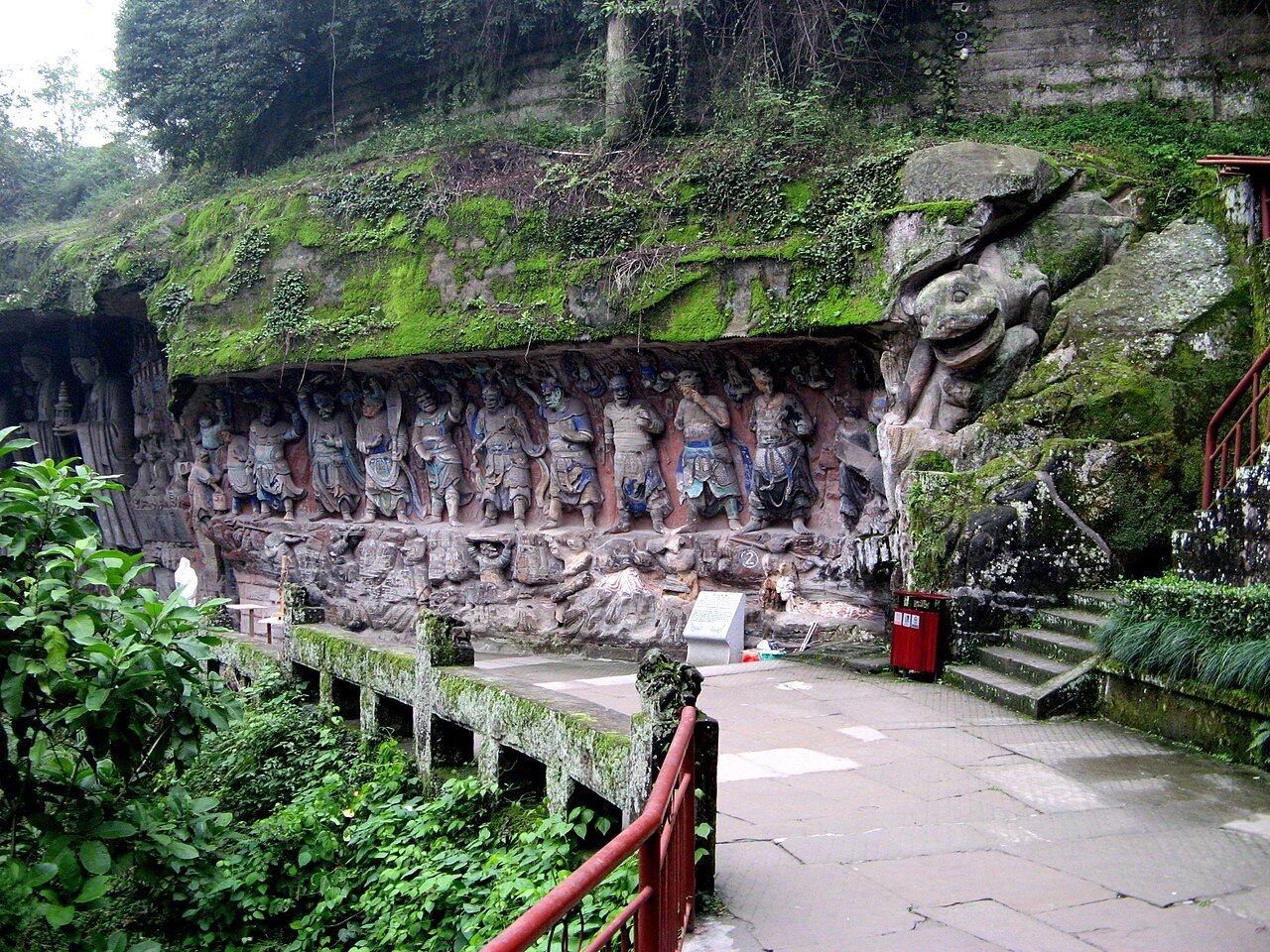
The Dazu Rock Carvings, inscribed by UNESCO in 1999, are the most extensive and best-preserved Tang-Song Buddhist cliff sculpture complexes in China: approximately 50,000 carved stone figures distributed across 75 sites in Dazu County, Chongqing Municipality, carved over five centuries from the Late Tang dynasty (618–907 CE) through the Song dynasty (960–1279 CE), with the principal concentration at the Baodingshan (Precious Summit Mountain) and Beishan (North Mountain) sites. Unlike the Northern Wei Buddhist cave complexes at Yungang (460–524 CE) and Longmen (493–750 CE), which were primarily imperial commissions executed in a formal monastic style, the Dazu carvings are characterised by narrative didacticism and popular accessibility: scenes from the Ten Courts of Hell (illustrating karmic punishments for specific moral infractions), the Parental Grace Sutra (depicting filial piety through 15-panel narrative sequences), and the “Gracious Bamboo” Guanyin (a standing bodhisattva 7 metres tall with 1,007 arms arranged in a full circle) reflect a Tang-Song Buddhist popularisation programme aimed at non-literate rural audiences in the Sichuan Basin — a fundamentally different audience from the Northern Wei imperial court’s Yungang patrons.
The Sichuan Basin: the Yangtze corridor and the red basin’s heritage Jiuzhaigou Valley · Huanglong · Mount Qingcheng Dujiangyan — 300 to 450 km
Three hundred kilometres north of Dazu by road (approximately 4.5 hours from Chongqing to the Jiuzhaigou Valley entrance via the G5 Chengdu-Lhasa Expressway and then north via Songpan), the Jiuzhaigou Valley (inscribed 1992) in Aba Tibetan and Qiang Autonomous Prefecture is the most visited natural UNESCO site in Sichuan Province — a 720-square-kilometre protected valley of multi-tiered waterfall chains, transparent lakes fed by underground springs, and dead conifer forests preserved underwater in the lakes’ mineral-rich water. The connection between Dazu’s Tang-Song Buddhist art and Jiuzhaigou’s natural landscape is the same Sichuan Basin context: both occupy the same humid subtropical highland zone that made Sichuan China’s most productive agricultural region, supporting the population density that provided the audience for Dazu’s popular Buddhist teaching carvings and the trading wealth that financed the carving campaigns. The Tang dynasty monk Zhao Zhifeng (1159–1249 CE), who directed the Baodingshan carving campaign at Dazu for 70 years (1179–1249 CE), was operating in the same Tang-Song Sichuan Basin cultural world that produced the commercial prosperity visible in the elaborate merchant portraits and banquet scenes carved into the Beishan site. From Chongqing (Jiangbei Airport or Chongqing North HSR), Jiuzhaigou is reached by flight to Jiuzhaigou-Huanglong Airport (1 hour) or by road via Chengdu (approximately 6 hours).
Three hundred fifty kilometres north of Dazu by road via Chengdu (approximately 5 hours from Dazu to Huanglong via the G5 Expressway and then north through Songpan), the Huanglong Scenic and Historic Interest Area (inscribed 1992) is a 700-square-kilometre valley in the same Aba Prefecture highland zone as Jiuzhaigou, documented for its travertine terraced pools fed by calcium-carbonate-rich springs at 3,400–5,588 metres altitude — the world’s largest travertine pool complex. Huanglong (Golden Dragon) takes its name from a Daoist legend of a golden dragon that flew across the valley and created the pool terraces with its scales: the Tang-period Daoist association of the valley preceded the Buddhist popularisation programme at Dazu by approximately 200 years, reflecting the same rural Sichuan religious landscape in which Buddhist and Daoist traditions competed for popular devotion. The Baodingshan carvings at Dazu include scenes depicting the Buddhist critique of Daoist immortality practices — a direct competitive messaging document that shows the Tang-Song Buddhist mission in Sichuan engaging with an already existing Daoist popular tradition in the same region. From Chongqing, Huanglong is reached via flight to Jiuzhaigou-Huanglong Airport (1 hour) or by road through Chengdu and Songpan (approximately 7 hours).
Three hundred kilometres northwest of Dazu by road via Chengdu (approximately 3.5 hours from Dazu to Chengdu via the Chengdu-Chongqing Expressway G85, then 1.5 hours from Chengdu to the Dujiangyan entrance), the Mount Qingcheng and Dujiangyan Irrigation System (inscribed 2000) document two distinct elements of Sichuan’s cultural-natural heritage within 15 kilometres of each other in Dujiangyan City, Chengdu. The Dujiangyan Irrigation System (built 256 BCE by the Qin engineer Li Bing and his son Li Er’lang) is the oldest large-scale irrigation system in continuous use in the world — a three-component water division, sediment ejection, and flood management system on the Minjiang River that created the Chengdu Plain’s extreme agricultural productivity by distributing the river’s flow across 14,000 kilometres of irrigation channels. The system’s 2,300-year continuous operation (it still irrigates approximately 670,000 hectares of Sichuan farmland today) is the direct material basis for the Chengdu Plain’s wealth that financed Dazu’s carving campaigns: without the Dujiangyan irrigation, Sichuan could not have supported the population density and surplus that funded 70 years of rock-carving on the religious instruction of a single monk’s vision. From Dazu, the Dujiangyan system is reached via the Chengdu-Chongqing HSR to Chengdu East and then local rail to Dujiangyan City (total approximately 2 hours).
Two hundred kilometres northeast of Dazu by road (approximately 2.5 hours from Chongqing to the Three Gorges area via the G50 Expressway east toward Yichang), the Three Gorges of the Yangtze River — the Qutang, Wu, and Xiling Gorges — are the most dramatic natural landscape feature of the same Yangtze River that created the Sichuan Basin’s alluvial fertility and provided the transportation route that connected Dazu to the Yangtze Delta’s commercial markets. The Three Gorges (not UNESCO-inscribed, but on China’s tentative list) are the 192-kilometre canyon sequence where the Yangtze cuts through the Daba Mountains — the geological barrier between the Sichuan Basin and the middle Yangtze plain that required pre-modern travelers from Chongqing to downstream China to navigate 57 individual rapids. The Three Gorges area’s Buddhist heritage — cliff-face inscriptions, riverside temples, and Song-period town sites now partially submerged by the Three Gorges Dam reservoir (completed 2006) — is contemporary with the Dazu carvings and belonged to the same Tang-Song Sichuan Buddhist cultural world. From Chongqing朝天門 (Chaotianmen Dock), Three Gorges cruise ships depart daily (downstream to Yichang, 3–5 days for full cruise, approximately 1.5 hours to the first gorge entrance).
East toward the middle Yangtze and south toward the Yunnan-Guizhou plateau Wudang Mountains · Wulingyuan · Yunnan Stone Forest — 500 to 700 km
Five hundred kilometres northeast of Dazu by high-speed rail (approximately 3.5 hours from Chongqing North to Wudangshan Station via the Xiangyang HSR hub), the Ancient Building Complex in the Wudang Mountains (inscribed 1994) in Hubei Province represents the Daoist mountain temple tradition that is the major religious alternative to Dazu’s Buddhist cave sculpture tradition in the Song-Yuan period. The same Tang-Song popular Buddhism that produced Dazu’s 70-year carving programme (1179–1249 CE) was producing the Daoist counter-tradition that the Wudang Mountains’ Tang-period temple foundations represent: in the same Sichuan-Hubei cultural zone, Buddhist popular devotion at Dazu and Daoist internal cultivation practice at Wudang were the two primary religious movements competing for the allegiance of the rural population outside the elite Confucian tradition. The Zhao Zhifeng who directed the Baodingshan campaign was reportedly in dialogue with Daoist masters in the same region, and several of the Dazu carvings explicitly depict Daoist practitioners in scenes of Buddhist instruction — the competitive engagement between the two traditions is documentable in the carvings themselves. From Chongqing, Wudang Mountains are reached by high-speed rail via Wuhan (total approximately 4 hours).
Five hundred kilometres southeast of Dazu by road and high-speed rail (approximately 4 hours from Chongqing to the Wulingyuan / Zhangjiajie area via HSR to Zhangjiajie West), the Wulingyuan Scenic and Historic Interest Area (inscribed 1992) in northwestern Hunan Province documents the quartzite sandstone pillar landscape most familiar internationally from the film Avatar (2009). The connection to Dazu is through the Tang-Song cultural world of the Yangtze Basin: Wulingyuan’s indigenous Tujia people had their own material culture of cliff-face carved figures (cliff burials in suspended wooden coffins — hanging coffin culture) in the same centuries when Dazu’s Buddhist carvings were being executed, reflecting the shared Yangtze Basin tradition of treating cliff faces as sacred surfaces for human expression. The sandstone pillars of Wulingyuan (over 3,000 isolated columns, the tallest at 400 metres) are geologically distinct from the Dazu limestone in which the carvings were cut, but both represent the same southwestern Chinese tendency to use the region’s dramatic rock terrain as the primary medium of cultural expression. From Chongqing, Zhangjiajie is most efficiently reached by high-speed rail (Chongqing North to Zhangjiajie West, approximately 4 hours).
Six hundred kilometres south of Dazu by road and high-speed rail (approximately 5 hours from Chongqing to Kunming via the Chongqing-Kunming HSR, scheduled to open 2027, or approximately 12 hours by current rail), the South China Karst (inscribed 2007, extended 2014) documents the karst landscape of Yunnan, Guizhou, Guangxi, and Chongqing provinces — a continuous geological formation whose surface expressions (stone forests, gorges, arches, and cave systems) represent the most diverse and largest karst landscape on earth. The Shilin Stone Forest near Kunming (a 350-square-kilometre area of 2–30 metre grey limestone pillars) is the most visited single component and the most iconic visual expression of the South China Karst formation. The geological connection between the South China Karst and the Dazu limestone is the same Triassic-Carboniferous limestone formation that underlies the entire Sichuan-Yunnan-Guizhou highland zone: the Dazu carvings were cut into the lateral face of an anticline of the same limestone whose more dramatically weathered form produces the Shilin pillars 600 km to the south. From Chongqing, Kunming is reached by current rail (approximately 12 hours) or flight (approximately 1.5 hours); the Chongqing-Kunming HSR when complete will reduce this to approximately 5 hours.
Practical information
The Dazu Rock Carvings are in Dazu County, Chongqing Municipality, approximately 167 kilometres west of Chongqing city centre. The nearest high-speed rail station is Dazu East Station on the Chengdu-Chongqing HSR (CRH Intercity), approximately 15 kilometres from the Baodingshan carving site — tourist shuttle buses and taxis serve the site from the station (approximately 25 minutes). From Chongqing North Station, direct intercity trains reach Dazu East in approximately 45 minutes; from Chengdu East, approximately 1 hour. The two principal visitor sites are Baodingshan (Precious Summit Mountain, the main site, 5 kilometres north of Dazu town) and Beishan (North Mountain, 2 kilometres north of Dazu town); a combined ticket covers both. Baodingshan’s main niche (Dafo Wan, Large Buddha Bay) is a U-shaped cliff face approximately 500 metres long and 15–30 metres high, with carvings covering the full cliff face in 31 identified composition groups — the most significant being the Reclining Sakyamuni (31 metres long, carved in reclining Parinirvana posture), the Thousand-Armed Guanyin (7 metres, 1,007 arms), and the Ten Courts of Hell (6 groups of 62 figures each illustrating karmic punishments). The Dafo Wan carvings are sheltered by natural cliff overhang, which has protected the pigmented polychrome colouring (red, green, gold, blue) visible on several groups — the most complete Tang-Song pigmented stone sculpture in China. Full coverage of both sites requires 1 full day; visiting in morning light (8:00–11:00 AM) provides the best illumination on the west-facing Baodingshan main niche. Accommodation in Dazu town (budget–midrange) is available, with the Dazu Hotel and several modern hotels near the town centre. The best visiting seasons are October–December (clear skies, cool temperatures, autumn colour in the surrounding hills) and March–May (spring flowers on the hillsides surrounding the carving complexes).
Frequently Asked Questions
Who was Zhao Zhifeng and why did the Baodingshan carvings take 70 years to complete?
Zhao Zhifeng (赵智凤, 1159–1249 CE) was a Song-period Buddhist monk from Dazu County who, according to the earliest surviving inscription at Baodingshan (dated 1179 CE), conceived, directed, and largely funded the Baodingshan carving programme as a single unified artistic and religious project — one of the longest and most ambitious single-patron art programmes in Chinese history. Zhao was ordained at age 16, studied at a monastery in Chengdu, and returned to Dazu at approximately age 20 to begin the Baodingshan site, which he directed continuously until his death at age 90 in 1249 CE. Unlike the Yungang and Longmen cave complexes (which were funded by successive emperors over multiple reigns), Baodingshan was conceived as a single didactic programme — a “Buddhist University in stone” intended to teach the full curriculum of esoteric (Tantric) Buddhism to a non-literate rural audience through visual narrative. The 70-year construction period reflects both the scale of the programme (approximately 10,000 individual carved figures in the Dafo Wan main site alone) and the funding constraints: Zhao Zhifeng solicited donations from local merchants, farmers, and gentry across the Dazu region throughout his lifetime, accepting gifts of food, labour, pigment, and money in exchange for the merit (Buddhist karma) generated by contributing to the holy site. The integration of the carvings into the natural cliff face — using the existing rock formations as compositional elements (natural caves become the Hell Courts, natural ledges become altars, natural springs become the holy water that flows from the carved figures’ hands) — was both an aesthetic and practical decision: it reduced the amount of carving required while making the supernatural seem to emerge naturally from the living rock.
What is the Ten Courts of Hell depicted at Dazu and how does it differ from the Hell imagery at other Buddhist sites?
The Ten Courts of Hell (十殿阎罗, Shidian Yanluo) at the Dazu Baodingshan site is a 6-group composition covering the complete karmic judgment and punishment system of Chinese popular Buddhism as developed in the Tang-Song period — the most elaborate surviving visual programme of the Chinese afterlife judicial system in stone sculpture. The Ten Courts system as depicted at Dazu shows the soul of a deceased person passing through a sequence of ten courts of judgment (each presided over by a king — the most famous being Yama, the Indian god of death, who at Dazu is depicted as a robed Chinese magistrate) where the record of the person’s life deeds is read, specific sins are matched to specific punishments (the carvings illustrate 40+ distinct categories of punishment, each for a named moral infraction — lying, disrespect to parents, killing animals, wasting food), and the soul is sentenced to an appropriate period of suffering before rebirth. The Dazu Hell compositions differ from earlier Buddhist Hell imagery (the Dunhuang Mogao Caves’ painted Hell scenes, 7th–10th centuries) in three significant ways: they are three-dimensional carved relief rather than painted, allowing the scenes to be viewed from multiple angles; they are integrated with didactic text labels (carved into the stone adjacent to each figure identifying the specific sin being punished) that allowed literate visitors to explain the scenes to non-literate ones; and they include Chinese-specific social references (a corrupt official accepting a bribe receives a specific punishment matching the moral weight of the transgression, while a filial child who neglected ageing parents receives a different one) that reflect the Confucianisation of Buddhist afterlife beliefs in the Song period. The Hell compositions at Dazu were the primary model for subsequent Chinese popular painting and woodblock print traditions depicting the afterlife — the visual vocabulary of Chinese Buddhist hell belief as it exists in contemporary popular culture is largely derived from the Dazu template.
Why did the Song dynasty produce such intensive Buddhist rock carving at Dazu while the imperial court was not involved?
The Dazu carvings’ Song-period concentration (approximately 80% of the Baodingshan site was carved after 1127, in the Southern Song period) reflects the specific political and cultural conditions of Southern Song Sichuan (1127–1279 CE) — a period when the Song court had lost the North China Plain to the Jurchen Jin dynasty and retreated to Hangzhou, leaving Sichuan as a semi-autonomous frontier zone that was simultaneously the empire’s most productive agricultural region and its most vulnerable western flank against both Jurchen pressure from the north and Mongol pressure from the northwest. The Southern Song court in Hangzhou had neither the political capacity nor the financial resources to fund large-scale imperial religious building programmes (unlike the Tang imperial patronage of Yungang, Longmen, and Dunhuang); the carving at Dazu was funded entirely by regional donors — merchants, local officials, gentry families, and individual devotees — whose prosperity came from Sichuan’s agricultural surplus rather than from imperial patronage. The absence of imperial control allowed Zhao Zhifeng to design the Baodingshan programme for its actual audience (rural Sichuan Buddhists of varying literacy levels) rather than for imperial display: the result was a more didactically effective, more narratively complex, and more emotionally accessible art than any of the earlier imperial-patronage cave complexes. The Mongol conquest of Sichuan (1234–1259 CE, which killed an estimated 60% of the Sichuan population) ended the carving programme with Zhao Zhifeng’s death in 1249 CE — if the Mongols had not arrived, the Baodingshan site might have been expanded further and might have transformed the entire cliff landscape of the Dazu area over subsequent generations.
Sources
- S1 — UNESCO World Heritage Centre — Dazu Rock Carvings (Ref. 912) — https://web.archive.org/web/20230601000000/https://whc.unesco.org/en/list/912/
- S2 — UNESCO World Heritage Centre — Statement of Outstanding Universal Value (Ref. 912) — https://whc.unesco.org/en/list/912/
Spotted an error? Write to editorial@culturalheritageonline.com and we correct it the same day.