
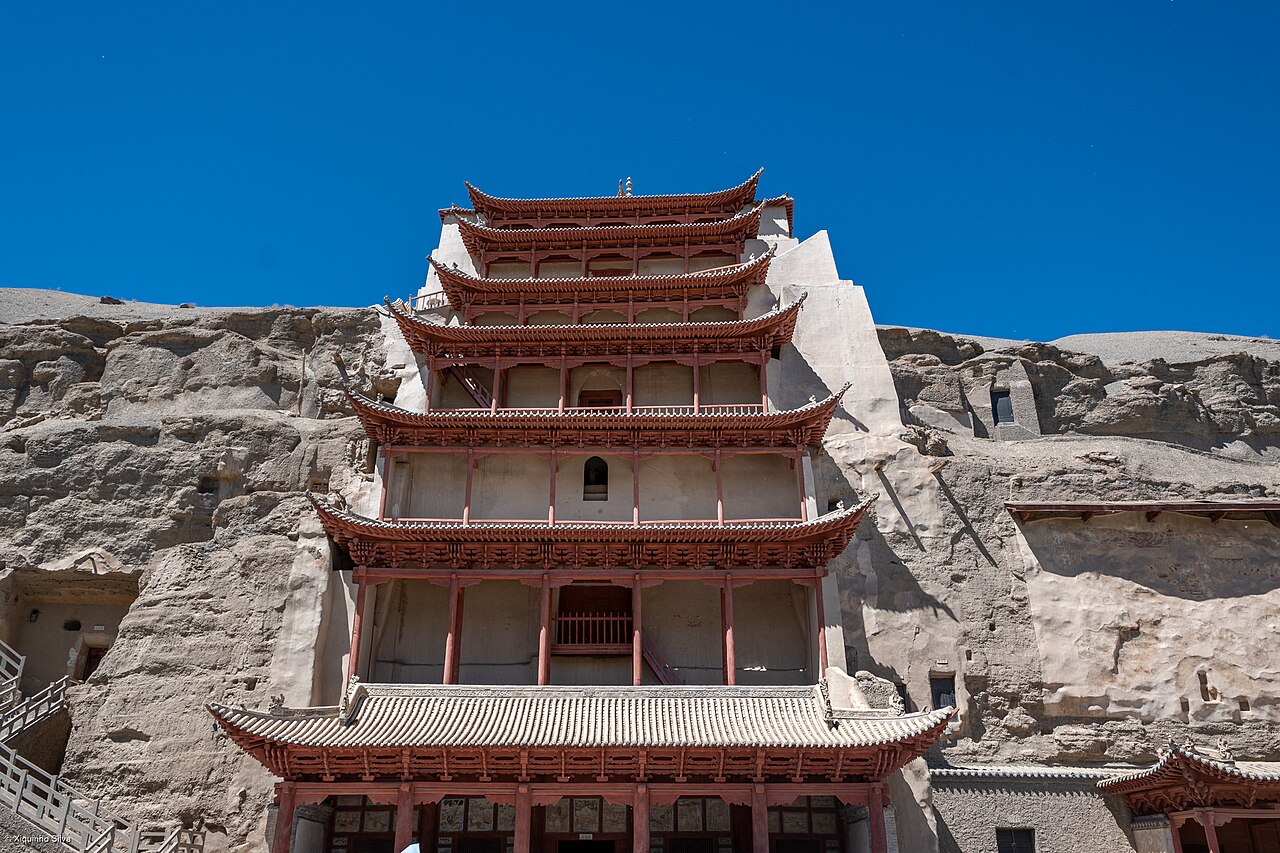
The Mogao Caves at Dunhuang, inscribed by UNESCO in 1987, is the world’s most extensive surviving collection of Buddhist cave art: 492 decorated caves containing approximately 45,000 square metres of murals and 2,000 painted clay sculptures, cut into the sandstone cliffs of the Mingsha Shan dune system east of Dunhuang city in Gansu Province. The caves were excavated and decorated continuously over 1,000 years (4th to 14th centuries CE) by Chinese, Tibetan, Uyghur, and Western Xia patrons, documenting the full evolution of Central Asian Buddhist iconography through the Tang (618–907 CE) golden age and into the Mongol period. The Dunhuang manuscripts — approximately 50,000 texts, scrolls, and paintings sealed in Cave 17 (the “Library Cave”) around 1000 CE and discovered in 1900 — are the largest single cache of medieval manuscripts found anywhere in the world.
The Silk Road corridor and the Hexi Corridor Jiayuguan · Xinjiang Tianshan · Turpan — 380 to 700 km
Three hundred eighty kilometres east of Dunhuang by high-speed rail (approximately 90 minutes from Dunhuang North to Jiayuguan South on the Lanzhou-Xinjiang HSR), Jiayuguan Fort marks the western terminus of the Ming Great Wall and the formal boundary of the Chinese empire proper. The fort’s 733-metre inner keep (three restored gate towers) and the Wall extending west across the Gobi Desert plain defined the checkpoint through which all Silk Road traffic — merchants, monks, diplomats, and military missions — was required to pass on departure from or arrival at China. Dunhuang, 380 kilometres west of Jiayuguan, was the first major oasis after the gate: travellers from the east rested at Dunhuang before the desert crossing to the Tarim Basin; travellers from Central Asia rested here before presenting themselves at Jiayuguan. The Mogao Caves were founded, decorated, and sustained by the accumulated wealth and piety of this Silk Road transit economy over 1,000 years. From Dunhuang North Station, Jiayuguan South is reached in approximately 90 minutes on the direct Lanzhou-Xinjiang HSR service.
Two components of the Silk Roads: the Routes Network of Chang’an-Tianshan Corridor (inscribed 2014, shared with Kazakhstan and Kyrgyzstan) are accessible within 80 kilometres of Dunhuang: the Yumenguan (Jade Gate Pass, Han dynasty frontier fort, approximately 80 km northwest of Dunhuang by road) and the Yangguan (Yang Pass, Han dynasty southern gateway, approximately 70 km southwest of Dunhuang by road) are both included in the 2014 UNESCO nomination as component sites documenting the Han dynasty’s western frontier infrastructure. The Yumenguan is the better-preserved of the two: a rectangular rammed-earth fort platform approximately 26 metres square and 10 metres high, standing isolated on the Gobi plain as it has stood since the Han dynasty garrison abandoned it approximately 100 CE. The Dunhuang oasis and its surrounding Han frontier forts (Yumenguan, Yangguan, and the Han-period wall sections west of Dunhuang) together document the same Silk Road system that the Mogao Caves commemorate in artistic form.
Seven hundred kilometres northwest of Dunhuang by high-speed rail and road (approximately 6–8 hours via Hami and Turpan), the Xinjiang Tianshan natural inscription (inscribed 2013) covers four components of the Tianshan mountain system in Xinjiang Uyghur Autonomous Region. The Tianshan range is the geographical backdrop to the northern Silk Road route (the Tian Shan Bei Lu) that ran north of the Taklamakan Desert through Turpan, Kucha, and Kashgar to the Pamir passes. Buddhist travellers who patronized the Mogao Caves at Dunhuang continued west through the Tianshan foothills to Central Asia: the pilgrim monk Xuanzang (602–664 CE), whose India journey is the basis of the novel Journey to the West, passed through Dunhuang, followed the northern Tianshan route through the Ili Valley, and crossed the Pamir into modern Afghanistan. The Tianshan inscription’s four components — Tomur, Bogda, Kalajun-Kuerdening, and Bayinbuluke — document the natural landscape that this Silk Road route traversed. From Dunhuang, Turpan (Turpan North Station) is reached by the Lanzhou-Xinjiang HSR in approximately 4 hours.
Four hundred fifty kilometres south of Dunhuang by road through the Altun Mountains (a full day’s drive on rough roads), the Qinghai Hoh Xil natural inscription (inscribed 2017) on the Tibetan Plateau documents one of the world’s last pristine high-altitude ecosystems: 4.5 million hectares of plateau grassland and wetland at 4,600–6,860 metres altitude supporting the Tibetan antelope (chiru), Tibetan wild ass, and Tibetan gazelle. The Hoh Xil plateau is the northern edge of the Tibetan geography that produced the Tibetan Buddhist tradition whose artistic legacy is visible in the Mogao Caves’ Tibetan-period paintings (7th–9th centuries, when Dunhuang was under Tibetan imperial control). From Dunhuang, the Hoh Xil is not practically accessible by road; the inscription’s nearest visitor gateway is Golmud (Qinghai Province) reached by overnight train from Xi’an or Lanzhou.
East along the Hexi Corridor and into the Central Plains Xi’an · Beijing · Huangshan — 1,100 to 1,900 km
One thousand one hundred kilometres east of Dunhuang by high-speed rail (approximately 5 hours from Dunhuang North to Xi’an North via the Lanzhou-Xinjiang HSR and Longhai Line), the Mausoleum of the First Qin Emperor with its Terracotta Army (inscribed 1987) at Lintong near Xi’an is the archaeological monument of the same unified Chinese state whose western territorial expansion made the Dunhuang oasis permanently Chinese. The First Emperor’s unification of China in 221 BCE created the political conditions for the Han dynasty’s westward expansion (beginning 139 BCE with Zhang Qian’s diplomatic mission to the Dayuan polity in modern Uzbekistan) that brought the Silk Road under Chinese political oversight and made Dunhuang an imperial garrison town. Without the Qin unification and the subsequent Han administration of the Hexi Corridor, the Mogao Caves’ Buddhist patronage would not have reached Dunhuang from Central Asia. From Xi’an, the Terracotta Army is reached by Xi’an Metro Line 9 in approximately 50 minutes; from Dunhuang, Xi’an requires approximately 5 hours on high-speed rail.
Fifteen hundred kilometres east of Dunhuang by high-speed rail (approximately 7 hours total via Xi’an and Zhengzhou), Mount Taishan in Shandong Province (inscribed 1987) represents the eastern pole of the Chinese ritual world that the Dunhuang Buddhist caves document in its western oasis form. The Tang dynasty (618–907 CE) produced the Mogao Caves’ greatest artistic flowering — the Cave 220 paradise scenes, the Cave 45 Tang polychrome sculptures, the Cave 96 colossal Buddha (35.5 metres high, the ninth-largest Buddha statue in China) — and in the same period conducted the most elaborate imperial feng and shan sacrifices at Taishan. The Tang Emperor Xuanzong, who conducted a celebrated Taishan ceremony in 725 CE and commissioned major calligraphic inscriptions at the summit, was also the emperor during whose reign Dunhuang’s Buddhist patronage reached its zenith. The Tang court is simultaneously the institution behind Taishan’s most important imperial inscriptions and Mogao’s most accomplished artistic period.
Twelve hundred kilometres northeast of Dunhuang by high-speed rail (approximately 5.5 hours via Lanzhou to Beijing South), the Forbidden City (inscribed 1987) is the institutional descendant of the Tang-Song-Yuan-Ming dynastic sequence that successively patronized Dunhuang and then allowed the cave complex to fall into disuse. The Mogao Caves’ last major building campaign was in the early Yuan dynasty (13th century); by the Ming period, Dunhuang had been depopulated by repeated conquest and the caves were abandoned. The Qing dynasty (whose palaces are documented in the Shenyang and Beijing Forbidden City inscriptions) eventually reincorporated Dunhuang into the Chinese administrative system in the 18th century, but by then the cave paintings had not been maintained for 400 years. The juxtaposition of the Forbidden City’s surviving imperial grandeur and the Mogao Caves’ accumulated millennium of art makes the two inscriptions complementary bookmarks on the Chinese imperial visual tradition.
Nineteen hundred kilometres east of Dunhuang by high-speed rail (approximately 9 hours via Xi’an and Nanjing), Mount Huangshan in Anhui Province (inscribed 1990) represents the Chinese landscape painting tradition at its farthest aesthetic remove from the Silk Road’s Buddhist art. The Mogao Caves document 1,000 years of imported Central Asian Buddhist visual culture adapted to Chinese artistic conventions; the Huangshan painters of the 17th century (Hongren, Shitao) developed a purely Chinese visual language of ink-wash mountain form. The journey from Dunhuang to Huangshan on the high-speed rail network is the journey from China’s Central Asian artistic frontier to its Jiangnan cultural heartland — from the Cave 17 Library Cave’s Central Asian scripts and silk paintings to the Huangshan painting album’s sumi ink and rice paper.
Practical information
Dunhuang City in Gansu Province is served by Dunhuang Mogao International Airport with direct flights from Beijing Capital (approximately 2.5 hours), Xi’an Xianyang (approximately 1.5 hours), Lanzhou Zhongchuan (approximately 1 hour), and Chengdu Shuangliu (approximately 2 hours). The new Dunhuang North high-speed rail station (opened 2017, 12 km north of the city) connects to the Lanzhou-Xinjiang HSR (the world’s longest high-speed railway through desert terrain), allowing rail access from Xi’an in approximately 5 hours and from Lanzhou in approximately 3 hours; the nearest major hub is Jiayuguan South (90 minutes west) or Hami South (2 hours east). The Mogao Caves visitor system requires advance booking via the Dunhuang Academy website (dha.ac.cn): general visitors (up to 6,000 per day, with access managed in timed-entry groups) enter specific sets of 8 open caves with a Chinese or English guide. A digital experience centre (the Digital Dunhuang Experience Hall, opened 2014) adjacent to the cave entrance provides immersive reproductions of caves not routinely open to the public and presents the library cave manuscripts in digital form. The most important caves accessible to general visitors include Cave 16–17 (the Library Cave context), Cave 96 (the colossal Tang Buddha, 35.5 m), Cave 45 (Tang polychrome sculptures), Cave 220 (Tang paradise murals), and Cave 257 (Northern Wei flying apsaras). The Mingsha Shan dune field south of Dunhuang (the sand dunes directly behind the cave cliff) and the Crescent Moon Lake (Yueya Quan) oasis within the dunes are accessible 6 km from Dunhuang city centre by taxi or rickshaw. The city’s restaurants are clustered near the Shaping Night Market; Dunhuang requires at least 2 full days (one for the caves, one for the desert landscape and the Han frontier sites west of the city).
Frequently Asked Questions
What are the Dunhuang manuscripts and where are they now?
The Dunhuang manuscripts are approximately 50,000 texts, silk paintings, and embroideries that were sealed inside Cave 17 (a small side chamber off Cave 16) at Mogao approximately 1000 CE and rediscovered in 1900 by the Daoist monk Wang Yuanlu, who was caring for the cave complex as a caretaker. The sealed chamber’s contents had been accumulated over several centuries of deposit at the cave complex: the collection includes Chinese Buddhist sutras and commentaries, Tibetan texts from the period of Tibetan control over Dunhuang (781–848 CE), Chinese Confucian and Daoist texts, documents in Sogdian (the lingua franca of Silk Road merchants), Uyghur, Sanskrit, and Hebrew (the only pre-modern Hebrew document found in China), as well as administrative documents, private letters, astronomical charts, and medical prescriptions. Between 1900 and 1915, the majority of the manuscripts were purchased or taken by European and Japanese scholars and are now divided among the British Library (London, approximately 14,000 items acquired by Aurel Stein in 1907), the Bibliothèque nationale de France (Paris, approximately 6,000 items acquired by Paul Pelliot in 1908), the National Library of China (Beijing, approximately 8,000 items acquired by the Qing government after Pelliot’s visit), the St Petersburg Institute of Oriental Manuscripts (approximately 19,000 items acquired by Sergei Oldenburg in 1914), and the Dunhuang Academy (Dunhuang, the remainder). The International Dunhuang Project (IDP), coordinated by the British Library, has digitized and made freely available online the full holdings of all major collections.
How were the Mogao Caves excavated and decorated?
The Mogao Caves were not carved into solid rock but built within the layered conglomerate sandstone of the Mingsha Shan cliff, which is too structurally weak to support unsupported cavern spans. The construction method was to excavate a roughly rectangular chamber with a flat ceiling, then apply multiple layers of clay plaster to every surface (walls, ceiling, floor platform) before painting. The clay plaster layers typically comprise an inner coarse layer with straw fibre reinforcement, a middle layer with finer clay and sand, and an outer fine layer of white gypsum or lime wash — the painting surface that all Mogao murals appear on. The sculptures in the caves are not carved stone but modelled clay over a wooden armature, then painted and gilded. The largest caves required extensive scaffolding for the ceiling murals; the post-holes of ancient scaffolding are visible in some cave walls. The 492 decorated caves span 1,000 years of construction in a cliff face approximately 1,600 metres long and 30 metres high; the access galleries (visible on the cliff exterior in the article photograph) are modern (early 20th century to present) wooden structures built to protect the cave entrances from sand abrasion by the Mingsha dunes immediately behind the cliff. The caves’ interior conditions — constant low humidity due to the desert climate, absence of light, and sealed entrances — are the reason for the exceptional survival of the murals over 1,700 years.
Who were the Silk Road merchants who patronized the Mogao Caves?
The patrons of the Mogao Caves are documented in dedicatory inscriptions (pati) on the cave walls that name the donors, their family members (including the deceased they were seeking to accumulate merit for), their occupations, and their ranks. The donor record shows a cross-section of Dunhuang’s Silk Road population: Chinese military commanders and civil administrators who were the highest-status permanent residents; Sogdian merchants (Iranian-speaking traders from the Samarkand region who were the dominant long-distance commercial operators of the Silk Road from approximately 500–900 CE); Uyghur traders and rulers who patronized several caves during the Uyghur presence at Dunhuang in the 9th–10th centuries; and Tibetan administrative officials whose patronage during the Tibetan occupation (781–848 CE) produced a distinctive Tibetan-Chinese Buddhist artistic fusion visible in several caves. The Sogdians are particularly well-documented at Mogao: Cave 285 (painted in 538–539 CE during the Western Wei period) includes donor inscriptions in Sogdian script alongside Chinese, documenting the same Sogdian merchants who are known from their letters found at Dunhuang (the “Sogdian Ancient Letters,” c. 313 CE, currently in the British Library) as the Silk Road’s commercial backbone. The Mogao Caves are therefore not simply a Buddhist art site but a social document of the most cosmopolitan population in medieval China.
Sources
- S1 — UNESCO World Heritage Centre — Mogao Caves (Ref. 440) — https://web.archive.org/web/20230601000000/https://whc.unesco.org/en/list/440/
- S2 — UNESCO World Heritage Centre — Statement of Outstanding Universal Value (Ref. 440) — https://whc.unesco.org/en/list/440/
Spotted an error? Write to editorial@culturalheritageonline.com and we correct it the same day.

.jpg)