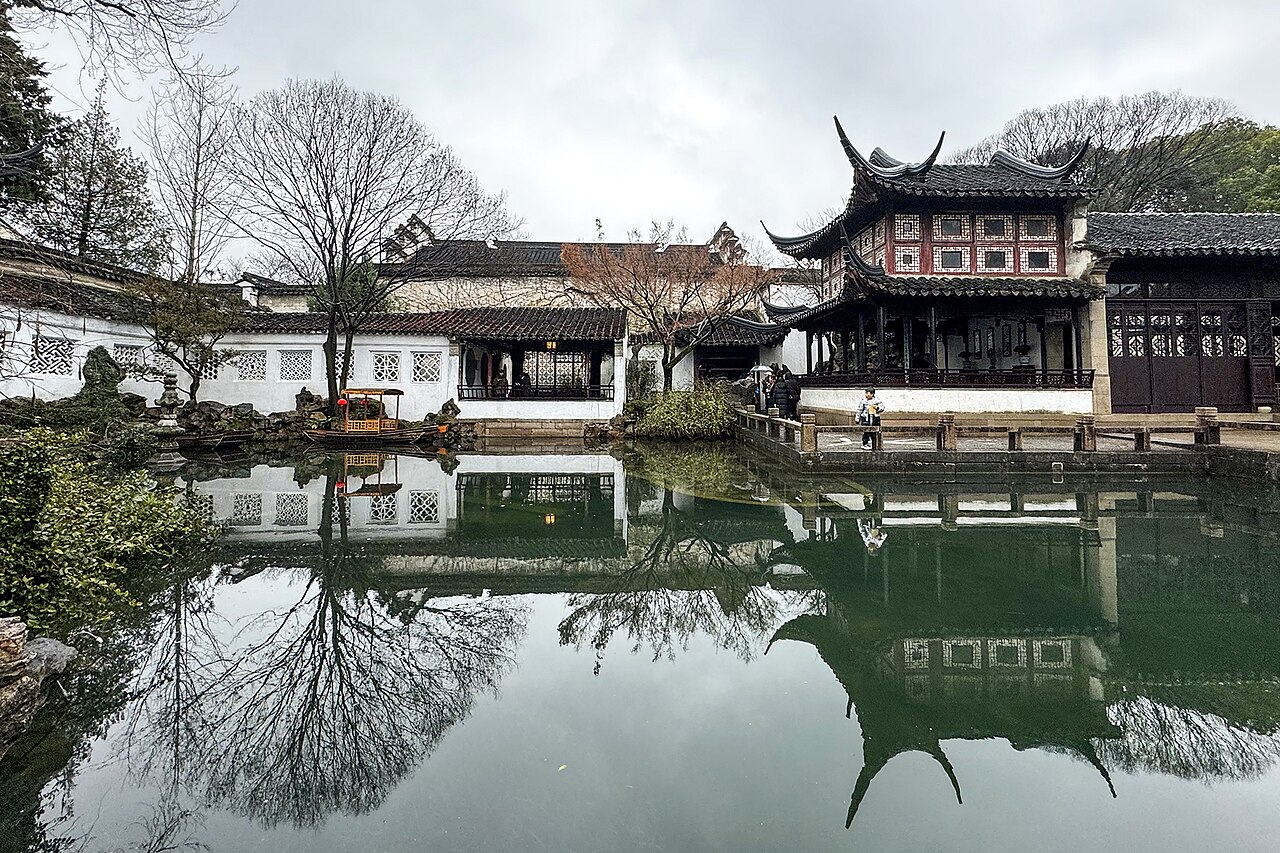
Nine classical gardens in Suzhou were first inscribed on the UNESCO World Heritage List in 1997, with the inscription extended in 2000 to cover four additional sites. The earliest gardens date from the Song dynasty, but the core group — including Zhuozheng Yuan (begun in 1509), Liu Yuan (substantially rebuilt in the 1870s), and Wang Shi Yuan (the Master of Nets Garden, with documented origins in 1140 CE) — reached their present form during the Ming and Qing periods. The gardens occupy a total area of under 20 hectares distributed across the old city of Suzhou, an urban fabric that has housed garden construction continuously for over 1,000 years. Suzhou itself is 100 kilometres from Shanghai by high-speed rail, a journey of approximately 25 minutes.
The Grand Canal through Suzhou and the city as serial UNESCO site within the city and region
The Grand Canal — listed by UNESCO in 2014 as a serial property across eight provinces — runs directly through Suzhou, making the city itself a node in two overlapping UNESCO inscriptions. The canal section within Suzhou includes the Shantang Street corridor, a 7-kilometre stretch of canal-side commercial and residential architecture dating from the Tang dynasty reconstruction under Bai Juyi, governor of Suzhou in 825 CE, who supervised the original dredging. The relationship between the canal and the gardens is economic: the salt and silk trade that the Grand Canal facilitated funded the retired officials and merchants who built Suzhou’s gardens from the Song dynasty onward. Wang Xianchen, the censor who began Zhuozheng Yuan in 1509 after his dismissal from imperial service, paid for the 5.2-hectare garden through proceeds from a family fortune built partly on canal commerce. Suzhou’s silk industry — the city supplied the imperial court with silk textiles — also depended on the canal for raw material transport from the Lake Tai mulberry-growing areas. The gardens are, in this sense, the private face of a mercantile wealth whose public infrastructure runs through the city in the form of stone-banked waterways. A visitor walking from Zhuozheng Yuan north to Shantang Street and then continuing to the canal embankment at Changmen can trace the spatial connection between the two UNESCO inscriptions within two hours on foot.
Tiger Hill — Huqiu — occupies a specific position in Suzhou’s cultural geography. The 36-metre conical hill, formed by a volcanic dike, contains the tomb of Helü, king of Wu, who died in 496 BCE according to Han-dynasty historical records. Above the tomb stands the Yunyan Pagoda, a seven-storey brick structure built between 959 and 961 CE during the Five Dynasties period and currently inclined 3.59 degrees from vertical — a lean that developed gradually after construction because the northeastern foundation rests on softer soil. The pagoda is not within the UNESCO garden inscription but is listed as a national key cultural protection unit; it serves as Suzhou’s most prominent historical vertical marker and was the subject of a Su Dongpo poem in the 11th century that remains one of the most quoted descriptions of the site. Tiger Hill is 3.5 kilometres from the city centre and accessible by water bus along the Shantang canal, which connects the hill to the old city through the Shantang Street corridor mentioned above.
Southwest to Hangzhou and south to Huangshan 175–300 km / 1–3h by HSR
West Lake Cultural Landscape of Hangzhou, 175 kilometres southwest of Suzhou by high-speed rail — approximately one hour on the G-class services from Suzhou North station to Hangzhou East — represents the closest major UNESCO site beyond the Suzhou city boundaries. The 2011 inscription covers the 5.6-square-kilometre lake, its islands and causeways, and the surrounding hills with their Buddhist temples, pagodas, and gardens. The relationship between Suzhou and Hangzhou is one of the most documented in Chinese cultural history: both cities served as regional capitals of exceptional prosperity during the Southern Song dynasty (Hangzhou as imperial capital, 1127–1276 CE; Suzhou as its major commercial satellite), and the proverb comparing Suzhou and Hangzhou to paradise — “上有天堂,下有苏杭” — appears in sources as early as the Tang dynasty. The West Lake’s Leifeng Pagoda, originally constructed in 975 CE, collapsed in 1924 when local residents extracted bricks from its foundations believing they contained protective charms; the current structure, completed in 2002, reproduces the pagoda’s documented five-storey octagonal form in concrete and copper cladding over a steel frame. Beneath the new pagoda, the foundations of the 975 CE original were preserved in situ and are accessible through a ground-floor archaeological display. The combination of Suzhou and Hangzhou in a single trip is the most natural pairing in this region and requires no more than a single travel day between them.
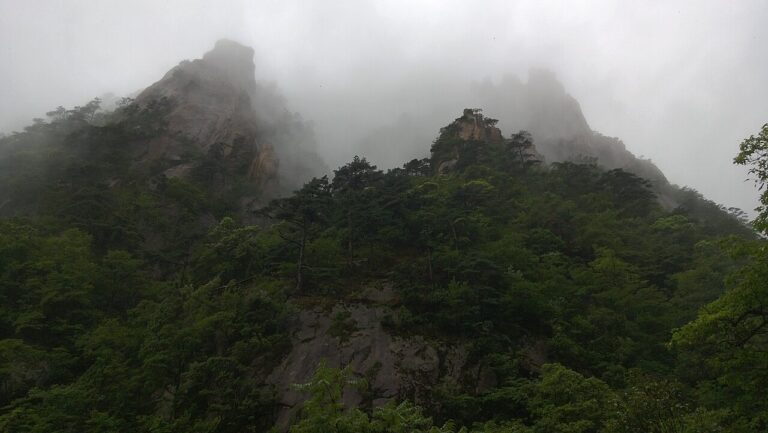
Mount Huangshan, 300 kilometres southwest of Suzhou — approximately three hours by G-class train to Huangshan North station — extends the circuit into the Anhui mountain landscape that supplied many of Suzhou’s garden designers with their foundational aesthetic references. The Taihu rocks used in Suzhou’s gardens — the scholar stones weighing up to several tonnes that serve as compressed representations of mountains — were quarried from Lake Tai, immediately west of Suzhou, and represent the same impulse to translate mountain scenery into a domestic scale that Huangshan’s peaks had supplied to Anhui painters. The 5-tonne Guanyunfeng stone in Liu Yuan’s central courtyard — too large to move through any existing doorway, which means it entered the garden during construction — is the most cited single object in the entire Suzhou garden inscription and the most direct physical argument for the borrowed-scenery principle: the stone is a mountain reduced to the scale of a room. Huangshan itself, at 154 square kilometres of granite peaks reaching 1,864 metres, represents the full-scale source material for the aesthetic the gardens compress. Tongli, 20 kilometres southeast of Suzhou, is a Song-dynasty water town whose canal grid and whitewashed architecture provide immediate context for understanding how Suzhou’s garden culture fitted into a broader regional pattern of canal-based settlement; it is not a UNESCO site but is linked to Suzhou by frequent bus and makes a useful half-day extension for visitors with time.
Practical information
Suzhou is served by Suzhou North station on the Shanghai–Beijing high-speed line and Suzhou station on the conventional rail network. From Shanghai Hongqiao, the fastest G-class trains reach Suzhou North in 24 minutes; from Shanghai South, conventional trains take 30 to 40 minutes. The garden sites cluster in the old city and are walkable between them, though distances across the full inscription area can reach 4 kilometres. The Master of Nets Garden (Wang Shi Yuan) is the smallest site at 0.54 hectares and the most spatially concentrated — all its pavilions, rockeries, water features, and courtyard walls fall within a single line of sight from the central pond, a quality that has made it the template for the Metropolitan Museum of Art’s Astor Court, a partial reconstruction installed in New York in 1981. The Lingering Garden (Liu Yuan) is the largest and most varied in compositional type, and the Guanyunfeng stone requires a separate inner-garden ticket. Opening hours vary across sites; most open by 07:30 and close between 17:00 and 17:30. Spring (March to April) and autumn (October to November) offer the most balanced conditions for garden visiting: peony season in late April is peak for Zhuozheng Yuan’s western garden, and the maple courtyard in Liu Yuan reads best in October.
Frequently Asked Questions
What is the borrowed-scenery principle and how do the Suzhou gardens use it?
Borrowed scenery — jiejing in Chinese, shakkei in the Japanese garden tradition that adapted it — is the technique of incorporating a distant view into a garden’s composition so that the eye reads the external landscape as part of the designed space. The earliest theoretical formulation appears in Ji Cheng’s 1634 treatise Yuanye (The Craft of Gardens), written partly in reference to Suzhou-area gardens. The principle operates at multiple scales. At the largest scale, pagodas on hills outside the garden walls were positioned so they appear framed through carefully placed windows or gate openings inside the garden — North Temple Pagoda, visible from Zhuozheng Yuan’s northern perimeter, is the canonical example. At the smallest scale, the same principle applies to the scholar stones: a Taihu rock placed against a whitewashed wall is read as a mountain silhouette against sky, compressing a range into a single object. The Master of Nets Garden applies borrowed scenery most rigorously at the spatial level: the central pond, approximately 40 metres across, is surrounded by pavilions whose eaves are positioned so that each pavilion frames a view of the one opposite, and every structure in the garden is visible from every other structure, creating a closed system of mutual borrowing. The five-tonne Guanyunfeng stone in Liu Yuan operates on the object scale: removed from its lake-floor context where erosion produced its perforated surface, it reads as a miniaturised mountain range, and the corridor surrounding it was designed so the visitor always views it against a plain background that emphasises its silhouette.
Are all nine UNESCO-listed gardens in Suzhou equally worth visiting, or should visitors prioritise?
The nine gardens vary substantially in scale, condition, and distinctiveness. For a visitor with one day, the sequence of Zhuozheng Yuan (the largest, with the most varied water-and-island composition), Wang Shi Yuan (the most spatially concentrated), and Liu Yuan (the most renowned single object, the Guanyunfeng stone, plus the longest covered corridor in Chinese garden architecture at 726 metres) covers the full compositional range of the inscription. Yi Yuan and Ou Yuan — respectively dating from 1874 and 1874 to 1879 CE — are among the later and smaller gardens in the inscription and are more suitable for visitors who have already seen the three principal sites. Canglang Ting (the Blue Wave Pavilion) is the oldest site in the inscription, with documented origins in 1044 CE under the poet Su Shunqin, and is notable for being the only major Suzhou garden that uses an external canal rather than an internal pond as its central water feature — the pavilion sits above a canal, and the garden’s relationship with the water outside is explicitly borrowed. Visitors specifically interested in the evolution of Chinese garden design will find Canglang Ting the most historically distinctive, precisely because its 11th-century layout precedes the full development of the internal-pond model that all the Ming and Qing gardens employ.
How does Tongli Water Town relate to the Suzhou UNESCO inscription, and is it worth including?
Tongli is not part of the UNESCO inscription but is administered under the same Suzhou municipal heritage framework and shares the same physical infrastructure — a canal grid cutting a residential area into islands connected by stone bridges — that defines the water-town typology across eastern Jiangsu Province. The town’s most significant single building, Tuisi Yuan (the Retreat and Reflection Garden), was added to the Suzhou gardens UNESCO inscription as an extension in 2000, making Tongli technically part of the World Heritage serial property through this single site even though the town itself is not inscribed. Tuisi Yuan, designed in 1886 by Ren Lansheng after his dismissal from imperial service — a biographical pattern that recurs across Suzhou garden history — is notable for its integration of the garden directly with a canal edge, so that the easternmost pavilion sits at water level and visitors look out across the canal surface from inside the garden. The 20-kilometre distance from central Suzhou makes Tongli a practical half-day trip by bus or taxi. The town’s preserved residential streets, three intersecting canals, and 49 stone bridges in an area of roughly 1 square kilometre give an accessible introduction to the canal-town urbanism that underlies both Suzhou’s garden culture and the Grand Canal’s broader inscription — the two UNESCO designations that bracket Suzhou from inside the city outward.
Sources
- S1 — UNESCO World Heritage Centre — Classical Gardens of Suzhou (Ref. 813) — https://web.archive.org/web/20230601000000/https://whc.unesco.org/en/list/813/
- S2 — Suzhou Landscape and Forestry Bureau — https://whc.unesco.org/en/list/813/
- S3 — Kuhn, Dieter. <em>The Age of Confucian Rule: The Song Transformation of China</em>. Harvard University Press, 2009. ISBN: 978-0-674-03661-1.
Spotted an error? Write to editorial@culturalheritageonline.com and we correct it the same day.