
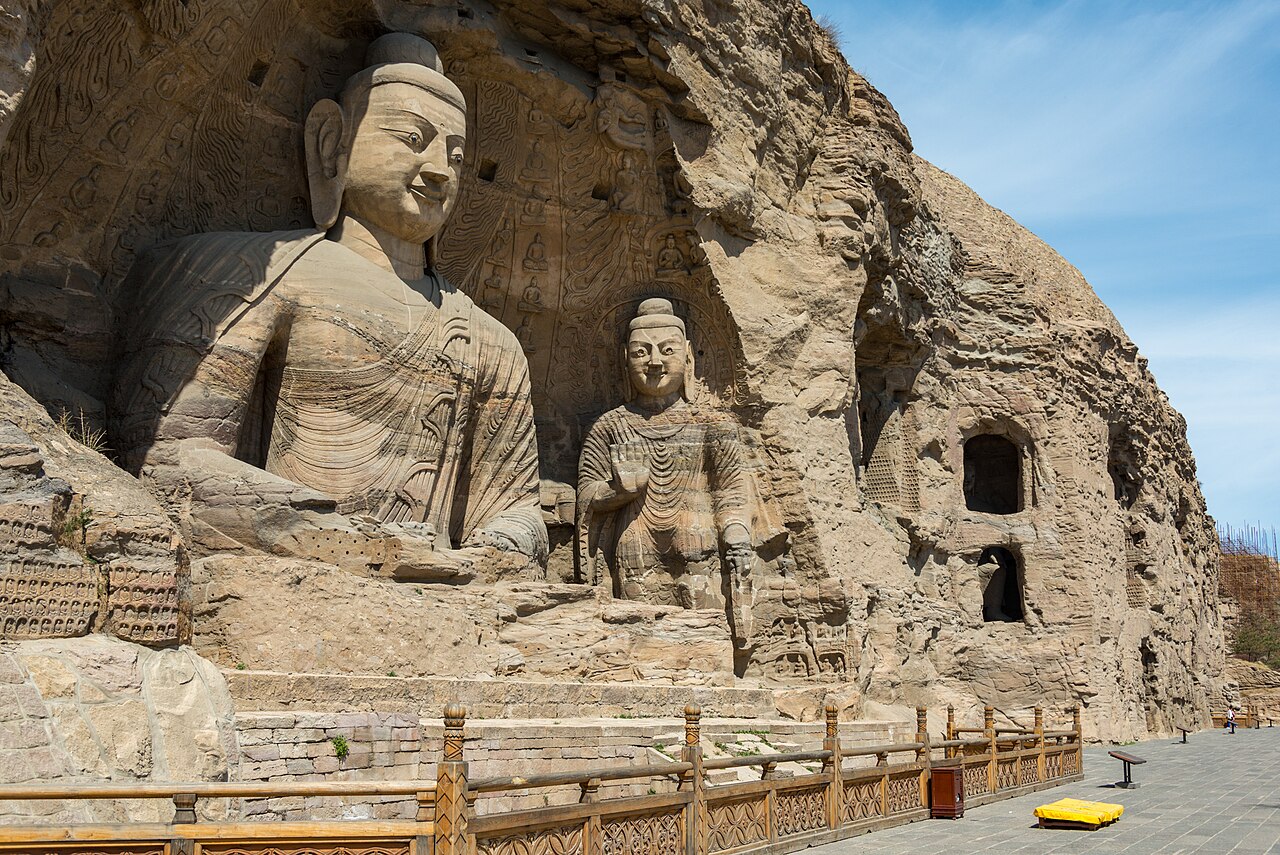
The Yungang Grottoes comprise 252 caves and 51,000 stone statues carved into a sandstone cliff 16 kilometres west of Datong, Shanxi Province, between 460 and 525 CE under the Northern Wei dynasty. The five earliest caves — commissioned directly by the monk Tanyao under imperial order — contain seated Buddhas up to 17 metres tall, each face modelled on the features of a reigning emperor. UNESCO listed the complex in 2001 as the finest example of fifth-century Chinese Buddhist rock art and the easternmost node in the continental chain of Gandharan sculptural influence.
South and west: Pingyao’s walled city and the Longmen comparison 280–700 km / HSR + train
The Ancient City of Pingyao, 280 kilometres south of Datong and roughly two and a half hours by high-speed rail, entered the UNESCO list in 1997 as the best-preserved example of a Ming- and Qing-dynasty Chinese county town. Its rammed-earth walls, erected in the 14th century and expanded under the Hongwu Emperor in 1370, run 6.4 kilometres in perimeter and reach 12 metres in height. Inside, roughly 4,000 buildings from the Ming and Qing periods survive intact along a street grid that has not been substantially altered in 600 years. The county government offices, temple of the City God, and the Rishengchang exchange firm — often identified as China’s first draft bank, founded 1823 — all remain accessible and in situ. Pingyao occupies a different register from Yungang: where the grottoes are a product of imperial patronage directed at a single devotional task, Pingyao is the physical archive of a merchant civilisation. The two sites together give a visitor access to the full arc of Northern Chinese history, from the Buddhist statecraft of the Northern Wei to the Qing commercial economy.
Seven hundred kilometres south by train — roughly five hours on the G-series high-speed services via Zhengzhou — the Longmen Grottoes outside Luoyang provide the essential stylistic counterpoint to Yungang. Longmen was commissioned from around 493 CE when the Northern Wei court relocated its capital from Datong to Luoyang, and work continued through the Tang dynasty, ending around 900 CE. The contrast with Yungang is not incidental: it is the central argument of Chinese Buddhist sculpture history. At Yungang, the earliest figures in Tanyao’s five caves read as Gandharan in origin — broad shoulders, heavy drapery folds, faces with strong Central Asian modelling influenced by the Kushan school that had reached China via the Silk Road. As Northern Wei court culture absorbed Han Chinese aesthetic values, the sculpture grew more linear, the drapery flatter, the faces more elongated. Longmen inherits and accelerates this process. The Tang-period Fengxian Temple, carved between 672 and 676 CE under Empress Wu Zetian, contains a 17.14-metre seated Vairocana Buddha whose face is so naturalistically rendered that Tang sources describe it as a portrait of the empress herself. Where Yungang’s colossi carry the weight of foreign import — Buddhism arriving as a state ideology from the northwest — Longmen’s figures have fully absorbed Chinese figural conventions. Visiting both sites in sequence is not a duplicate experience. It is a before-and-after documentation of how a foreign religion became a Chinese art form over two centuries.
North and east: the Great Wall near Datong and Mount Wutai 50–180 km / car or bus
The sections of the Great Wall closest to Datong belong to the Northern Qi dynasty, constructed in phases between 550 and 577 CE — roughly a century after work began at Yungang, and under a successor dynasty to the Northern Wei. These sections are included in the serial UNESCO inscription of the Great Wall, listed in 1987, which covers construction phases spanning from the Warring States period through the Ming dynasty. The Northern Qi walls northeast of Datong were built primarily of earth rather than the fired brick that characterises the Ming-era sections near Beijing, and they survive in fragmentary condition, running across the Sanggan River valley and the hills toward Inner Mongolia. For a visitor based in Datong, the Yanmenguan Pass — roughly 120 kilometres south, also within the Great Wall inscription — offers more accessible and better-preserved remains, including a restored gate tower and sections of stone-faced wall. The wall’s function in this region was specifically to contain pressure from the Rouran Khaganate and later the Khitan, the same steppe forces the Northern Wei court had spent a century managing through a combination of military garrison and Buddhist patronage at Yungang.
Mount Wutai, 180 kilometres east of Datong by car — the road through the mountains takes around two and a half hours — was listed by UNESCO in 2009 as a cultural landscape representing the convergence of Buddhist sacred geography with actual mountain topography. The inscription covers 58 monasteries across five flat-topped peaks, the highest reaching 3,058 metres. Foguang Temple, on the eastern slope, contains a main hall dated with documented precision to 857 CE, confirmed by a dated inscription on a main beam and by the building’s structural correspondence with Tang architectural drawings preserved in the Dunhuang manuscripts. It is one of the four surviving Tang-period wooden buildings in China. The temple’s clay sculptures, also dated to 857 CE, occupy the same transitional moment that Longmen’s Tang-period caves represent in stone: full Tang naturalism applied to Buddhist subject matter. A visit pairing Yungang with Wutai’s Foguang Temple gives access to both the origin point and a mature development of the same sculptural tradition, 400 years apart.
Practical information
Datong is best approached by high-speed rail from Beijing South station; G-series trains cover the 360 kilometres in two hours and ten minutes, with multiple departures per day. Datong’s main station is a short taxi ride from the city centre. The Yungang Grottoes are 16 kilometres from the centre; buses and taxis run throughout the day, and the site requires a minimum of three hours to walk through the principal caves at a reasonable pace. The ticket office closes at 17:00. April through October offers the most stable weather; July and August are hot but the caves maintain a lower internal temperature. The site is exposed sandstone: flat shoes with grip are practical, and a small torch is useful in the darker rear chambers where ceiling carvings are otherwise difficult to see. Combining Yungang with a Pingyao visit requires an overnight stay — Pingyao’s guest houses within the walled city book up in advance during Chinese national holidays (1–7 October and 1–5 May). The Longmen excursion from Datong is a full-day rail trip; travellers planning both should allow a minimum of four nights based in Shanxi Province, with a separate night in Luoyang or an early return train.
Frequently Asked Questions
What is the stylistic difference between the Yungang Grottoes and the Longmen Grottoes?
The two sites mark the beginning and a mature point in the same 400-year process of cultural assimilation. Yungang was carved starting in 460 CE, when the Northern Wei dynasty had recently unified northern China but still maintained close connections to the Central Asian Buddhist communities that had brought the religion eastward along the Silk Road. The sculptures in Tanyao’s five earliest caves — the largest, Cave 20, has a seated Buddha 13.7 metres tall — show clear Gandharan influence: heavy robe folds rendered as parallel ridges, broad faces with prominent noses, and a monumental frontality borrowed from the Kushan Buddhist sculpture of present-day Afghanistan and Pakistan. As the Northern Wei court absorbed Han Chinese aesthetic values through the late fifth century, the Yungang figures became progressively more linear and the drapery more calligraphic. When the court relocated to Luoyang in 493 CE and work began at Longmen, this process accelerated. By the Tang dynasty, when Longmen’s largest commission — the Fengxian Temple with its 17.14-metre Vairocana — was completed in 676 CE, Chinese Buddhist sculpture had developed a fully independent figural language: naturalistic body proportions, flowing asymmetric drapery, and faces that follow Han Chinese ideals of physiognomy. Yungang is where that transformation begins; Longmen is where it arrives.
How much time is needed to visit the Yungang Grottoes properly?
The site runs roughly 1 kilometre in length along the cliff face, with the 252 caves grouped into three main clusters. A focused visit taking in the five Tanyao caves (Caves 16–20), the twin pagoda caves (Caves 9–10), and the detailed narrative relief caves of the middle cluster (Caves 5–6) requires a minimum of three hours at a comfortable walking pace. Cave 5 alone — which houses a seated Buddha 17 metres tall — takes time to absorb because the ceiling paintings and the density of votive niches cut by later donors across every surface reward slow attention. A comprehensive visit covering all accessible caves takes five to six hours. The site provides audio guides in Mandarin and English, and the orientation centre at the entrance has scale models that help visitors understand the three-dimensional relationship between the cave clusters before entering the cliff. Early morning arrival avoids the tour group concentration that peaks between 10:00 and 14:00.
Is it possible to combine Yungang with Mount Wutai in a single trip from Beijing?
Yes, and the combination is geographically logical. From Beijing, Datong is two hours and ten minutes by G-series high-speed rail. After one or two nights in Datong — which also has a restored Ming-era old city and a well-preserved Nine Dragon Screen from 1392 — travellers can hire a car or take a bus through the Heng Mountains to Mount Wutai, roughly two and a half hours east. Wutai requires at least two nights to visit Foguang Temple on the eastern slope (a 20-kilometre dirt road from the main monastic complex) and the major temples clustered around Taihuai town in the central valley. From Wutai, travellers can continue south to Pingyao — approximately three hours by car — for the Ming-era walled city. The full circuit of Datong, Wutai, and Pingyao can be covered in five to six days without rushing, using Datong as the rail entry and exit point. Organised tour operators in Beijing offer variations of this circuit, but independent travel by high-speed rail and hired car gives more flexibility for early-morning access to the grottoes and Foguang Temple before group traffic arrives.
Sources
- S1 — UNESCO World Heritage Centre — Yungang Grottoes (Ref. 1039) — https://web.archive.org/web/20230601000000/https://whc.unesco.org/en/list/1039/
- S2 — Yungang Research Academy Datong — https://whc.unesco.org/en/list/1039/
- S3 — Kuhn, Dieter. <em>The Age of Confucian Rule: The Song Transformation of China</em>. Harvard University Press, 2009. ISBN: 978-0-674-03661-1.
Spotted an error? Write to editorial@culturalheritageonline.com and we correct it the same day.

.jpg)