
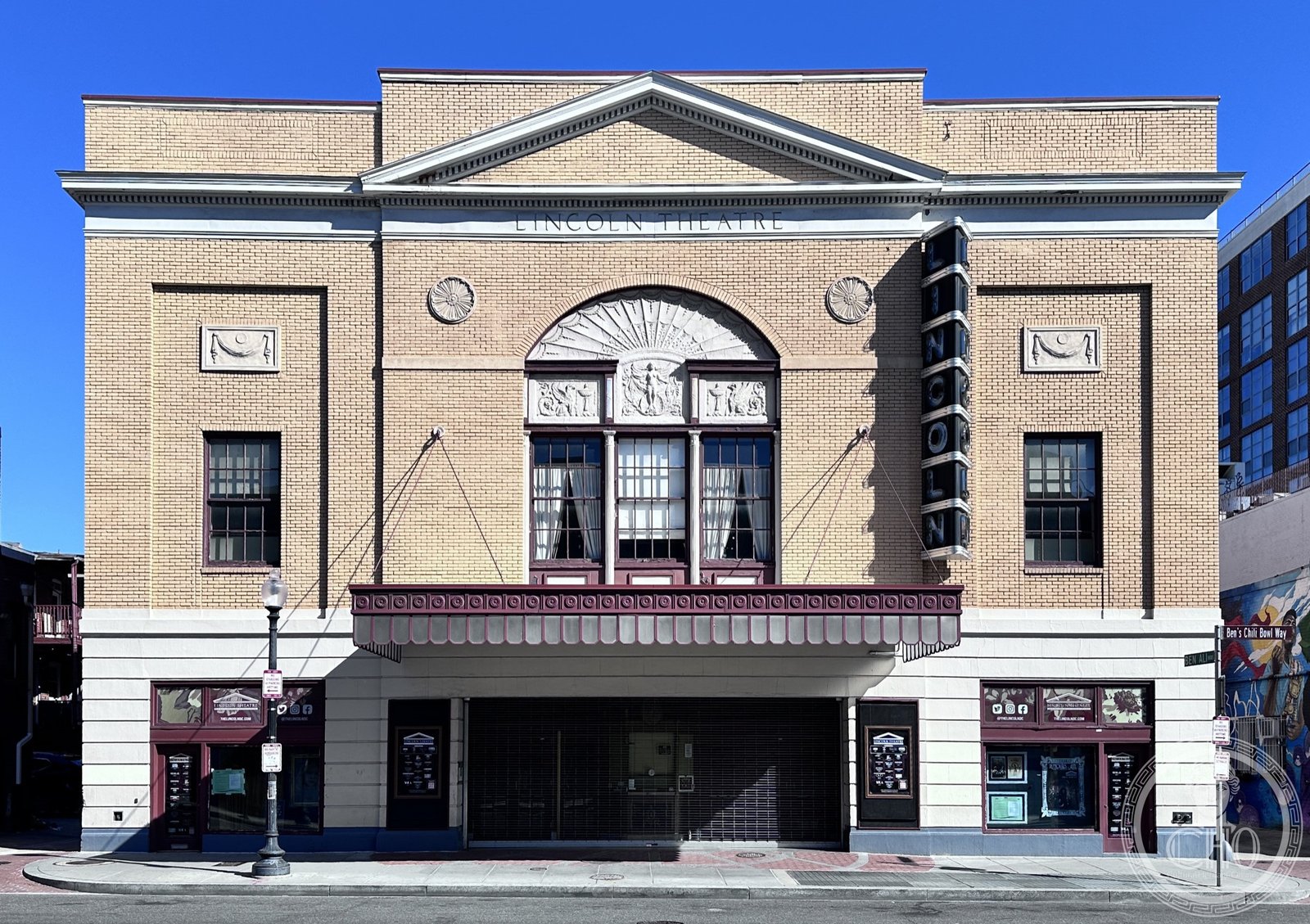
The Lincoln Theatre opened in 1922 on U Street NW, the heart of Washington’s historic African American commercial and cultural district, and became the premier entertainment venue for a community that was building one of the most vibrant Black cultural corridors in America.
At a glance
Washington’s U Street corridor in the early twentieth century was sometimes called the “Black Broadway” of the American South: a stretch of theaters, clubs, hotels, and restaurants that served a segregated African American community while generating cultural production of national significance. The Lincoln Theatre, opened in 1922, was the premier movie house and entertainment venue of this corridor, presenting films and live performances to audiences that included the African American middle class that Washington’s federal workforce and Howard University had produced. The Lincoln hosted Duke Ellington, Cab Calloway, and other luminaries of the Harlem Renaissance era and is now a DC-government-supported performing arts venue on the revitalized U Street corridor.
Key facts
- Address: 1215 U Street NW, Washington, DC 20009
- Opened: 1922
- Style: Atmospheric theater
- Listed: National Register of Historic Places; DC Historic Landmark
- Current operator: District of Columbia Department of General Services
- Neighborhood: U Street / Shaw, Washington DC
History
Washington’s African American community in the early twentieth century was one of the most established and institutionally developed in the United States. Howard University, founded in 1867, was producing generations of doctors, lawyers, teachers, and federal employees. The U Street corridor from roughly 7th to 14th Streets NW had become the commercial center of Black Washington, with insurance companies, newspapers, hotels, and the professional offices that served a community excluded from the city’s white commercial districts by segregation.
The Lincoln Theatre opened on U Street in 1922, naming itself for the president whose Emancipation Proclamation had been the legal foundation for the community it served. The theater brought the full movie palace experience to a population that was formally excluded from Washington’s white-only theaters, and it became the most important entertainment venue in Black Washington. Through the 1920s and 1930s, the Lincoln’s stage presented performers who were simultaneously defining the sound of the Harlem Renaissance: Duke Ellington — a native Washingtonian who grew up in the Shaw neighborhood surrounding U Street — performed at the Lincoln, as did Cab Calloway, Pearl Bailey, and Ella Fitzgerald.
The civil rights movement and urban renewal of the 1950s and 1960s disrupted the U Street corridor, and the 1968 riots following Martin Luther King’s assassination devastated much of the neighborhood. The Lincoln closed and fell into disrepair. A restoration funded by the DC government and community organizations returned the theater to operation in 1994, and it now serves as a venue for music, theater, and community events on a U Street that has been transformed by gentrification while preserving key landmarks of its African American heritage.
What you see
The Lincoln Theatre presents a symmetrical facade on U Street with a central arched entrance bay, decorative brickwork, and a marquee assembly that has been restored to recall the theater’s appearance during its 1920s heyday. The building’s scale is that of a neighborhood theater rather than a grand picture palace, suited to a commercial street that served a community rather than a downtown with regional draw.
Inside, the auditorium retains much of its atmospheric decorative program, with the layered plasterwork and the intimate proportions of a theater designed for live performance and film. The restoration has preserved the visual character of the 1922 design while updating the technical systems and seating for contemporary use. A Duke Ellington mural, acknowledging the theater’s most celebrated local association, is a focal point of the restored interior.
Practical information
- Access: 1215 U Street NW; Metro: U Street / Cardozo (Green/Yellow Lines)
- Hours: Box office open for scheduled events; check the Lincoln Theatre website
- Best for: African American cultural heritage, U Street corridor history, live music
- Tip: The National Museum of African American History and Culture, 1.5 miles south on the National Mall, provides deep context for the Lincoln’s place in American cultural history
Getting there
The Lincoln Theatre is on U Street NW between 12th and 13th Streets, in the Shaw neighborhood of Washington DC. The U Street/Cardozo Metro station (Green and Yellow Lines) is one block east of the theater. By car, the theater is 1.5 miles north of the National Mall via 14th Street NW. Parking is limited in the neighborhood; Metro is strongly recommended. Reagan National Airport (DCA) is approximately 5 miles south, with direct Metro access via the Yellow Line.
Nearby
- African American Civil War Museum — one block north on Vermont Avenue NW, documenting the 180,000 African American soldiers who served in the Union Army
- Howard University — 10 minutes north on Georgia Avenue, the historically Black university founded in 1867 that shaped the professional class served by the Lincoln Theatre
- National Museum of African American History and Culture — on the National Mall, the Smithsonian’s museum of African American history, culture, and heritage
- Ben’s Chili Bowl — on U Street NW, a Washington institution since 1958 that survived the 1968 riots and became a living symbol of the corridor’s continuity
Sources
- DC Historic Preservation Office — Lincoln Theatre landmark designation and documentation
- National Register of Historic Places — Lincoln Theatre, Washington, DC
- Historical Society of Washington DC — U Street corridor African American heritage
Find it on the map
See this place and what’s around it →Record researched and written by Luigi De Marchi for Cultural Heritage Online, 2026.
📷 Become a Cultural Heritage Online photographer
Share your photos of places: they stay published under your name as the author. The more they're seen, the more you get noticed — and soon a contest will reward the most appreciated photos.
Log in or sign up free to add a photoIs this page about you?
This page is read by travellers and heritage enthusiasts who find it on Google. Tell us how you are connected to this place and we will take it from there.