The Sacred Sites and Pilgrimage Routes in the Kii Mountain Range, inscribed by UNESCO in 2004, span 506 hectares of sacred sites and 307 kilometres of designated pilgrimage trails across three prefectures on the Kii Peninsula south of Osaka. The inscription covers three distinct sacred areas — Yoshino-Omine, Kumano Sanzan and Koyasan — representing 1,200 years of continuous religious practice that blended Shinto and Buddhist belief in ways unique to Japan. The Kumano Kodo pilgrimage trails and the Camino de Santiago in Spain are the only two UNESCO-inscribed pilgrimage routes with a formal bilateral recognition programme for pilgrims who complete both.
Koyasan and the monk who may still be meditating 816 m plateau above Osaka — 2 hr by train and cable car from Osaka-Namba
Koyasan is a flat mountain plateau at 816 metres altitude in Wakayama Prefecture, enclosed by eight peaks that the monk Kukai (774–835 CE) interpreted as the petals of a lotus flower. Kukai — posthumously known as Kobo Daishi, the Great Teacher Who Spread the Dharma — established Koyasan in 816 CE as the headquarters of the Shingon school of esoteric Buddhism, which he had founded after returning from study in Tang Dynasty China in 806 CE. The imperial court assigned him the mountain site, and the complex he built there became one of the most significant Buddhist institutions in Japanese history.
Kukai died on Koyasan on 22 April 835 CE. What distinguishes his death in the Buddhist tradition — and what drives the pilgrimage — is the belief, held by Shingon practitioners, that Kukai did not die but entered a state of eternal meditative absorption (nyujo) in his mausoleum at Okunoin, in the forest cemetery northeast of the main temple precinct. He is believed to be waiting, in that state, for the arrival of Miroku, the future Buddha. Every morning and evening, temple monks carry ritual offerings of food and clothing to the mausoleum lantern hall (Toro-do) adjacent to the tomb — a practice that has continued without interruption for approximately 1,190 years. Approximately 50,000 pilgrims visit Koyasan annually, many specifically to make offerings at Okunoin and to feel the presence of a teacher considered to still be alive.
The cemetery at Okunoin is one of the most extraordinary sites in Japan. It extends for approximately 2 kilometres through old-growth cryptomeria forest, with an estimated 200,000 grave markers lining the path to the mausoleum. The graves span thirteen centuries of Japanese aristocratic, samurai, merchant and commoner burials — the oldest markers are worn nearly flat — and include the tombs of feudal lords, Buddhist monks from across Japan and, memorably, a number of corporate memorials erected by Japanese companies in the 20th century, including a monument from the Termite Research Institute of the Kinki Chemical Company commemorating termites used in experiments. Beyond the corporate monuments, the forest itself — ancient, dark, with mossy stone markers disappearing into the understorey — has a physical weight that even non-pilgrims note as qualitatively different from ordinary temple gardens.
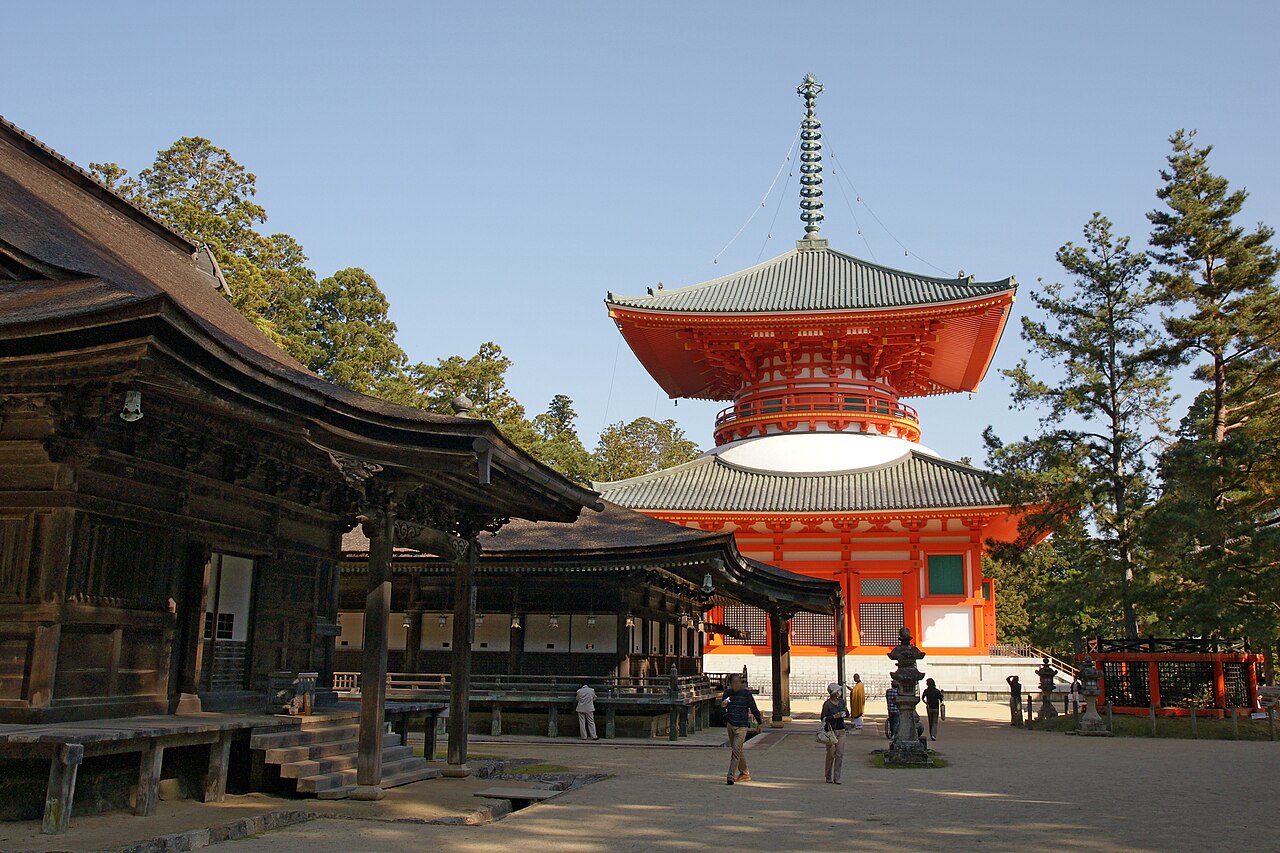
The central religious complex of Koyasan, Danjogaran, includes the Konpon Daito pagoda (the vermilion structure visible in most photographs of Koyasan), a 48.5-metre two-storey pagoda built to represent the mandala of the esoteric cosmos in three dimensions — Kukai’s original concept of Koyasan itself as a three-dimensional mandala. The current pagoda dates to 1937, rebuilt after fire; earlier versions occupied the same site from 887 CE. The plateau is also home to approximately 120 temples, many of which offer shukubo (temple lodging), allowing visitors to stay overnight in traditional temple guest quarters, take early-morning meditation sessions and eat vegetarian Buddhist cuisine (shojin ryori).
Kumano Sanzan, Nachi Falls, and the pilgrimage routes Southern Kii Peninsula — 3 hr from Osaka by train and bus to Kumano Hongu
The Kumano Sanzan — “three grand shrines of Kumano” — are three Shinto shrine complexes at the southern tip of the Kii Peninsula: Kumano Hongu Taisha, Kumano Hayatama Taisha and Kumano Nachi Taisha. Together they were the most popular pilgrimage destination in medieval Japan. During the Heian period (794–1185 CE), multiple retired emperors undertook the Kumano pilgrimage annually — ex-Emperor Go-Shirakawa made the journey 34 times between 1149 and 1176 CE. The pilgrimages were remarkable for accepting women. Most pilgrimage sites in medieval Japan prohibited or severely restricted female entry; Kumano did not, and women made the journey in substantial numbers, including aristocratic women from Kyoto who travelled the full 70-kilometre mountain route on foot or by palanquin.
The Kumano Kodo pilgrimage trails connect the Osaka and Kyoto region to the Kumano shrines across the mountains of the Kii Peninsula. The total registered trail network measures 307 kilometres. The most walked section, the Nakaheji route from Osaka to Kumano, covers approximately 70 kilometres across mountain passes reaching 800–1,000 metres altitude through old-growth cryptomeria and oak forest. The trails pass through small settlements with minshuku (family guesthouses) and oji — minor shrine stations where pilgrims historically paused for ritual purification. Approximately 99 oji stations survive along the Nakaheji route, some with simple stone markers, others with maintained small shrine structures.
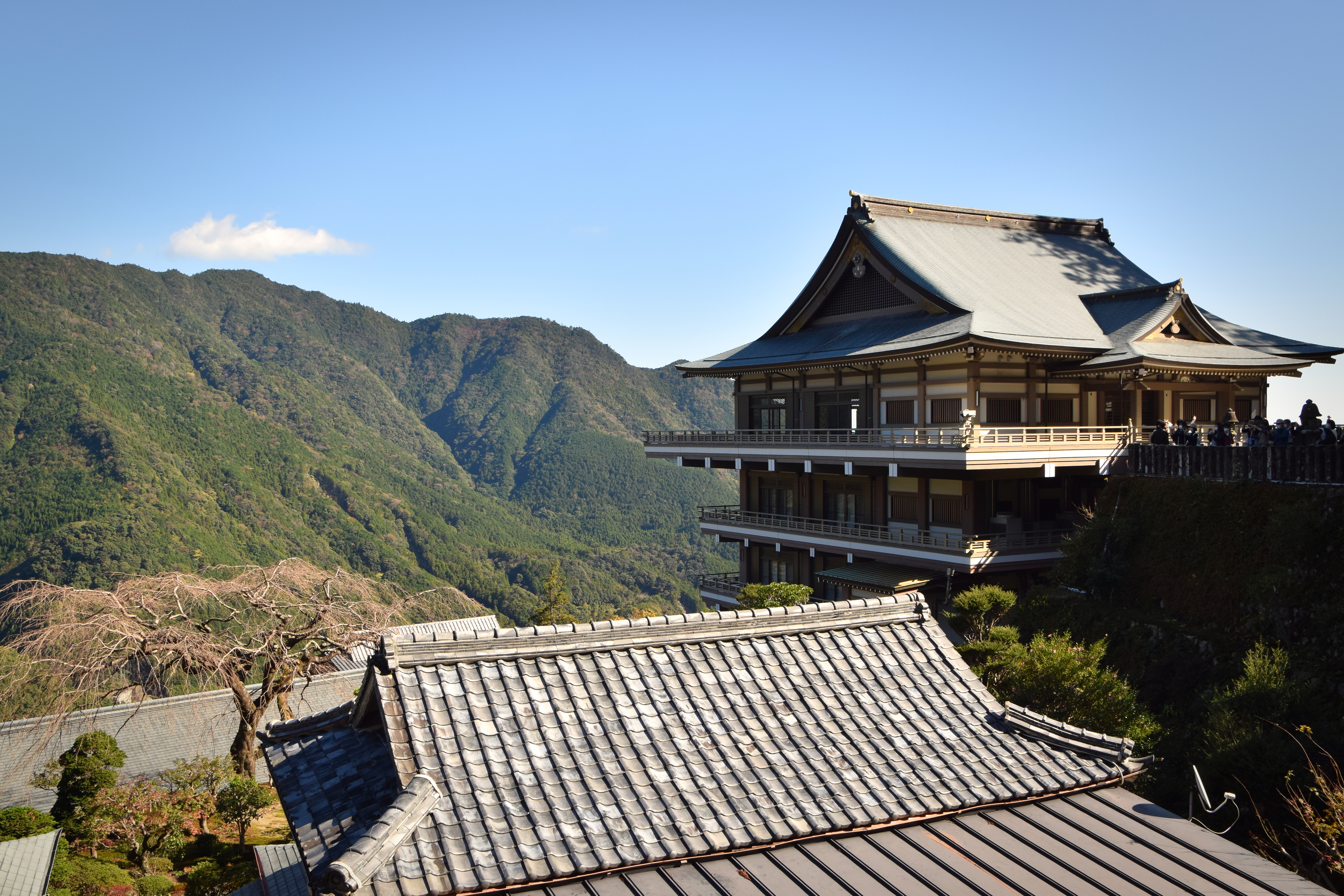
Nachi Falls (Nachi-no-taki), within the Kumano Nachi Taisha component, drops 133 metres in a single unbroken fall — the tallest single-drop waterfall in Japan. The falls are not merely a scenic backdrop: they are considered a kami (Shinto deity) in themselves and are the object of direct worship at the Nachi Fire Festival (Hi Matsuri), held annually on 14 July. During the festival, twelve large portable shrines, each shaped to resemble the waterfall and carrying lit torches, are carried through the precinct by white-robed priests. The image of the three-storey vermilion pagoda of Seiganto-ji with the falls visible behind it is photographed more than almost any other image from the Kii Mountain sites.
The third sacred area, Yoshino-Omine, is associated with the ascetic practice of Shugendo — mountain worship combining Buddhist and Shinto elements, attributed to the legendary holy man En no Gyoja in the late 7th century CE. Mount Yoshinoyama (858m) carries approximately 30,000 cherry trees distributed across four zones at progressively higher altitudes. Each zone blooms roughly one week after the zone below it, extending the flowering season to nearly a month — a property that Shugendo practitioners used as a natural calendar. Women were historically banned from the upper reaches of the Omine range above Yoshino (the Sanjo-gatake peak); this restriction formally remains in place under Shugendo custom, though it has no legal force.
Practical information Koyasan: 2 hr from Osaka; Kumano: 3–4 hr from Osaka by train and bus
Koyasan is reached from Osaka-Namba by Nankai Railway to Gokurakubashi Station (approximately 90 minutes by Nankai Koya Line Limited Express, ¥1,640), followed by a cable car to the plateau (5 minutes, ¥830 round trip). The Nankai-Koyasan World Heritage Ticket (¥3,400) covers the round-trip rail fare, cable car and unlimited bus travel on the plateau for two days. Shukubo (temple lodging) at Koyasan ranges from ¥10,000 to ¥20,000 per person including dinner and breakfast; booking 2–4 weeks ahead is recommended for weekends.
Kumano is significantly more time-consuming to reach. Kumano Hongu Taisha from Osaka requires approximately 3 hours by Kintetsu or JR to Shingu or Kii-Tanabe, then a bus. The Mie Prefecture side of the trail network is accessible from Nagoya by JR Kintetsu via Matsusaka. A dedicated walking itinerary on the Nakaheji trail takes 3–5 days. The Japan Tourism Agency provides official Kumano Kodo hiking guidance with registered accommodation along the route. The dual-stamp programme with the Camino de Santiago — a certificate recognising completion of both routes — is administered by the Tanabe City Kumano Tourism Bureau; walkers who complete the required sections of both trails and collect stamps at designated points qualify for a certificate.
Frequently Asked Questions
What is the Kumano Kodo and how does the dual-pilgrimage programme with the Camino de Santiago work?
The Kumano Kodo is the network of pilgrimage trails connecting the Osaka-Kyoto region to the Kumano Sanzan shrines on the Kii Peninsula. The total UNESCO-registered trail length is 307 kilometres, though the most-walked section — the Nakaheji route — covers approximately 70 kilometres. The trails are maintained mountain paths through cryptomeria and oak forest, crossing passes at 800–1,000 metres altitude; sections near the shrines also pass through small agricultural settlements with guesthouses (minshuku) accepting walkers. The bilateral recognition programme with the Camino de Santiago — formally established in 1998 through a tourism agreement between Tanabe City (Wakayama Prefecture) and the Cathedral Chapter of Santiago de Compostela — is the only programme of its kind in the world: it recognises pilgrims who complete the designated sections of both trails with a “Dual Pilgrim” certificate. To qualify, walkers must complete the traditional Pilgrim credentials stamp system on the Camino (at least 100 km walked to Santiago) and collect the required stamps at designated points on the Kumano Kodo (at minimum the Nakaheji route between Takijiri-oji and Kumano Hongu Taisha, approximately 38 km). The programme is administered by the Tanabe City Kumano Tourism Bureau, which issues the certificate on presentation of both credentials. As of the mid-2020s, tens of thousands of dual certificates have been issued. The pairing reflects a broader recognition that the Kumano Kodo and the Camino are structurally similar as pilgrimage experiences: multi-day walking routes through rural landscapes, with accommodation at regular intervals, converging on a major shrine or cathedral.
Who was Kukai and why is he believed to be still alive at Koyasan?
Kukai (774–835 CE) was a Japanese Buddhist monk who travelled to Tang Dynasty China in 804 CE and spent two years studying esoteric Buddhism under the master Huiguo at the Qinglong Temple in Chang’an (present-day Xi’an). He returned to Japan in 806 CE and established the Shingon school of esoteric Buddhism, which centres on the use of mandalas, mudras (ritual hand gestures), mantras and visualisation practices to attain insight into the nature of reality — a more elaborate and visually rich system than the other major Buddhist schools in Japan at the time. He is also credited, in popular tradition, with devising the hiragana syllabary used to write Japanese (this attribution is disputed by modern linguists, who regard it as a simplification of a more gradual historical process). The belief that Kukai did not die but entered nyujo — a state of eternal deep meditation — rests on Shingon doctrine and on the manner of his death. He entered a state of stillness on 22 April 835 CE, his disciples reported that his body retained warmth and colour for an extended period after his breathing ceased, and the interpretation that he had not died but passed into a meditative state beyond ordinary life and death took hold within the Shingon community. The imperial court awarded him the posthumous title Kobo Daishi in 921 CE. The daily offerings of food and robes to the mausoleum have continued since shortly after 835 CE, making this one of the longest continuous devotional practices in Japan. The phrase “Dogyo ninin” — “two travelling together” — refers to the Shingon pilgrim’s belief that Kobo Daishi walks alongside every pilgrim who undertakes the 88-temple Shikoku pilgrimage circuit, which Kukai is also said to have established.
What is Shugendo and how does it differ from mainstream Japanese Buddhism and Shintoism?
Shugendo is a Japanese religious practice that developed from approximately the 7th century CE through the synthesis of mountain worship, Buddhist esoteric ritual and Shinto animism. Its name means roughly “the way of cultivating power through practice.” Its practitioners (yamabushi — “those who lie down in the mountains”) undertake physically demanding ascetic exercises in mountain environments: cold-water immersion, periods of fasting, fire-walking, and extended mountain traversals in which the progression through the landscape is interpreted as movement through stages of spiritual development. The legendary founder En no Gyoja (En no Ozunu, active late 7th century CE) is a semi-historical figure credited with codifying the practice; his historical existence is attested in several 8th-century sources, though the biographical accounts are heavily embellished. Shugendo was officially suppressed by the Meiji government in 1872 as part of the government’s policy of separating Buddhism and Shintoism (shinbutsu bunri) and distinguishing “pure” Shinto from syncretic practices — Shugendo was too hybrid to survive the separation. It revived after World War II and continues today, with active yamabushi communities at Yoshino-Omine and at other mountain sites including Dewa Sanzan in Yamagata Prefecture and the Haguro range. The particular restriction on women entering the Omine range above Yoshino, which Shugendo practice maintains, has been contested by Japanese women’s rights groups and noted critically by UNESCO. The trail above Sanjozan (the restricted section) forms part of the inscribed UNESCO property, creating an unusual tension between the World Heritage designation and an ongoing religious gender restriction.
Sources
- S1 — UNESCO World Heritage Centre — Sacred Sites and Pilgrimage Routes in the Kii Mountain Range (Ref. 1142) — https://whc.unesco.org/en/list/1142/
- S2 — Wikipedia — Kumano Nachi Taisha — https://en.wikipedia.org/wiki/Kumano_Nachi_Taisha
All addresses were reachable on 20 October 2026.
Spotted an error? Write to editorial@culturalheritageonline.com and we correct it the same day.