
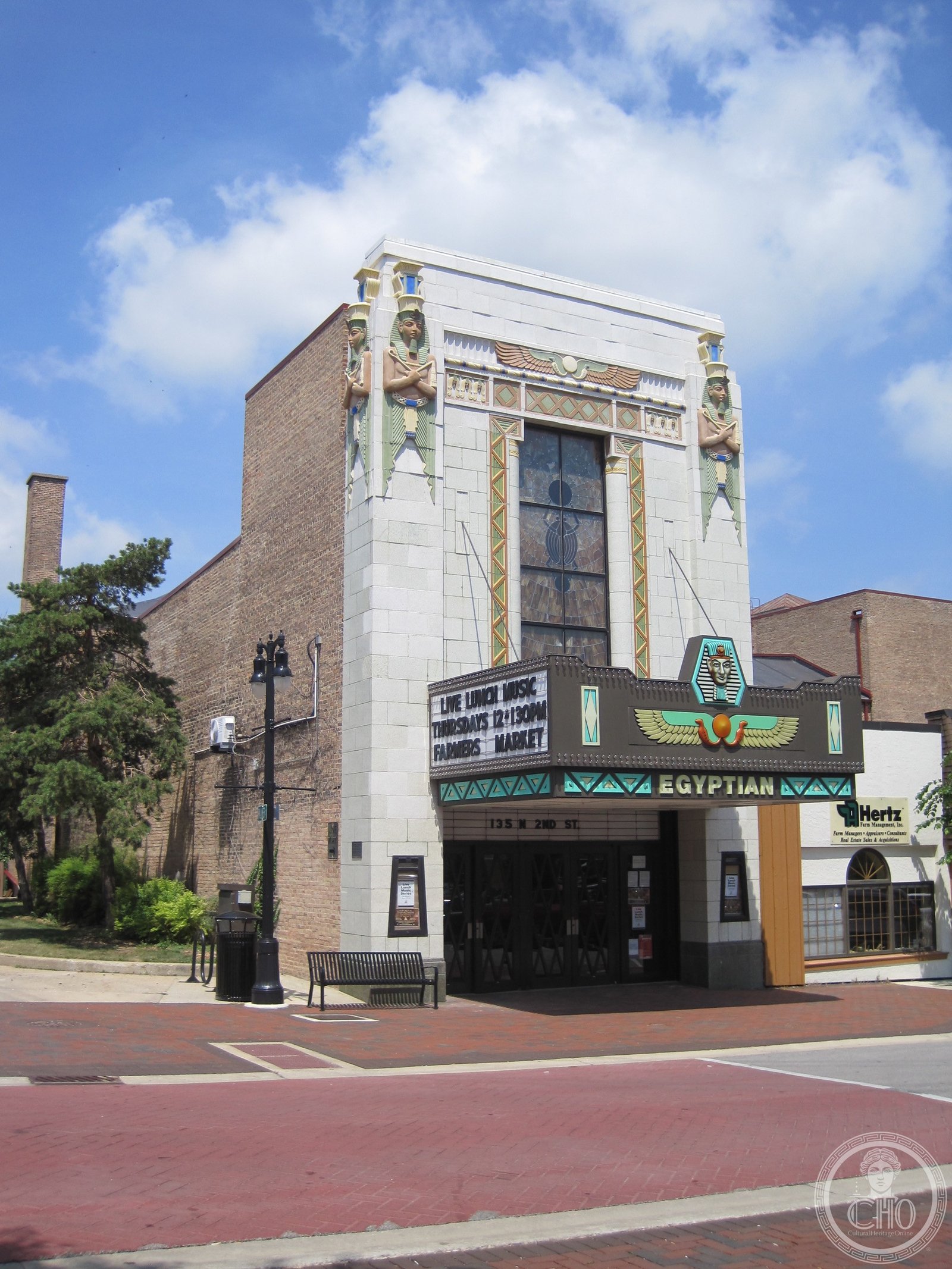
The Egyptian Theatre in DeKalb is one of only a handful of surviving theaters in the United States built in the Egyptian Revival style—the vogue for pharaonic ornament that swept American popular architecture after Howard Carter’s discovery of Tutankhamun’s tomb in 1922—its 1929 facade of winged scarabs, papyrus columns, and hieroglyphic friezes still intact on Second Street.
At a glance
The Egyptian Theatre at 135 N Second Street in DeKalb, Illinois, opened in 1929 as an exotic fantasy in a university town 65 miles west of Chicago. The discovery of Tutankhamun’s tomb by Howard Carter in November 1922 sparked a popular enthusiasm for Egyptian aesthetics—”Tut-mania”—that ran through fashion, furniture, jewelry, and architecture across the 1920s, reaching its most sustained theatrical expression in theaters that adopted the Egyptian Revival vocabulary wholesale. The DeKalb Egyptian is one of the finest surviving examples of this short-lived architectural fashion: the Second Street facade is a dense composition of Egyptian ornamental elements applied with considerable confidence, and the interior continues the theme through the lobby and into the auditorium. Owned by the Egyptian Theatre Organization and restored through community fundraising, the theater operates today as a performing arts center and cinema serving DeKalb and Northern Illinois University.
Key facts
- Address: 135 N 2nd Street, DeKalb, IL 60115
- GPS: 41.9295° N, 88.7514° W
- Built: 1929
- Style: Egyptian Revival
- Capacity: approximately 1,400 seats
- Status: Active cinema and performing arts venue
- NRHP: Listed on National Register of Historic Places
History
Howard Carter and Lord Carnarvon’s November 1922 discovery of Tutankhamun’s tomb in the Valley of the Kings was the major cultural event of that year, generating global press coverage and a sustained fascination with ancient Egypt that ran well into the 1930s. The gold mask of Tutankhamun, the parade of artifacts from the tomb chamber, and the newspaper reports of “curses” and mysterious deaths all contributed to an Egyptian aesthetic that spread through fashion, graphic design, furniture, and architecture. Movie theaters—which already operated in an economy of fantasy and escapism—were particularly susceptible to the Egyptian vogue, and several were built or redecorated in the Egyptian Revival style through the 1920s.
DeKalb in 1929 was a prosperous agricultural and commercial town that had recently become home to Northern Illinois Normal School (now Northern Illinois University). The combination of a stable commercial economy and a growing student population made the investment in a picture palace viable, and the Egyptian Theatre opened at the peak of the Egyptian Revival’s commercial expression—three years after the style’s highwater mark in decorative design but while the style still carried sufficient novelty to attract audiences to a theater that promised them an exotic cultural experience.
The Egyptian ran first-run films through the 1930s, 1940s, and 1950s. The downtown DeKalb commercial corridor declined through the postwar decades as suburban development moved commercial activity away from Second Street. The Egyptian Theatre Organization formed in the 1980s to save the building and has managed it since through restoration campaigns and programming that maintains the theater as the cultural anchor of downtown DeKalb.
What you see
The Second Street facade is the most concentrated display of Egyptian Revival ornament on any surviving Illinois building. The composition deploys the full vocabulary of the style: winged scarab beetles in high-relief plaster above the entrance portal; papyrus-column pilasters on either side of the ticket booth; a cornice carved with a continuous hieroglyphic frieze (decorative rather than philologically accurate); and cast-metal ornamental details at the entrance doors in the Egyptian mode. The facade reads as densely decorated without becoming illegible—the architects organized the elements with enough compositional clarity that the building works as a picture palace entrance rather than as a scholarly recreation of an Egyptian temple.
Inside, the Egyptian theme continues in the lobby: plaster capitals on the pilasters take the form of papyrus and lotus bundles; the walls carry painted Egyptian motifs in ochre, blue, and gold; and decorative frieze elements line the transition between lobby and auditorium. The auditorium itself is less thoroughly Egyptian in character—the main hall reads more as a conventional picture palace with Egyptian surface ornament applied—but the overall effect maintains the themed environment that the facade establishes. The proscenium arch carries Egyptian decorative detail in plaster around its perimeter.
Practical information
- The Egyptian Theatre programs first-run and art-house films, concerts, comedy, and community events; check egyptiantheatre.org for the current schedule.
- The building operates as a working cinema as well as a live event venue—film screenings are a regular part of the programming calendar.
- Accessible entrance on Second Street; ADA seating in the orchestra.
- Street parking on Second Street and the surrounding downtown DeKalb blocks; the NIU campus parking is available on evenings and weekends.
- The Egyptian Theatre is unusual enough as a building type that it rewards even a brief exterior inspection for visitors passing through DeKalb on I-88.
Getting there
The Egyptian Theatre is at 135 N 2nd Street in downtown DeKalb, Illinois, 65 miles west of Chicago via I-88 (Illinois Tollway). From Chicago O’Hare Airport, take I-90 west to I-88 west; total drive time is approximately 75 minutes. DeKalb is served by Northern Illinois University’s Huskie Bus route connecting it to the Elburn Metra station (Union Pacific West Line), providing rail access from Chicago’s Ogilvie Transportation Center in approximately 90 minutes total. The Egyptian Theatre is walkable from the NIU campus and downtown DeKalb’s commercial corridor.
Nearby
- Northern Illinois University (0.5 miles east): the public university’s campus includes the NIU Art Museum at Altgeld Hall and the Anthropology Museum; NIU is the largest employer in DeKalb County.
- Ellwood House Museum (0.5 miles north): the 1879 mansion of barbed wire magnate Isaac Ellwood is a preserved example of Victorian commercial wealth; the DeKalb region became a center of barbed wire production in the 1870s-1880s.
- Shabbona Lake State Park (15 miles northwest): the 1,550-acre park offers fishing, camping, and hiking around the 319-acre reservoir named for Potawatomi chief Shabbona.
- Fermilab National Accelerator Laboratory (30 miles east): the Department of Energy’s particle physics research facility near Batavia includes a visitor center and nature areas open to the public.
Sources
- Egyptian Theatre Organization, egyptiantheatre.org — venue history and restoration documentation
- National Register of Historic Places, “Egyptian Theatre DeKalb” nomination
- Illinois Historic Preservation Agency records
- Cinema Treasures, “Egyptian Theatre, DeKalb” database entry
Find it on the map
See this place and what’s around it →Record researched and written by Luigi De Marchi for Cultural Heritage Online, 2026.
📷 Become a Cultural Heritage Online photographer
Share your photos of places: they stay published under your name as the author. The more they're seen, the more you get noticed — and soon a contest will reward the most appreciated photos.
Log in or sign up free to add a photoIs this page about you?
This page is read by travellers and heritage enthusiasts who find it on Google. Tell us how you are connected to this place and we will take it from there.