
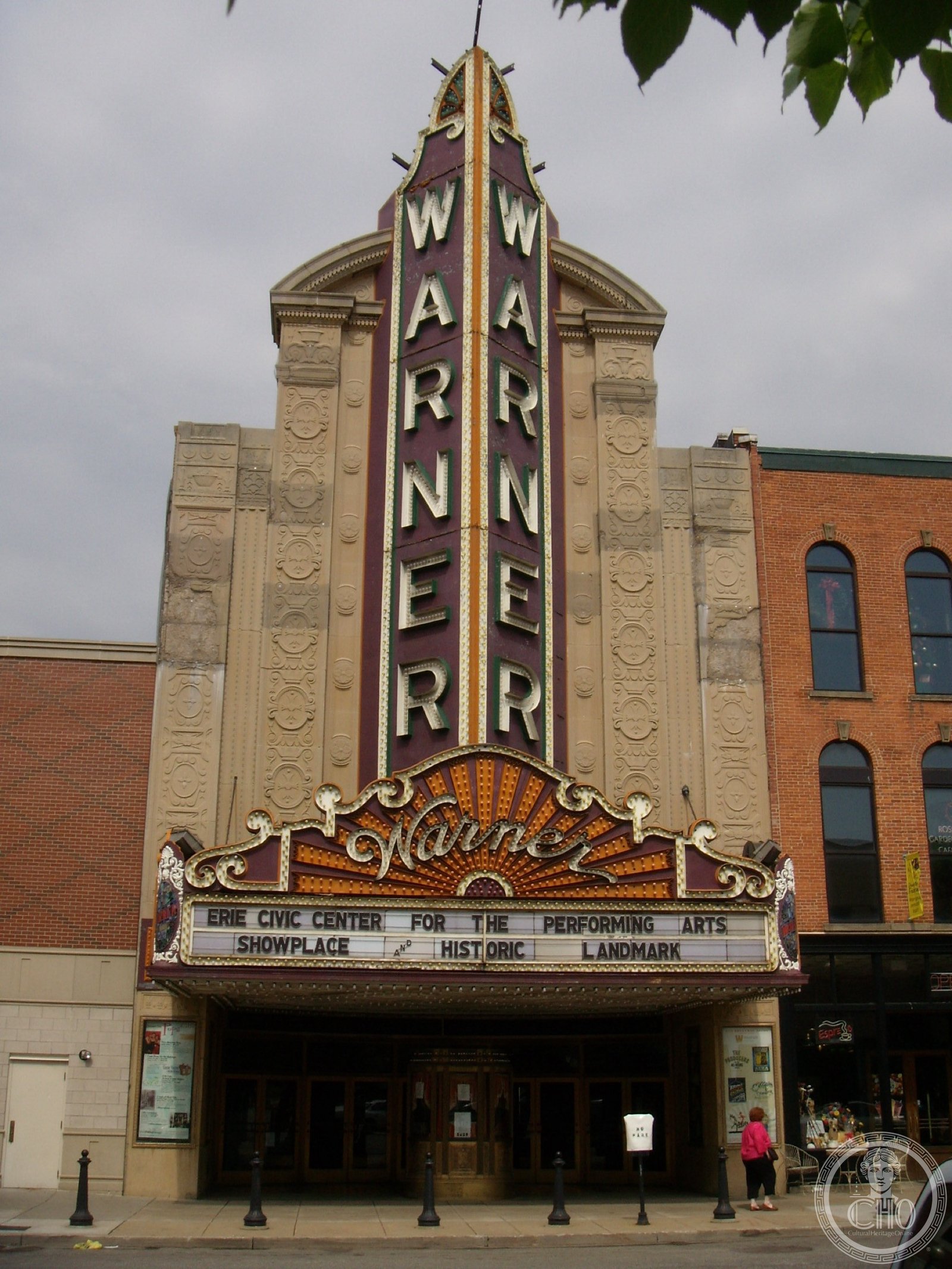
Rapp & Rapp gave Erie one of their most precisely resolved Art Deco interiors in 1931—the Warner Theatre’s State Street facade in buff limestone and the five-story auditorium behind it remain the architectural reference point of northwest Pennsylvania’s performing arts scene.
At a glance
The Warner Theatre opened in Erie in 1931 as the flagship of Warner Bros. Pictures’ Pennsylvania exhibition circuit, designed by Chicago theater architects Rapp & Rapp in a restrained Art Deco vocabulary that suited the Warners’ preference for sophisticated elegance over atmospheric fantasy. The limestone facade on State Street, the vertical neon sign, and the elaborately plastered auditorium interior have all been preserved through the theater’s conversion to a performing arts center in the 1970s and subsequent investments by the Erie Philharmonic and Erie Events. Today it serves as the primary concert hall for the region.
Key facts
- Address: 811 State Street, Erie, PA 16501
- GPS: 42.1272° N, 80.0833° W
- Built: 1931
- Architects: Rapp & Rapp (C.W. & George Rapp)
- Style: Art Deco
- Capacity: approximately 2,400 seats
- Status: Active performing arts center (Erie Philharmonic home venue)
- NRHP: Listed on National Register of Historic Places
History
Erie’s position on Lake Erie made it a natural stopping point on the transit corridor between Cleveland and Buffalo, and its population of around 115,000 in 1930 supported a downtown entertainment district along State Street substantial enough to attract Warner Bros.’ attention. The studio’s exhibition subsidiary commissioned Rapp & Rapp—the same Chicago firm behind the Paramount Theatre in New York and Chicago and numerous other circuit houses—to design a theater that would convey the Warners’ brand identity through architecture as much as programming.
Rapp & Rapp’s design for Erie chose restraint over spectacle. The buff limestone facade, the shallow-relief Art Deco ornament at the cornice, and the vertically-organized entrance bay communicate solidity and ambition without the baroque excess of the atmospheric theaters competing in the same market. The auditorium interior—gilt plaster, stepped cornice moldings, and an elaborately framed proscenium—carries the same register of controlled elegance. The theater opened in 1931 to serve as a first-run Warner Bros. circuit house and ran continuous programming through the sound era.
The postwar decades brought the familiar pressures on downtown movie houses. The Warner closed as a cinema in the 1970s and was acquired by the Erie Philharmonic, which converted it to a concert hall configuration while preserving the essential fabric of Rapp & Rapp’s design. The Erie Events organization subsequently took over management and has maintained the building as the primary performing arts venue for northwest Pennsylvania. The Erie Philharmonic’s subscription season, visiting Broadway productions, and major concert tours pass through the Warner’s stage calendar each season.
What you see
The State Street facade presents a five-bay composition in buff limestone with Art Deco ornamental bands at the second and cornice levels. The center bay carries the Warner’s vertical neon sign—one of the most photogenic elements of Erie’s downtown streetscape—and the stepped entrance portal in dark stone. The outer bays carry shallow-relief abstract ornament derived from the Zigzag Moderne vocabulary that Rapp & Rapp adapted consistently across their circuit work of this period.
The auditorium is the building’s most significant interior in terms of preserved fabric. Five tiers rise from orchestra to upper balcony, each framed by paired pilasters in gilt plaster. The proscenium arch carries a full program of Art Deco ornamental plasterwork—sunbursts, chevrons, and stepped profile elements—in cream and gold. The ceiling coffers carry painted medallions. The acoustics, shaped by the same geometry that Rapp & Rapp refined across their theater career, are excellent for orchestral programming—the Erie Philharmonic’s choice of the Warner as its permanent home reflects architectural as much as logistical judgment.
Practical information
- The Warner Theatre hosts the Erie Philharmonic, Broadway touring productions, and major concert acts; check the Erie Events calendar for programming.
- Guided tours are available on select dates; contact the venue for current tour availability.
- Fully accessible; ADA seating at orchestra level with companion seats.
- Street parking on State Street; parking garages within two blocks on French Street and 8th Street.
- Allow time before the performance to study the lobby plasterwork and the State Street facade at street level.
Getting there
The Warner Theatre is at 811 State Street in downtown Erie, at the corner of State Street and 9th Street. Erie is served by Amtrak’s Lake Shore Limited (Chicago–New York route) at the Erie station on 14th Street, ten blocks north. By car, Erie is 100 miles northeast of Pittsburgh via I-79, 90 miles southwest of Buffalo via I-90. Erie International Airport (ERI) receives regional jet service with connections to hub airports.
Nearby
- Erie Art Museum (2 blocks north): the regional art museum at 411 State Street occupies an 1839 Greek Revival bank building with a modern addition; strong collection of American art.
- Presque Isle State Park (3 miles west): the peninsula extending into Lake Erie offers the city’s primary natural landscape—beaches, birding, and lake views—within city limits.
- Erie Maritime Museum (1 mile north): the museum at the bayfront documents the Battle of Lake Erie (1813) and houses the reconstructed brig Niagara, Oliver Hazard Perry’s flagship.
- Millcreek Mall (4 miles west): suburban commercial hub for context on the forces that competed with downtown Erie’s entertainment corridor from the 1970s onward.
Sources
- Erie Events, warnertheatre.org — venue history and programming
- National Register of Historic Places, “Warner Theatre Erie” nomination
- Erie Philharmonic historical records
- Cinema Treasures, “Warner Theatre, Erie” database entry
Find it on the map
See this place and what’s around it →Record researched and written by Luigi De Marchi for Cultural Heritage Online, 2026.
📷 Become a Cultural Heritage Online photographer
Share your photos of places: they stay published under your name as the author. The more they're seen, the more you get noticed — and soon a contest will reward the most appreciated photos.
Log in or sign up free to add a photoIs this page about you?
This page is read by travellers and heritage enthusiasts who find it on Google. Tell us how you are connected to this place and we will take it from there.