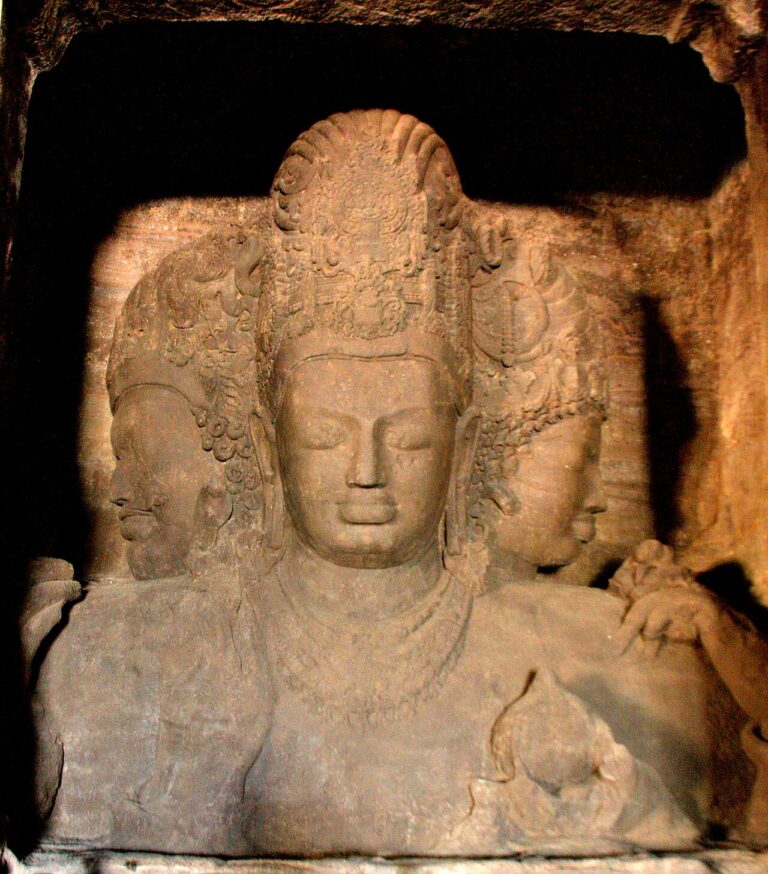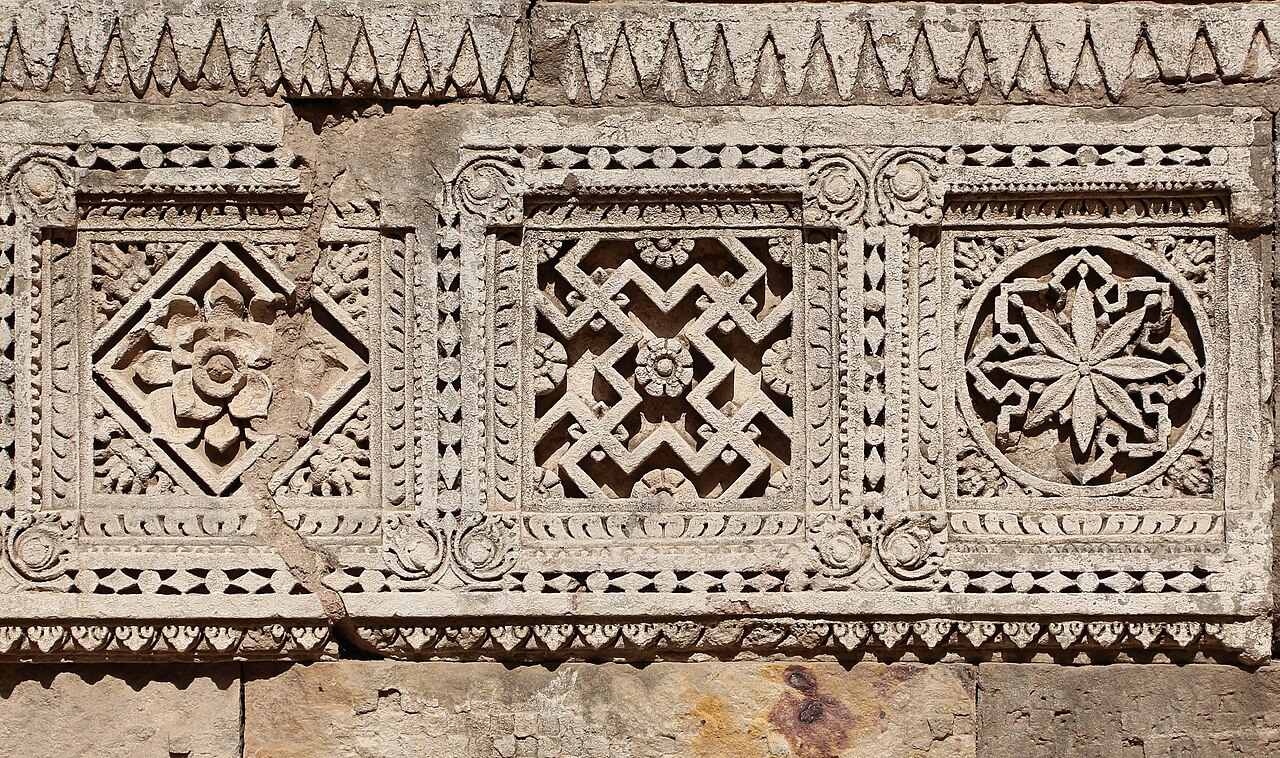
Rani ki Vav, built around 1063 CE in Patan, Gujarat, is a stepwell 64 metres long, 20 metres wide, and 28 metres deep, with seven storeys of carved galleries descending to the water level. Queen Udayamati built it as a memorial to her dead husband, King Bhimdev I of the Solanki dynasty. River floods buried it under sediment for roughly seven centuries, which preserved its 500 major sculptures and 1,000 minor carvings so completely that UNESCO listed it as a World Heritage Site in 2014.
An inverted temple: the architecture of water as sacred space Patan, North Gujarat, India
A vav is a stepped well — a structure that provides access to groundwater through a descending staircase that reaches the water table, with galleries, pavilions, and ornamented walls lining the descent. The technology is ancient and practical: in Gujarat’s semi-arid climate, groundwater levels fluctuate seasonally and fall well below the surface for most of the year. A simple open well requires a rope and bucket; a stepped well allows a person to walk down to the water’s level, making it usable for washing, drawing large quantities for irrigation, and for ritual bathing. Gujarat has hundreds of historic stepwells, from the simple to the elaborate, but Rani ki Vav is in a category of its own.
The Solanki (Chaulukya) dynasty built in the Maru-Gurjara style — a regional variant of North Indian temple architecture characterised by dense surface carving, curved shikhara spires, and an integration of erotic and devotional imagery that was standard in 11th-century Gujarat. What makes Rani ki Vav conceptually distinctive is that its designers applied the full grammar of temple architecture to a functional water structure, inverting the temple’s relationship to the ground: where a temple rises from its platform, the stepwell descends into the earth, and the “sanctum” — the water itself — is at the bottom. Water in Hindu cosmology is not merely a practical resource; it is ritually purifying, associated with specific deities, and the site of important lifecycle ceremonies. Building a full-scale temple complex around a water source was therefore theologically coherent, not merely decorative excess.
The seven storeys descend in sequence from the entrance at ground level to the circular well shaft at the bottom. Each level has a slightly different character: the upper levels are broader, with more open galleries and wider staircases; the lower levels are narrower and darker, with the carved walls pressing closer to the central stair. At each landing, ornamented niches hold sculpted figures. The iconographic programme is dominated by Vishnu — specifically the ten Avatars of Vishnu (Dashavatar), each depicted in multiple panels — but also includes apsaras (celestial dancers), women in various poses drawn from the Naayika tradition of classical Indian art, and nagakanyas (serpent women). The total sculptural inventory runs to approximately 500 principal figures and more than 1,000 decorative carvings.
The Queen’s identity is established by inscription. Udayamati was the wife of Bhimdev I, who ruled the Solanki kingdom of Anhilwara (the ancient name for Patan) from approximately 1022 to 1064 CE. She built the stepwell after his death as both a practical water infrastructure project and a memorial — a votive structure connecting the king’s memory to the sacred function of water. The Solanki dynasty at its peak controlled most of Gujarat and parts of Rajasthan and Malwa; Anhilwara was one of the major cities of medieval India, and the stepwell’s scale reflects that prosperity.
Seven centuries underground, the ₹100 banknote, and what else survives nearby 140 km from Champaner-Pavagadh, 25 km from Modhera
The Saraswati River, which flows past Patan, flooded repeatedly in the centuries after the Solanki dynasty’s decline, and silt progressively buried the stepwell from the top down. By the medieval period, Rani ki Vav was effectively invisible at ground level — locals knew something was there, but the full extent was unknown. British officials noted the site in the 19th century, but systematic excavation only began in the 1940s under the Archaeological Survey of India, and the major campaign that revealed the structure as it now stands ran from the 1980s onward.
The river sediment proved to be the stepwell’s preservation mechanism. Where above-ground temple sculptures in Gujarat were subject to centuries of weathering, iconoclasm, and stone quarrying for later construction, the buried galleries of Rani ki Vav were protected by the mud that covered them. When excavated, the carvings emerged with surface detail intact — the faces of the Vishnu panels, the jewellery details on the apsara figures, and the lotus-petal mouldings on the column shafts were sharp enough that they might have been carved a generation rather than a millennium earlier. The state of preservation is genuinely exceptional by the standards of Indian medieval sculpture.
India’s Reserve Bank of India put Rani ki Vav on the reverse of the ₹100 banknote in 2018, following the site’s UNESCO listing in 2014. The banknote image shows the stepwell from a slightly elevated angle, capturing the descending galleries in perspective — the same view that most visitors photograph from the entrance platform. The choice of a stepwell for a major denomination banknote was deliberate: it recognised both the site’s cultural significance and the broader importance of water conservation infrastructure in Indian history, a resonance that carries particular force in a country where water scarcity is a chronic policy concern.
The Modhera Sun Temple, 25 km from Patan, was built by Bhimdev I himself — Udayamati’s husband — making it a direct Solanki contemporary of Rani ki Vav built by the same dynasty within the same decade. The temple is dedicated to Surya (the sun deity) and is designed so that at the equinoxes the rising sun illuminates the central shrine directly. It is not a UNESCO World Heritage Site but is one of the finest surviving examples of Maru-Gurjara architecture in India and is maintained by the Archaeological Survey. The Navaratri festival is celebrated at Modhera with classical dance performances in the temple’s tank; the juxtaposition of the tank (kund) at Modhera with the fully developed stepwell at Patan illustrates the Solanki dynasty’s sustained interest in water architecture as sacred and civic infrastructure.
Champaner-Pavagadh (UNESCO 2004) lies 140 km south of Patan, reachable in about two and a half hours by road via Ahmedabad. Champaner was the capital of the Gujarat Sultanate under Sultan Mahmud Begada, who conquered it in 1484 CE and renamed the city Muhammadabad. The UNESCO property encompasses 11 mosques and several stepwells within the Sultanate city, as well as the Hindu and Jain temples on Pavagadh hill above the city — a combination that, like Bagerhat in Bangladesh, documents the Islamic architectural traditions that succeeded the Hindu dynasties of earlier centuries. The Jami Masjid at Champaner, with its two minarets and carved stone screens, is widely cited as one of the finest pre-Mughal mosques in India.
Dholavira (UNESCO 2021) is the most distant but architecturally revelatory comparison: a 310-km drive southwest, primarily across the Rann of Kutch. Dholavira is an Indus Valley Civilization city occupied roughly from 2650 to 2100 BCE, with a water management system — reservoirs, channels, and check dams — that demonstrates that the tradition of elaborate water infrastructure in Gujarat is not medieval or even ancient-historical in origin but prehistoric. The Indus Valley engineers who built Dholavira’s 16 reservoirs were solving the same problem as Solanki-era builders: how to store and access water in a semi-arid landscape with highly variable rainfall.
Practical information
Patan is located in North Gujarat, approximately 125 km north of Ahmedabad. The most practical access is by road from Ahmedabad: state buses run from Geeta Mandir bus terminal in Ahmedabad to Patan in about 2.5 hours; private taxis cover the same distance in roughly 2 hours. There is no direct rail service between Ahmedabad and Patan on a convenient schedule; most visitors travel by road. Ahmedabad has full international and domestic airport connectivity (Sardar Vallabhbhai Patel International Airport).
Rani ki Vav is managed by the Archaeological Survey of India. The site is open daily except Fridays, 08:00–18:00. Admission fees are charged; foreign nationals pay a higher rate than Indian nationals, as is standard at ASI-managed sites. Photography is permitted throughout the stepwell. The site has a basic interpretive display at the entrance; a site museum is planned but as of 2024 has not opened.
The town of Patan has limited tourist accommodation; Mehsana, 37 km south, has a broader range of hotels and serves as the practical base for visitors combining Rani ki Vav with Modhera. Ahmedabad, with its own UNESCO World Heritage City designation (listed 2017 for its historic walled city), is the recommended base for a multi-day Gujarat itinerary covering Rani ki Vav, Modhera, Champaner-Pavagadh, and Dholavira. The ideal season is October to March (cool and dry, 15–28°C); April–June is very hot (up to 42°C), and the July–September monsoon brings rain but also crowds as the stepwell fills with water, creating the closest approximation to its original functional appearance.
Frequently Asked Questions
Why was a stepwell considered a suitable memorial for a deceased king?
In the religious and political culture of 11th-century Gujarat, water infrastructure carried an explicit devotional charge. Providing water was an act of dharmic merit — one of the highest forms of charity recognised in Hindu social ethics — and a ruler’s or queen’s generosity in building a tank, well, or irrigation system was commemorated in inscriptions alongside military victories and religious endowments. The vav (stepwell) as a form was already developed well before the Solanki period: inscriptions in Gujarat document stepwells built as acts of merit by kings and merchants from the 3rd century CE onward. By the 11th century, the tradition had evolved to the point where a stepwell of sufficient scale was a legitimate vehicle for the full iconographic programme of a major temple — not a lesser alternative to building a shrine but an equivalent act of merit connected to a specific sacred substance. For Queen Udayamati, building Rani ki Vav served multiple functions simultaneously: it created lasting water access for the population of Anhilwara, it expressed the Solanki dynasty’s power and taste through the quality of its sculptural programme, it memorialised Bhimdev I’s reign in a form as permanent as any above-ground monument, and it generated ongoing religious merit for the queen and her husband through its continued use in ritual contexts. The fact that it was both functional and sacred was not a paradox but the point.
How do the sculptures at Rani ki Vav compare to other Solanki-dynasty sites?
The Solanki (Chaulukya) dynasty’s court workshops produced some of the finest stone carving in medieval India, and several major monuments survive to allow comparison. The Modhera Sun Temple (built by Bhimdev I, the same king commemorated at Rani ki Vav) and the Dilwara temples at Mount Abu in Rajasthan (built by Solanki-era Jain merchants in the same period) represent the same tradition working in different materials and formats. The Dilwara temples are in white marble and are widely regarded as the most technically accomplished expression of the tradition; Rani ki Vav is in sandstone. What distinguishes Rani ki Vav sculpturally is the number of figures — 500 principal sculptures on a single structure is extraordinary — and the consistent quality maintained across all seven storeys, suggesting a well-organised workshop operating over an extended campaign of work. The iconographic emphasis on Vishnu’s Avatars is particularly detailed: each Avatar receives multiple panels showing different episodes from the Puranic narratives, making Rani ki Vav one of the most comprehensive visual representations of Vaishnava mythology in stone anywhere in India. The condition of the sculptures, preserved by river sediment, allows assessment of detail that is simply not possible at above-ground sites that have weathered for the same period.
What is the relationship between Rani ki Vav and the ancient city of Patan?
Patan was known in medieval sources as Anhilwara or Anhilpur Patan, and it served as the capital of the Solanki kingdom from its founding by Vanraj Chavda in 746 CE through the Solanki period and into the 13th century, when the dynasty declined under pressure from the Vaghela rulers and eventually the Delhi Sultanate. At its height, Anhilwara was one of the largest cities in the Indian subcontinent — medieval Arab and Persian travellers described it as a major commercial and political centre, and estimates of its population at its 11th-century peak run to several hundred thousand. The city was sacked by Alauddin Khalji in 1299 CE and never recovered its former significance. Modern Patan is a small town of roughly 100,000 people, and most of the medieval city lies buried beneath it or has been built over. Rani ki Vav and the Sahasralinga Talav — an enormous artificial lake created by Solanki king Siddharaja Jayasimha in the early 12th century, now dry and partially excavated — are the two most visible physical remnants of Anhilwara’s medieval grandeur. The stepwell’s UNESCO listing has brought new scholarly and tourist attention to Patan, which also preserves the Patola silk weaving tradition (a double ikat technique requiring approximately 2–3 months to produce a single sari) that has been practised in the city since the Solanki period.