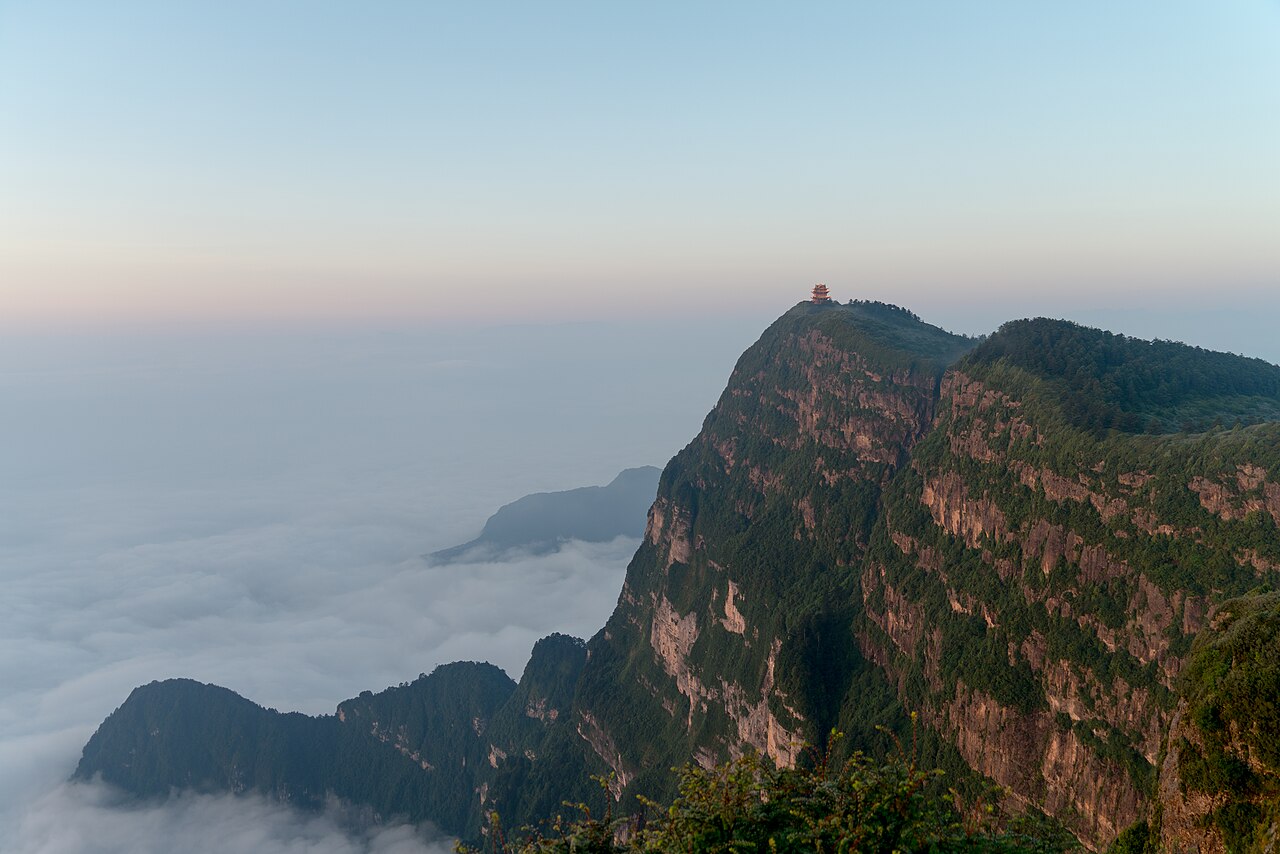
Mount Emei (Emei Shan) and the Leshan Giant Buddha, located in Leshan prefecture, Sichuan province, received joint UNESCO World Heritage designation in 1996 under both natural and cultural criteria. At 3,099 metres, Emei is the highest of China’s four sacred Buddhist mountains; the summit plateau holds the Wannian Temple complex and the Golden Summit (Jinding) where the Brocken spectre — a circular rainbow halo projected by sunlight onto cloud — appears at dawn. Thirty kilometres east at the confluence of three rivers, the Leshan Giant Buddha, carved between 713 and 803 CE, stands 71 metres tall and remains the largest stone Buddha in the world. One hundred kilometres northwest, the Sichuan Giant Panda Sanctuaries — a separate UNESCO site — extend the heritage geography of the Chengdu basin.
Mount Emei: The Sacred Peak of Samantabhadra and the Pilgrimage to the Golden Summit Leshan Prefecture, Sichuan Province
Mount Emei is one of the four sacred mountains of Chinese Buddhism, each associated with a particular Bodhisattva whose earthly residence the mountain is considered to be. Emei is the sacred abode of Samantabhadra (Puxian Pusa), the Bodhisattva of Practice and Vows, typically depicted riding a white elephant. Buddhist texts identify Emei as his domain from at least the 1st century CE, and monastery construction on the mountain began under the Eastern Jin dynasty (317–420 CE). Over 30 Buddhist temples and monasteries survive on the mountain in various degrees of preservation and active use; the oldest foundation identified by tradition is the Xixiang Chi (Elephant Bathing Pool) temple, placed by records in the 4th century, though the current buildings on all sites are predominantly Ming and Qing constructions.
The full pilgrim route from the base at Baoguo Temple to the Golden Summit at 3,077 metres (the cable-car terminus and summit complex, distinct from the true biological summit of 3,099 metres) covers approximately 50 kilometres on foot through subtropical and montane forest. The elevation gain, passing through five distinct vegetation zones, produces the biological diversity cited in the UNESCO inscription: the mountain’s forests contain over 3,000 plant species including rare conifers, rhododendrons in bloom from April through June, and dozens of endemic species whose ranges are confined to the Emei ecological zone. Tibetan macaques (Macaca thibetana) inhabit the middle-altitude sections of the mountain between 1,000 and 2,500 metres. These large primates — substantially heavier than the rhesus macaques more commonly seen at other Chinese sites — are habituated to human presence along the pilgrim trails and are known to solicit food from walkers, occasionally taking it by force. Food storage precautions are posted at trailheads.
The summit offers one of the mountain’s most documented atmospheric phenomena. When cloud layers fill the valleys below the summit in the morning and sunlight strikes from behind the observer, the shadow projected onto the cloud top is surrounded by a circular halo of refracted light — a Brocken spectre, the same optical effect known from the Brocken peak in Germany’s Harz mountains and from alpine summits worldwide. On Emei, this phenomenon has been called “Buddha’s Glory” (Fo Guang) since the Tang dynasty. Historically, pilgrims who witnessed it interpreted the appearance of their own shadow at the circle’s centre as a direct manifestation of Samantabhadra. The spectre is most likely to appear on clear mornings after foggy nights, most frequently in summer. The summit complex is equipped with overnight accommodation to allow pilgrims to position themselves for dawn observation.
The Leshan Giant Buddha: 71 Metres of Tang Dynasty Engineering and the Monk Who Gouged His Eyes Leshan City, Sichuan Province
At the confluence of the Min, Dadu, and Qingyi rivers in Leshan, 30 kilometres east of Mount Emei, a cliff face of red conglomerate rock was carved between 713 and 803 CE into a seated Buddha figure 71 metres in height. The Leshan Giant Buddha (Dafo) depicts Maitreya — the future Buddha — in the posture of seated meditation, with hands resting on knees and feet planted on the valley floor at river level. Measured by height, it is the largest stone Buddha statue in the world; it predates and exceeds in scale the Bamiyan Buddhas of Afghanistan (destroyed 2001) that it broadly resembles in concept. The ears alone are 7 metres long; the head is 14.7 metres from crown to chin; the shoulders are 28 metres wide.
The project was initiated by a Buddhist monk named Haitong, who believed the statue’s presence at the dangerous river confluence would calm the currents that regularly capsized boats carrying goods and pilgrims. Haitong raised funds from donors across the region for decades. When local officials attempted to extort the construction funds, Haitong, according to Tang dynasty chronicles, gouged out his own eyes and presented them to the officials on a plate as proof of his sincerity and his willingness to destroy himself before surrendering the temple’s resources. The officials retreated. Haitong died before the project’s completion. The work was continued under two successive governors with imperial backing and finished in 803 CE, ninety years after it began. Whether the statue actually calmed the currents is a matter the Tang historical record is ambiguous about; the removal of vast quantities of rock from the cliff during the carving process certainly altered the river bottom topography at the confluence, and records suggest the most dangerous eddies did diminish.
The completed statue incorporated a drainage engineering system that has received growing scholarly attention: over 1,000 drainage outlets — hidden gutters, channels, and vents — were carved into the statue’s hair, robes, and base to move water off the stone surface and prevent the accumulation of moisture that would accelerate weathering. The system is largely invisible at normal viewing distances and was identified and mapped in detail only in modern archaeological surveys. Despite this system, the statue’s face and upper body have experienced significant surface erosion in the modern period, partly attributed to acid rain from Sichuan’s industrialisation. Conservation work has been ongoing since the 1990s, with a major cleaning and stabilisation campaign completed in 2019.
One hundred kilometres northwest of Leshan, the Sichuan Giant Panda Sanctuaries — inscribed as UNESCO World Heritage in 2006 — cover a network of nature reserves and scenic areas protecting the last significant wild population of giant pandas and red pandas in the Qionglai and Jiajin mountain ranges. The Chengdu Research Base of Giant Panda Breeding, while not itself a UNESCO-inscribed site, is a short distance from Chengdu city and is the most accessible facility for viewing captive-bred pandas. A multi-day Sichuan itinerary combining Emei Shan, the Leshan Giant Buddha, and the panda sanctuary areas covers three distinct UNESCO inscriptions within a roughly 200-kilometre radius of Chengdu.
Practical information
The practical base for visiting both sites is Leshan City or Chengdu, connected by high-speed rail in approximately 35 minutes (Chengdu to Emei station) or 50 minutes (Chengdu to Leshan station). Chengdu Tianfu International Airport and Chengdu Shuangliu International Airport both serve major Chinese cities and select international routes. Mount Emei is 8 kilometres from Emei rail station by taxi or bus to the Baoguo Temple entrance. The full foot ascent to the summit takes 2 to 3 days, with accommodation at Hongchunping, Xixiangchi, and the summit-level hotels. A cable car from Leidongping to the Golden Summit reduces the ascent to a half-day from the mid-mountain area, reachable by bus from the base. The Leshan Giant Buddha is most impressively viewed from a boat on the river, with ferries departing from the Binjiang Road dock in Leshan; land-level viewing from the cliff staircase alongside the statue allows closer inspection but loses the full-scale perspective. Entry to the Buddha site includes the cliff staircase and the Lingyun Temple above. The Sichuan Giant Panda Sanctuaries’ primary accessible point is the Bifengxia Base near Ya’an (approximately 110 km from Chengdu by road) or the Wolong National Nature Reserve (approximately 130 km northwest of Chengdu). Peak visitor periods for Emei are the Golden Week holidays in May and October; pre-booked summit accommodation is essential in those periods.
Frequently Asked Questions
How was the Leshan Giant Buddha carved and how did the drainage system work?
The Leshan Giant Buddha was carved from a cliff of red conglomerate sandstone at the confluence of the Min, Dadu, and Qingyi rivers, beginning in 713 CE under the Tang dynasty. The carving was initiated by the monk Haitong and completed — after his death — under two successive Tang governors with imperial backing, finishing in 803 CE after a construction period of 90 years. The technique was direct rock removal: teams of craftsmen cut away the cliff material to reveal the form of the seated Buddha within the natural rock mass, working from the top of the head downward. The removed material — hundreds of thousands of cubic metres of rock — was reportedly used to help fill the river bottom at the confluence and reduce the worst of the eddies, though the historical sources describing this are ambiguous. The statue was originally sheltered by a wooden structure (the Dafo Lou, Great Buddha Pavilion) that enclosed the carved figure; this building was destroyed, probably by fire, and no longer exists. The drainage engineering built into the statue is one of its less-discussed features. More than 1,000 individual drainage elements — channels cut into the hair coils on the head, gutters along the robe folds, vent shafts through the body — were incorporated during or shortly after the carving to route surface water away from the stone and prevent standing moisture. These outlets were designed to be invisible from viewing distance and were identified in their full extent only by modern archaeological investigation. Their effectiveness over 1,200 years is demonstrated by the relative stability of the statue’s core structure, despite surface erosion. A major conservation campaign in 2018–2019 cleaned fungal growth and repaired deteriorated mortar fills in fracture lines on the face and chest.
What is the Brocken spectre (Buddha’s Glory) and when is it visible at Mount Emei’s summit?
The Brocken spectre is an atmospheric optical phenomenon in which an observer standing at elevation casts a shadow onto a layer of cloud or fog below, and this shadow is encircled by a circular halo of coloured light produced by the diffraction and reflection of sunlight through water droplets in the cloud layer. The effect requires specific geometry: the sun must be behind the observer, the cloud layer must be below the observer, and the viewing angle between sun, observer, and cloud must fall within the range where diffraction produces the circular rainbow band. The shadow of the observer appears at the precise centre of the halo. The name derives from the Brocken peak in Germany’s Harz mountains, where the phenomenon was described by European natural philosophers in the 18th century, but the same effect occurs at any sufficiently elevated vantage point when the conditions are met. On Mount Emei, the phenomenon has been documented and named since the Tang dynasty (618–907 CE), when it was described in Buddhist travel accounts and called Fo Guang (Buddha’s Glory) or Guanghuan (Light Ring). Pilgrim literature from the Tang, Song, and Ming periods describes it as a sacred manifestation of Samantabhadra, with the observer’s own shadow interpreted as the self appearing within the Bodhisattva’s aura. The summit of Emei at 3,077 to 3,099 metres is frequently above cloud layers, particularly in the summer months (June through August), when moisture from the Sichuan basin produces persistent low cloud. The phenomenon is most likely on clear mornings following misty nights. Summit observation platforms face east to maximise the probability of viewing conditions at dawn. Accommodation at the summit complex — several hotels operate at or near the Golden Summit — allows overnight positioning for early morning observation.
Who was Haitong and why is the story of his self-mutilation historically significant?
Haitong was a Buddhist monk from Lingyin (some sources give his origin as Guizhou province) who is credited in Tang dynasty historical records as the initiator of the Leshan Giant Buddha project. His motivation, as recorded, was practical: the confluence of the Min, Dadu, and Qingyi rivers at Leshan was one of the most dangerous stretches of the Sichuan river transport network, with powerful eddies and unpredictable currents that regularly sank vessels. Haitong believed that a large sculptural representation of Maitreya (the future Buddha) at the confluence would pacify the waters through the Buddha’s spiritual presence, reducing the loss of boats, goods, and lives. He spent decades soliciting donations across the region. The incident of self-mutilation — gouging out his own eyes and presenting them to officials who attempted to extort the construction funds — is recorded in the Jiu Tang Shu (Old Book of Tang) and the Tang Huiyao, official Tang dynasty historical compilations, as well as in local Leshan county records. It is one of the more graphically documented acts of religious self-sacrifice in Tang Buddhist history, a tradition in which bodily self-offering (sheshen) was understood as the highest demonstration of commitment to the Buddha-dharma. The officials who had demanded payment withdrew. Haitong continued fundraising until his death, which occurred before the project was complete. Construction was continued under the Tang governors Wei Gao and Zhangchou Jianqiong under imperial mandate and finished in 803 CE. Whether the carved statue actually reduced river casualties is not established by evidence; Tang river records for the period are incomplete, and the alteration of the confluence’s hydrodynamics by the removal of massive quantities of rock during carving may have had as much practical effect as any spiritual one. The historical significance of the story lies partly in what it reveals about how 8th-century Tang Buddhist communities understood the relationship between sacred space, sacrifice, and natural forces.