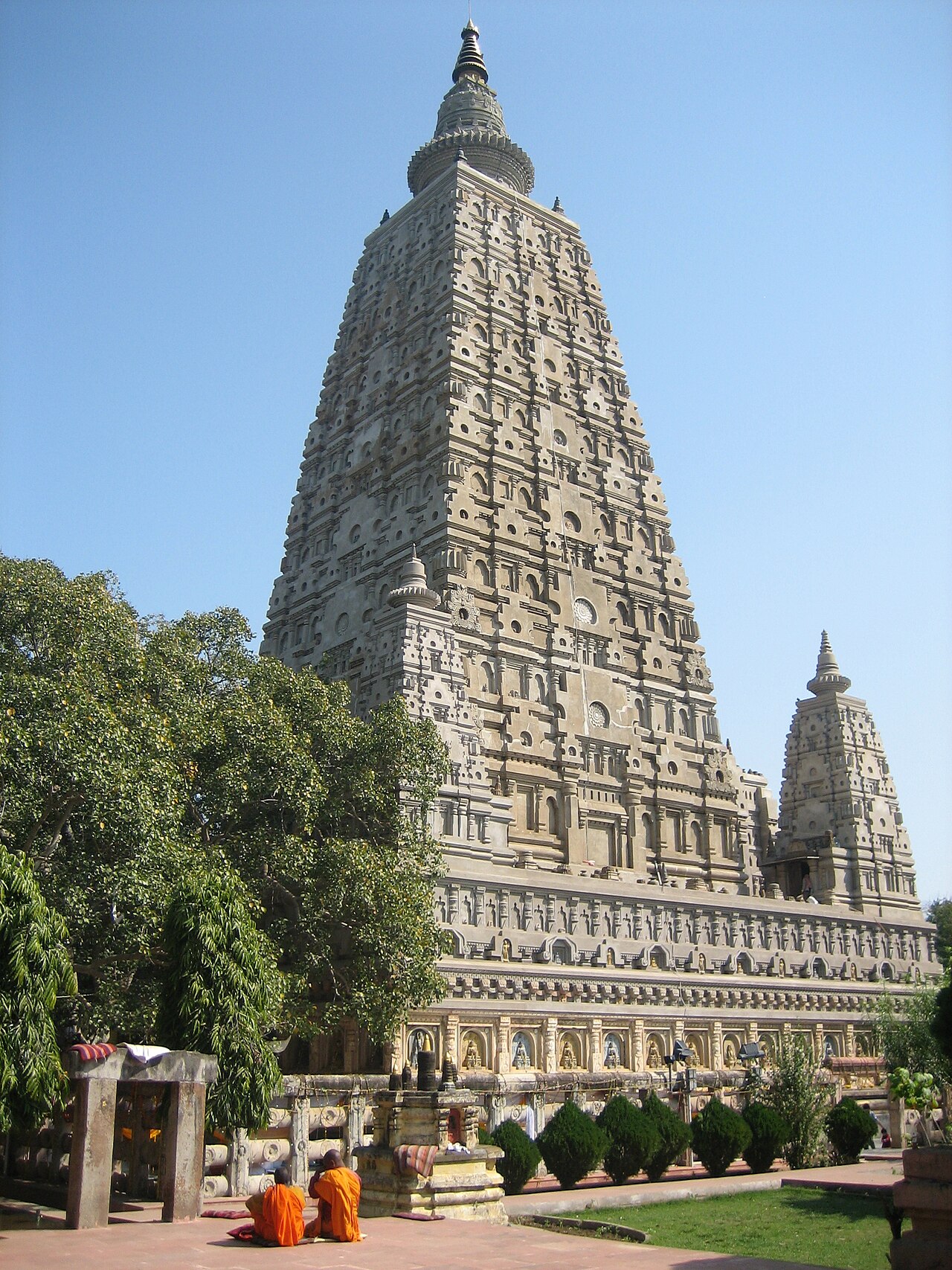
The Mahabodhi Temple Complex at Bodh Gaya in Bihar marks the location where Siddhartha Gautama attained enlightenment under a pipal tree around 500 BCE — the founding event of Buddhism. The main shikhara tower stands approximately 55 metres tall and dates in its current form primarily to the Gupta period (5th–6th century CE), with subsequent restorations under British Burma’s Archaeological Survey in the 1880s–1890s. UNESCO inscribed the complex in 2002; it is considered the most sacred site in Buddhism worldwide.
The Site of Enlightenment: Tree, Throne, and Tower Bodh Gaya, Bihar, 115 km from Patna
Three physical objects at Bodh Gaya carry particular weight in Buddhist tradition: the Bodhi Tree, the Vajrasana (Diamond Throne), and the Mahabodhi Temple itself. Each marks a different aspect of the same event — the moment when Siddhartha Gautama, after years of practice and a night of sustained meditation, attained the state of awakening (bodhi) that made him the Buddha.
The Bodhi Tree standing at the site today is a pipal (Ficus religiosa), as the original was. The genealogy of the current tree is documented and significant: in the 3rd century BCE, Emperor Ashoka’s daughter Sanghamitta took a cutting from the original tree to Sri Lanka, where it was planted at the Jaya Sri Maha Bodhi at Anuradhapura. That tree still grows in Sri Lanka and is considered one of the oldest living trees with a documented planting date in the world. At some point in the medieval period — accounts differ on when — the original tree at Bodh Gaya died. In the 19th century, a cutting from the Anuradhapura descendant was brought back to Bodh Gaya and planted at the site. The current tree is therefore genetically continuous with the original through this Sri Lankan lineage, a fact given specific significance in Buddhist pilgrimage practice.
Immediately beneath the Bodhi Tree sits the Vajrasana — the Diamond Throne. This stone slab was placed by Emperor Ashoka around 250 BCE to mark the exact spot where the Buddha sat during his night of enlightenment. It is considered, in Buddhist cosmological terms, the nabhi — the navel or centre of the earth. The Vajrasana still exists under the tree today and remains the focal point of circumambulation by pilgrims. Meditating at the Vajrasana, for many Buddhist practitioners, is the primary purpose of a journey to Bodh Gaya.
The Mahabodhi Temple’s shikhara tower rises approximately 55 metres above the complex. The earliest structure on the site was built by Ashoka himself; the current building dates to the 5th and 6th centuries CE with significant later restoration. The British Burma Archaeological Survey undertook a major restoration campaign in the 1880s and 1890s that drew considerable criticism from Buddhist communities in Asia, who felt that the character of the structure had been altered. That controversy, along with later debates over the management of the site (which was for many decades administered by a Hindu trust despite being Buddhism’s most sacred location), ran through much of the 20th century and remains part of the site’s history.
Bodh Gaya in the Buddhist Pilgrimage Circuit and International Presence UNESCO site; Nalanda 95 km northeast
Bodh Gaya is one of four major sites in the Buddhist pilgrimage circuit corresponding to the key events in the life of the historical Buddha. The four are: Lumbini in southern Nepal (birthplace); Bodh Gaya in Bihar (enlightenment); Sarnath near Varanasi in Uttar Pradesh (first sermon, where the Buddha set the Wheel of the Dharma in motion for the first time); and Kushinagar in eastern Uttar Pradesh (parinirvana — the final passing). Of these four, Bodh Gaya draws the largest and most internationally diverse pilgrimage. Millions of Buddhists from Thailand, Sri Lanka, Japan, South Korea, Myanmar, Tibet, Bhutan, Cambodia, and Vietnam arrive annually, with particularly heavy traffic in November through February, the cooler months of the Indian winter.
This international pilgrimage has produced an architectural consequence unique in India: surrounding the Mahabodhi Temple complex, different Buddhist nations and traditions have built their own monasteries and temples over the course of the 20th century, each in the architectural style of its home country. The Thai temple (Wat Thai Bodh Gaya), the Japanese temple (Daijokyo Buddhist Temple), the Tibetan Monastery, the Sri Lankan temple, the Bhutanese monastery, the Korean temple, the Chinese monastery, and a dozen others stand within walking distance of the Mahabodhi complex. Each serves as a retreat and pilgrimage base for practitioners from its respective tradition. The result is a small town where the architectural vocabulary of Buddhist Asia is displayed in concentrated form — a phenomenon with no precise parallel elsewhere on the subcontinent.
Nalanda Mahavihara, 95 kilometres to the northeast near Rajgir, provides a logical extension to a Bodh Gaya visit. Nalanda was the greatest monastic university in the ancient world — a centre of Buddhist and secular learning from the 5th century CE until its destruction by Bakhtiyar Khilji’s forces in 1193. At its height it housed thousands of monks and students from across Asia, including the Chinese pilgrim Xuanzang, who studied there in the 7th century CE and whose accounts remain among the primary sources for the university’s activities. UNESCO inscribed Nalanda Mahavihara on the World Heritage List in 2016. The two sites together — enlightenment and scholarship — trace two defining threads of early Buddhist civilisation.
Practical information
The Mahabodhi Temple Complex is open daily; the temple and inner precinct have specific opening hours (generally 5:00 AM to 9:00 PM, with a midday closure). Entry to the complex requires removing shoes; there is an entry fee for the archaeological museum on site. Photography inside the main temple is restricted. The nearest major city is Gaya, approximately 12 kilometres away, which has a domestic airport with connections to Delhi, Kolkata, and (seasonally) international flights from Bangkok and Colombo. Patna, the state capital of Bihar, is approximately 115 kilometres north and has a larger airport. The Gaya Junction railway station connects to major Indian cities. From Gaya, auto-rickshaws, cycle-rickshaws, and taxis serve Bodh Gaya. Accommodation in Bodh Gaya ranges from the national tourism department’s tourist complex to international-standard hotels; many of the national monasteries offer guesthouses for pilgrims of their tradition. The busiest and most atmospheric time to visit is during the Tibetan Buddhist winter congregation (usually December–January), when tens of thousands of Tibetan monks and laypeople gather for the Kalachakra or other teachings. October to March is the recommended visiting season; the monsoon months (July–September) are wet and hot.
Frequently Asked Questions
What is the Bodhi Tree at Bodh Gaya today, and how is it connected to the original tree under which the Buddha sat?
The Bodhi Tree currently growing at Bodh Gaya is a pipal (Ficus religiosa) — the same species as the tree under which Siddhartha Gautama sat when he attained enlightenment around 500 BCE. The connection between today’s tree and the original is documented through a specific lineage. In the 3rd century BCE, Emperor Ashoka’s daughter Sanghamitta carried a cutting from the original Bodhi Tree to Sri Lanka, where it was planted at the Jaya Sri Maha Bodhi shrine at Anuradhapura. This Sri Lankan tree has grown continuously from that cutting and is considered one of the oldest living trees with a verified historical planting record. The original tree at Bodh Gaya appears to have died at some point in the medieval period — sources are not consistent about the date. In the 19th century, during the period of Buddhist revival in Asia, a cutting from the Anuradhapura tree (itself a direct descendant of the original) was brought back to Bodh Gaya and planted at the site. The current tree therefore continues the genetic line of the original, through the Sri Lankan intermediary, over approximately 2,300 years. For Buddhist pilgrims, particularly from the Theravada traditions of Sri Lanka, Thailand, and Myanmar, this documented lineage carries profound significance. Circumambulating the tree, meditating under it, and receiving leaves that have fallen from it are among the specific acts performed by pilgrims at the site.
Who manages the Mahabodhi Temple Complex, and why has management been contested?
The management of the Mahabodhi Temple Complex has been the subject of sustained dispute across the 20th century and into the 21st, centred on the fact that Buddhism’s most sacred site was administered for many decades under a body in which Hindu representatives held a majority. The Bihar State Buddhist Mahabodhi Temple Management Committee, established under a 1949 state act, gave the majority of seats to Hindus and a minority to Buddhists. This arrangement drew objections from Buddhist communities in India and internationally, who argued that the arrangement gave followers of a different religion administrative control over their holiest shrine. Campaigns for reform were led by, among others, Dalit Buddhist communities following B.R. Ambedkar’s conversion movement, and by Buddhist advocacy organisations from Sri Lanka and Japan. The Bihar state legislature amended the act in 2013 to adjust the composition of the committee, though the question of full Buddhist control of the site remained debated. The UNESCO inscription in 2002 added an additional layer of international scrutiny to the management arrangements. For visitors, the practical consequence is that the temple is professionally maintained and accessible, with regular conservation work ongoing; the administrative history is part of the broader narrative of Buddhism’s revival and assertion in independent India.
What is the significance of Nalanda in relation to Bodh Gaya, and how can the two sites be visited together?
Nalanda Mahavihara, located approximately 95 kilometres northeast of Bodh Gaya near the town of Rajgir in Bihar, was the most significant centre of Buddhist learning in the ancient world. Founded in the 5th century CE, it operated as a monastic university for roughly seven centuries, attracting students from across Asia — China, Korea, Japan, Tibet, Central Asia, and Southeast Asia. The Chinese pilgrim Xuanzang, who studied at Nalanda in the 7th century CE, left detailed accounts that remain among the most important sources for understanding the institution at its height. At its peak, Nalanda housed an estimated 10,000 monks and students and a library of hundreds of thousands of manuscripts. The university was destroyed by the military forces of Bakhtiyar Khilji in 1193 CE — a date that marks the effective end of Buddhism as a mass religion in the Indian subcontinent for several centuries. UNESCO inscribed Nalanda Mahavihara on the World Heritage List in 2016. The archaeological remains include multiple monastic blocks, temples, and the library site. Visiting Nalanda from Bodh Gaya is practical as a day trip or overnight stop: the road distance is approximately 95 kilometres, and Rajgir, adjacent to Nalanda, has its own significance in early Buddhist history as the capital of the Magadha kingdom during the Buddha’s lifetime. A two- to three-day itinerary based in Bodh Gaya or Gaya, covering both sites, is a natural framework for visitors with a specific interest in the archaeology and history of early Buddhism in Bihar.