Djenné is a city on a floodplain island in the Bani River in central Mali, one of the oldest continuously inhabited cities in sub-Saharan Africa, with urban settlement at the adjacent archaeological site of Djenné-Djenno dated to 250 BCE. Its Great Mosque, rebuilt in 1907, is the world’s largest mud-brick building and requires replastering by the entire community every year. UNESCO inscribed the Old Towns of Djenné in 1988.
The world’s largest mud-brick building: architecture, torons and the annual replastering Bani River floodplain, central Mali
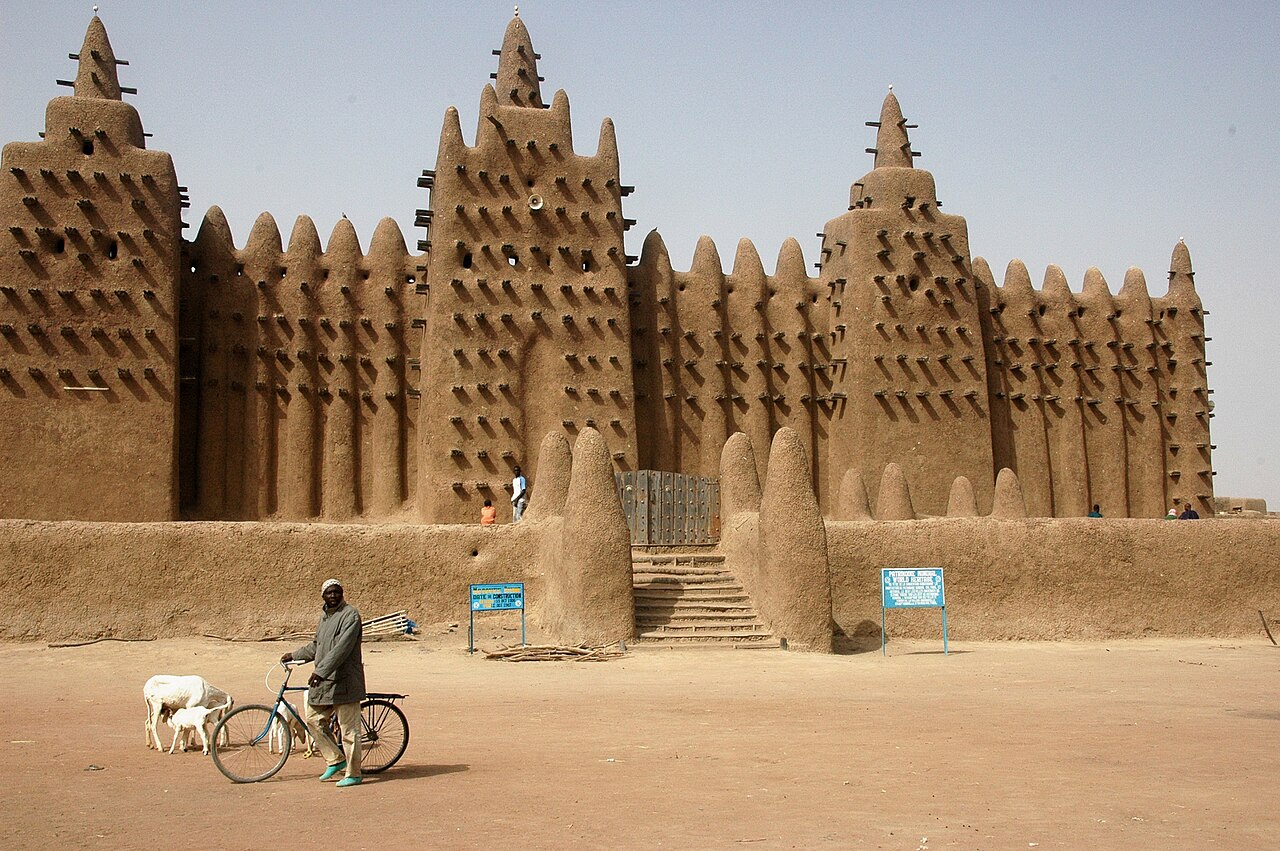
The Great Mosque of Djenné occupies the north side of the main market square. From the square, its three minarets rise above a facade studded with torons — structural wooden rods of palm wood that project outward from the surface at regular intervals across the entire building. On the main façade there are approximately 100 of them, each topped with an ostrich egg, a symbol of fertility and purity in Sahelian tradition. The torons are not decorative afterthoughts; they are embedded in the structural core of the building, extending deep into the banco walls, and they serve as the permanent scaffolding system for annual maintenance. When the replastering team climbs the building each spring, they use the torons as footholds and anchor points.
The building measures approximately 75 by 75 metres at the base, making it the largest mud-brick structure on earth. The construction material is banco — a mixture of sun-dried mud bricks, straw, and an organic binder — covered with a smooth plaster of the same material applied annually. The interior prayer hall has a forest of heavy columns supporting a low ceiling pierced by small ventilation shafts; the effect is one of considerable intimacy and spiritual concentration despite the building’s vast exterior scale. The columns, like the walls, are banco, and they have been thickened by successive replasterings over decades.
The current building dates to 1907, but this formulation requires context. A mosque has occupied this site since the 13th century; the local king Koi Konboro converted to Islam around 1240 CE and reportedly had his palace demolished to build the first mosque. That structure was demolished in 1830 by the Islamic reformer Sékou Amadou, who found its ornament inconsistent with his austere interpretation of the faith, and replaced with a plainer building. The 1907 mosque was constructed under French colonial administration, working with local builders, on the footprint of the previous structure and in the same Sudano-Sahelian tradition. The design followed local memory of the form of the earlier mosque, which had been demolished only 77 years before. In the architectural sense, the current building is a reconstruction; in the cultural and spiritual sense, it is the continuation of a seven-century tradition at the same site.
The annual replastering festival is the most famous event in Djenné’s calendar. It takes place in April, before the onset of the rainy season that would otherwise erode the exposed banco surface. The entire male population of the city participates: younger men and boys carry banco from riverside mixing pits to the base of the mosque, passing the material up human chains; teams of experienced plasterers work the surface. Women prepare food and water for the workers. The event combines practical necessity with communal celebration; it is simultaneously a feat of collective engineering and a religious act. Since 1996, access by non-Muslim visitors during the festival has been restricted following what the local community considered disrespectful behaviour by media photographers. The restriction is respected by responsible tour operators.
Djenné-Djenno and the archaeology that rewrote African urban history Archaeological site 3 km south; excavated 1970s–1980s
Three kilometres south of the city of Djenné lies Djenné-Djenno, an archaeological tell — a mound built up by successive layers of occupation — that was excavated systematically by Susan and Roderick McIntosh beginning in the mid-1970s. What they found overturned a central assumption of African historiography. Djenné-Djenno shows continuous occupation from approximately 250 BCE to about 1400 CE, when the site was progressively abandoned as the nearby city of Djenné itself absorbed the population. At its peak around 800 CE, Djenné-Djenno covered approximately 33 hectares and had a population that may have reached several thousand. It is one of the earliest known urban settlements in sub-Saharan Africa — predating the Islamic period and the trans-Saharan trade that most previous scholarship had credited with introducing urbanism to the region.
The significance of this finding for the history of Africa cannot be overstated. The dominant model before the McIntosh excavations held that urban centres in West Africa were essentially a product of Arab contact, Islamic conversion, and the commercial stimulus of the trans-Saharan trade, beginning in the 8th century CE at the earliest. Djenné-Djenno pushed the beginning of urban life in the inland Niger Delta back by a thousand years, into a period before any significant Arab or Islamic contact with the region. The settlement had ironworking from its earliest phase, domesticated cattle and fish as the basis of the economy, and a material culture entirely its own. Its growth appears to have been internally driven, based on the agricultural and economic potential of the floodplain rather than on outside stimulus.
The McIntoshes also found something that complicated simple narratives of urban evolution: Djenné-Djenno did not follow the pattern of a single central authority accumulating power and expanding outward. Instead, the landscape around the main tell showed a cluster of satellite mounds, each with its own specialised production (ironworking, pottery, fishing), linked to the central site but apparently maintaining a degree of autonomy. This “heterarchical” model of African urbanism — multiple nodes in a network rather than a single hierarchical centre — has since been applied to other West African sites and has substantially changed how archaeologists think about pre-Islamic African societies.
The city of Djenné also hosts one of West Africa’s most commercially active weekly markets, held every Monday in the square directly in front of the Great Mosque. The market serves communities across the surrounding floodplain and has been a central feature of Djenné’s economic life for centuries. The nearest UNESCO World Heritage Sites are the Cliff of Bandiagara (Land of the Dogons), approximately 150 kilometres to the southeast, and Timbuktu, approximately 570 kilometres to the northeast.
Practical information
Djenné is located in central Mali, approximately 570 kilometres northeast of Bamako by road. The standard approach is by bus or 4×4 vehicle from Mopti, 130 kilometres to the northeast — a journey of 2 to 3 hours depending on road and river conditions. Djenné sits on a seasonal island; a vehicle ferry across the Bani River is necessary year-round. The ferry crossing takes roughly 10 to 20 minutes and operates throughout the day. The Great Mosque is the focal point of any visit; exterior photography from the market square is generally welcomed, but photography of the interior and access rules vary depending on prayer times and the disposition of the guardian. Monday market day is the most photogenic and commercially vibrant time to visit, but also the most crowded. Guesthouses in Djenné are modest but adequate; several are located in traditional mud-brick houses. Security conditions in central Mali should be checked with current government travel advisories before travelling; the situation is less acute in the Mopti–Djenné corridor than in the far north, but Mali overall requires attention to conditions on the ground.
Frequently Asked Questions
How does the banco of the Great Mosque survive the annual rainy season, and what happens if replastering is delayed?
Banco — the mixture of mud, straw, and organic binder used to construct and maintain the Great Mosque — is an inherently stable building material in dry conditions but vulnerable to water erosion when exposed to sustained rain. The Sahelian rainy season runs from approximately June to September in Djenné; the annual replastering in April applies a fresh layer of plaster to the entire exterior surface before the rains arrive. The new plaster is thick enough to protect the structural core through the wet season. If replastering were seriously delayed or skipped, the erosive impact of the rains would progressively dissolve the outer plaster and eventually begin to damage the structural banco beneath. Multiple consecutive missed replasterings could cause significant structural damage, particularly to the base of the minarets and to horizontal surfaces where water pools. The community’s commitment to the annual cycle is therefore not merely traditional; it is the practical maintenance regime without which the building could not survive. UNESCO and international architectural conservation bodies have studied the mosque’s construction and maintenance techniques as a model of sustainable vernacular architecture — a building system that is entirely self-repairing, using locally available materials and community labour, with no requirement for imported industrial products.
Can non-Muslims enter the Great Mosque of Djenné?
Access rules for the Great Mosque of Djenné have changed over the years and require confirmation with local guides at the time of visit. For a period in the early 2000s, non-Muslim visitors were denied access to the interior entirely following conflicts over photography during prayer times and a general feeling in the local community that tourism was not being conducted respectfully. More recently, access has been partially restored under a system managed by local mosque guardians, who charge a fee and typically permit visitors to enter outside the five daily prayer times. However, conditions vary depending on who is on duty, the day of the week, and the general atmosphere in the city. The Monday market day — when visitor numbers are highest — sometimes sees more restrictive access because of the concentration of cameras and tourists. The exterior of the mosque, visible from the market square, is always visible and extensively photogenic. The interior is remarkable — the forest of banco columns and the quality of light through the ventilation shafts — and worth the effort of seeking access. The safest approach is to arrive with a local guide who has current relationships with the mosque administration and can negotiate access appropriately.
What is the connection between Djenné-Djenno and the city of Djenné, and why was the ancient site abandoned?
Djenné-Djenno and the present city of Djenné are two separate but related settlements approximately 3 kilometres apart on the same floodplain island complex. Djenné-Djenno is the older settlement, occupied from around 250 BCE; the city of Djenné was founded nearby at an uncertain date, with Islamic-period sources suggesting establishment sometime before 800 CE. For several centuries the two settlements appear to have coexisted, with Djenné growing in commercial and religious importance as it became integrated into the trans-Saharan Islamic trade network after the 13th century. Djenné-Djenno’s population gradually transferred to the newer, commercially better-connected city, and the older site was progressively abandoned between approximately 1200 and 1400 CE. The tell at Djenné-Djenno accumulated over 1,600 years of continuous occupation before being left; its depth of archaeological deposit makes it one of the richest excavation sites in West Africa. The McIntoshes’ excavations in the 1970s and 1980s recovered thousands of terracotta figurines, many of which remain culturally significant — figures of riders, snakes, and kneeling humans that point to a complex religious and symbolic life predating Islam by many centuries. Many of these figurines were subsequently looted by antiquities traffickers in the 1980s and 1990s and ended up in private collections and auction houses in Europe and North America; Malian and international efforts to repatriate them have had partial success.