The Alto Douro Wine Region in north-eastern Portugal became a UNESCO World Heritage Site in 2001, recognised for its extraordinary cultural landscape of terraced vineyards cut into steep schist hillsides above the Douro River. The region holds the distinction of being the world’s oldest officially demarcated wine appellation — a boundary drawn in 1756 by the Marquis of Pombal, predating Bordeaux’s famous 1855 classification by 99 years. Stretching 24,600 hectares between Mesão Frio and Barca d’Alva, the valley contains over 80 indigenous Portuguese grape varieties and a wine-making tradition that reaches back more than two millennia.
A Landscape Carved by Hand: 2,000 Years of Terraced Viticulture Douro Valley, northeastern Portugal
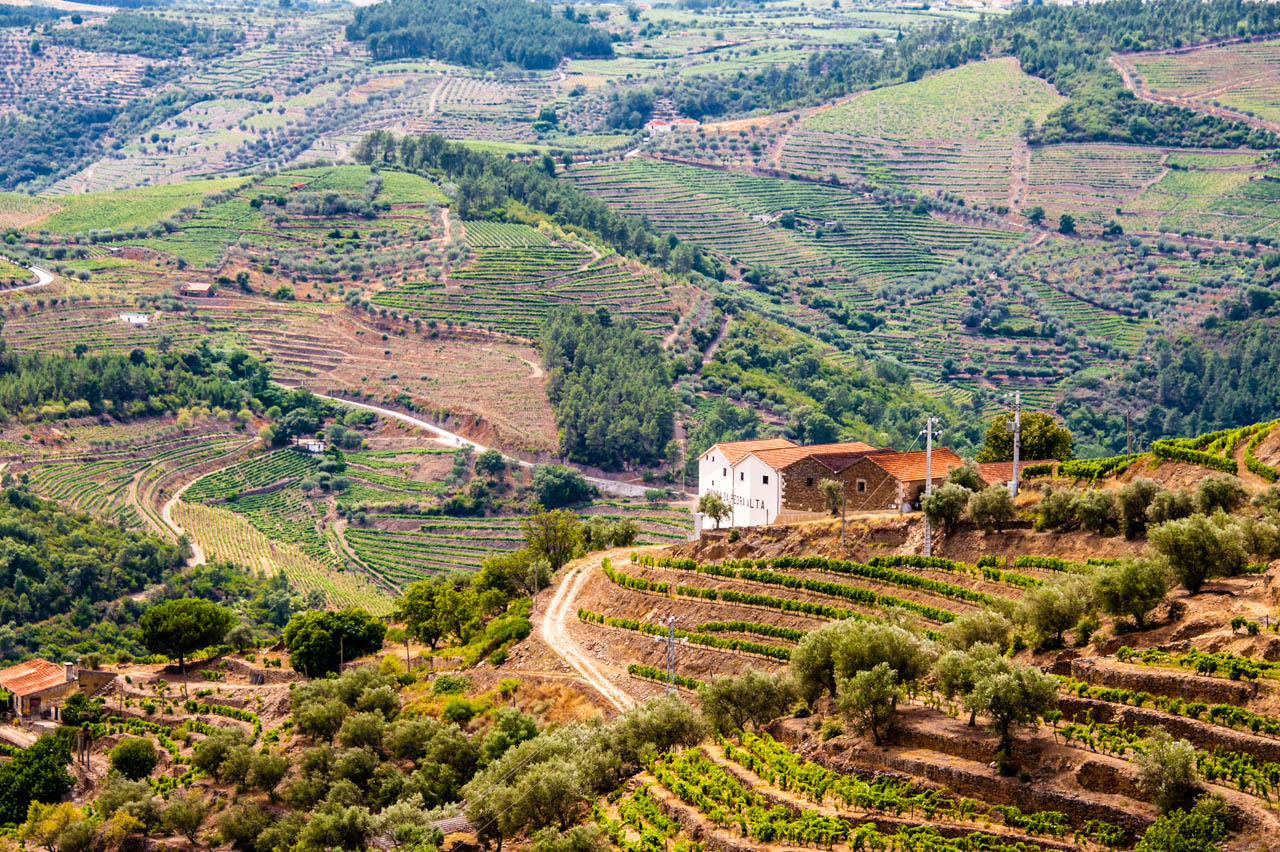
The terraces of the Alto Douro — known locally as socalcos — are the defining feature of this landscape and one of the most ambitious agricultural engineering projects in European history. Built by human hands over the course of two thousand years, these narrow stone-walled platforms were cut into hillsides that in places exceed a gradient of 30 degrees. The underlying geology is schist, a metamorphic rock that fractures into thin plates and produces thin, acidic soils with poor water retention on its own. The terraces solve two problems simultaneously: they hold the shallow soil in place on near-vertical slopes, and their stone retaining walls absorb solar heat during the day and radiate it back to the vines at night — a passive thermal system that extends the effective growing season in a continental climate with cold winters and summers that regularly exceed 40 degrees Celsius.
The vine varieties grown here reflect a genetic diversity found nowhere else in the wine world. Over 80 indigenous Portuguese varieties are cultivated in the Douro, many of them documented in ampelographic surveys dating back to the 18th century. The four primary varieties used in Port wine production are Touriga Nacional, Tinta Roriz (known elsewhere as Tempranillo), Tinta Barroca, and Tinta Cão — each contributing specific qualities of colour, structure, and aroma to the final blend. Many Douro vineyards maintain a traditional interplanting style called campo promiscuo, where multiple varieties grow side by side in the same rows, a practice that pre-dates modern monovarietal planting and acts as a natural insurance against localised disease or climatic variation.
The UNESCO inscription divides the valley into three sub-regions, each with distinct climatic and geological character. The Baixo Corgo, closest to the Atlantic coast, receives more rainfall and produces lighter, more aromatic wines. The Cima Corgo, the historic heartland of classic Port production and home to the most celebrated quintas (wine estates), experiences drier summers and fuller grape maturation. The Douro Superior, extending toward the Spanish border, is the driest and hottest sub-region, and produces the most concentrated wines from some of the oldest vine plantings in the region. The Douro Superior was also historically the most difficult to farm — before the construction of roads along the valley, reaching it required days of river travel.
The transition from an exclusively Port-producing region to a producer of internationally recognised dry table wines is one of the most significant shifts in Portuguese viticulture of the past four decades. Producers such as Quinta do Crasto, Quinta do Vale Meão, and Niepoort began releasing dry Douro reds and whites in the 1990s and 2000s that attracted critical attention outside Portugal. Today, dry Douro wines account for a growing share of production and have opened the region’s reputation to a broader international audience beyond the traditional Port markets of Britain and Scandinavia.
The Rabelo, the Railway, and the Route to Porto 80 km west to Porto; Douro Line railway follows the river
For centuries, the product of those terraced vineyards reached the world by water. The rabelo is a traditional flat-bottomed wooden boat with a distinctive square sail and a long steering oar at the stern, developed specifically for navigation of the Douro River before it was dammed and its course regularised. The critical cargo was the pipe of Port — a barrel of approximately 550 litres — which needed to travel from the upstream wine estates down the river to Vila Nova de Gaia, the city directly across the Douro from Porto. There, in the long stone lodges (armazéns) that line the waterfront, the wine underwent ageing in a cooler, more humid microclimate before bottling and export through the port of Leixões.
Navigation of the pre-dam Douro was dangerous. The river descended through a series of rapids and narrows that required considerable skill to navigate, particularly when heavily laden. The rabelo boats were steered by a crew of up to six men, with the helmsman working a rudder mounted on a long pole projecting from the stern. The outbound journey, downriver with the current, could be accomplished in a few days; the return upstream against the current required weeks, using sails, poles, and in some stretches teams of oxen hauling from the riverbanks. The construction of a series of dams along the Douro between 1950 and 1994 created a series of artificial lakes that made navigation easier but ended the working life of the rabelo as a commercial vessel.
The rabelo did not disappear entirely from the Douro. Each year on 24 June — the Feast of São João, St John’s Day, the most important popular festival in Porto — a regatta of rabelo boats takes place on the stretch of river between the Ponte Luís I and the Ponte da Arrábida. The boats, decorated with flags and the emblems of the major Port houses, compete in a race that recalls the river’s commercial history even as that history belongs entirely to the past.
Visitors who want to follow the route of the wine from vineyard to cellar have an unusually direct option: the Douro Line (Linha do Douro), a railway that runs from São Bento station in central Porto east along the river valley as far as Pocinho, near the eastern end of the UNESCO zone. The section between Régua and Pinhão — a stretch of about 25 km — passes through the heart of the Cima Corgo sub-region, where the terraced vineyards rise directly from the riverbank and the stations are decorated with azulejo tile panels depicting scenes of the wine harvest. The journey from Porto to Pinhão takes approximately two and a half hours and is consistently listed among the most scenic rail journeys in Europe.
Practical information
The Alto Douro Wine Region is accessible from Porto, 100 km to the west, by train on the Douro Line (services from São Bento station; journey time approximately 2.5 hours to Pinhão), by car via the A4 motorway or the scenic N222 road along the south bank of the river, or by river cruise — multiple operators offer day and multi-day boat trips from Porto. The town of Peso da Régua (Régua) is the main hub of the region and home to the Museu do Douro, which covers the history of wine production, the rabelo boats, and the demarcation of 1756. The town of Pinhão, 25 km further east, is the centre of the Cima Corgo sub-region and is surrounded by some of the most famous quintas. Many quintas are open for visits by appointment; the Douro Valley is home to a growing number of wine tourism operations offering tastings, vineyard tours, and cellar visits.
The best time to visit for the harvest is September, when the grape picking (vindima) is underway and many quintas allow visitors to observe or participate. The river valley in summer is extremely hot; spring (April-May) and autumn (September-October) offer the most comfortable conditions. Accommodation is available in Régua and Pinhão and at several quintas that have converted historic manor houses into hotels.
The nearby UNESCO site of Prehistoric Rock Art in the Côa Valley lies 80 km to the east, accessible by car from Pinhão in approximately one hour; the Historic Centre of Oporto (Porto) is 100 km to the west.
Frequently Asked Questions
What makes the Alto Douro Wine Region a UNESCO World Heritage Site?
The Alto Douro Wine Region received UNESCO World Heritage status in 2001 under cultural landscape criteria, recognised for the outstanding universal value of a landscape that represents 2,000 years of continuous wine-making tradition. UNESCO cited the terraced vineyards (socalcos), the architecture of the wine estates (quintas), the riverside villages, and the system of roads and the Douro Line railway as elements that together form an exceptional record of human adaptation to a challenging natural environment. The region is also distinguished by the 1756 demarcation decree of the Marquis of Pombal, which established the world’s first officially delimited wine region — a legal and commercial innovation whose model was later adopted by wine regions across Europe and the world. The UNESCO-protected area covers approximately 24,600 hectares divided into three sub-regions (Baixo Corgo, Cima Corgo, Douro Superior), and the inscription specifically acknowledges the ongoing living tradition of viticulture as central to the site’s value. The demarcation predates the Bordeaux classification of 1855 by nearly a century, and the concentration of indigenous grape varieties grown here — over 80 documented varieties — represents a genetic reservoir of global agricultural importance.
What is Port wine and how is it made in the Douro Valley?
Port wine is a fortified wine produced exclusively from grapes grown in the Alto Douro Wine Region. Fortification means that a neutral grape spirit (aguardente) is added to the fermenting must before all the sugar has converted to alcohol, stopping fermentation and preserving a significant residual sweetness while raising the alcohol content to approximately 19-22% ABV. The primary grape varieties used are Touriga Nacional, Tinta Roriz, Tinta Barroca, and Tinta Cão, though the regulations permit a much wider range of the indigenous Douro varieties. After the harvest in September, the grapes are crushed — traditionally by foot in large stone troughs called lagares, a method still used at some estates for premium wines — and the must ferments for a short period before fortification. The fortified wine is then transported to Vila Nova de Gaia, across the river from Porto, where it is aged in wooden casks (pipes, each holding approximately 550 litres) in the riverside lodges under controlled conditions. The style of Port produced depends on the ageing: Ruby Port is aged for a few years in large tanks and retains its deep red colour; Tawny Port is aged for longer periods in small barrels, developing an amber colour and oxidative nutty flavours; Vintage Port is declared in exceptional years and ages for decades in bottle.
How do I get from Porto to the Alto Douro Wine Region by train, and is it worth it?
The Douro Line (Linha do Douro) departs from São Bento station in the centre of Porto and follows the Douro River eastward to Pocinho, near the eastern boundary of the UNESCO zone. The first stretch of the journey runs through the Douro Litoral as far as Caíde, then enters the river valley at Entre-os-Rios. From Régua (Peso da Régua) eastward, the train travels directly alongside the river, with vineyards rising on the slopes above and the Douro — widened into an artificial lake by the dams — reflecting the landscape below. The most scenic section is between Régua and Pinhão, approximately 25 km, which passes through the centre of the Cima Corgo sub-region. Journey time from Porto to Pinhão is approximately 2 hours 30 minutes. CP (Comboios de Portugal) operates regular services on the line; there is also a historical steam train (Comboio Histórico) that runs a special tourist service between Régua and Tua on selected weekends between May and October, with on-board wine tasting included. The rail journey is widely considered one of the finest in Europe and is a legitimate travel destination in itself, not merely a means of reaching the vineyards. The stations at Régua, Pinhão, and Tua are decorated with large azulejo tile panels depicting scenes of life in the Douro Valley.