The Garden Kingdom of Dessau-Wörlitz (Gartenreich Dessau-Wörlitz) is an 18th-century landscape park covering 142 square kilometres in Saxony-Anhalt, created from 1764 onward by Prince Leopold III Frederick Francis of Anhalt-Dessau. Inscribed as a UNESCO World Heritage Site in 2000, it is the first English-style landscape park on the European continent and contains more than fifty garden structures — including Wörlitz Palace, a volcano, the Rousseau Island, a Pantheon, and a synagogue built as a Roman temple — arranged across a system of lakes and interconnecting waterways. The park was designed not merely as a pleasure ground but as a physical embodiment of Enlightenment thought, intended to be walked and read like a philosophical text.
Prince Franz and the garden state: Enlightenment built at landscape scale Wörlitz, 15 km east of Dessau, Saxony-Anhalt
Leopold III Frederick Francis of Anhalt-Dessau — known universally as Prince Franz — inherited the principality of Anhalt-Dessau in 1758 at the age of eighteen and governed it until his death in 1817. His principality was a small one by the standards of 18th-century German princely states, approximately 800 square kilometres of flat north German agricultural land on the Elbe floodplain, without the military ambitions or the courtly extravagance of larger neighbours. What distinguished Franz was not conquest or ceremony but a systematic attempt to translate Enlightenment ideas into physical reality — to build a state that embodied the ideals he had encountered through reading, through correspondence with the European intellectual community, and above all through travel.
The decisive experience was the Grand Tour. Franz made three extended journeys to England, the first in 1763 to 1764, and encountered the English landscape garden tradition at the height of its creative fertility — the parks of Stowe, Stourhead, and Painshill, the theories of William Kent and Lancelot “Capability” Brown, and the underlying philosophical argument that a garden designed to look like natural landscape was morally superior to the geometric gardens of French absolutism because it expressed freedom rather than control. He returned to Anhalt-Dessau and began transforming the Elbe floodplain around Wörlitz into an English-style landscape park in 1764, continuing the project for the remaining fifty years of his life. The result was a park of extraordinary ambition: not a decorative garden around a palace but a landscape at agricultural scale, in which working farms, riverside meadows, and productive orchards were integrated with lakes, islands, bridges, and a sequence of garden structures that formed a programme of Enlightenment ideas.
Wörlitz Palace (Schloss Wörlitz), designed by Friedrich Wilhelm von Erdmannsdorff and built between 1769 and 1773, is the centrepiece of the inscription and holds a specific distinction: it is the first Neo-Classical building in Germany. The building follows the Palladian model Franz had studied at English country houses — a symmetrical block of moderate scale, cream-coloured stucco, and classical proportions, without the Baroque grandeur or decorative excess of contemporary German court architecture. Its interior was designed as an integrated aesthetic environment, with collections of antique sculpture, majolica, and paintings assembled from Franz’s Italian travels. The palace sits directly at the edge of the first of the park’s lakes, its reflection in the water forming one of the most photographed images of 18th-century German architecture.
The volcano, the Synagogue, and the system of ideas that connects them Park circuit: 20 km of paths, gondolas on the lakes
The garden structures of Dessau-Wörlitz are not decorative follies in the conventional sense of the English landscape tradition — hermitages built for picturesque effect, ruins constructed to suggest the passage of time. They are, rather, a systematic programme of reference points, each corresponding to an idea, a passage from classical or contemporary literature, a moral principle, or a historical model that Franz wanted the walking visitor to encounter and reflect upon. The park was designed as pedagogy: Franz opened it to the public, including Anhalt-Dessau’s farmers and artisans, explicitly believing that exposure to its ideas would improve the moral and intellectual quality of his subjects. The landscape was both garden and school.
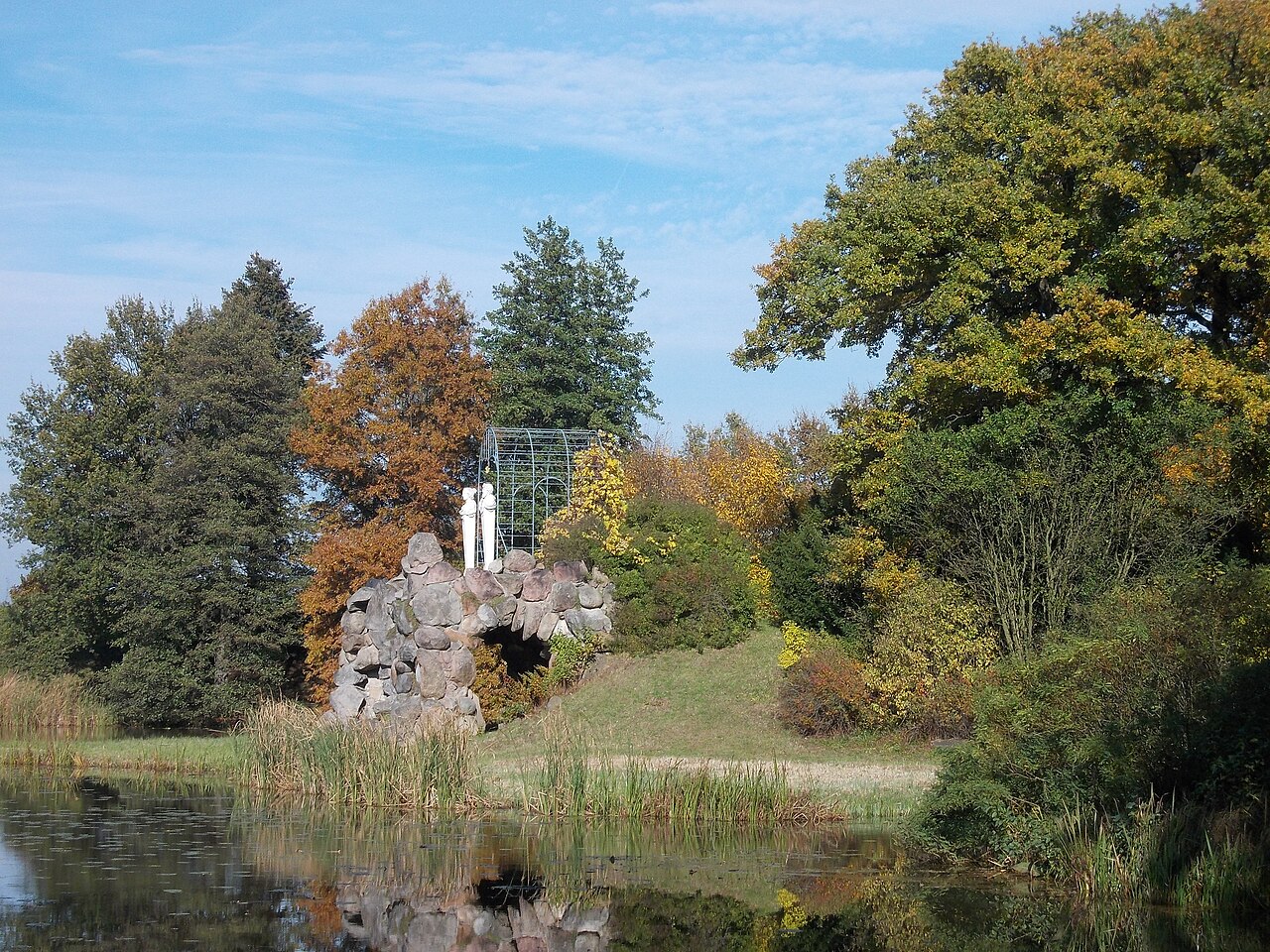
The Rousseau Island (Rousseau-Insel) is a small island in the Wörlitz lake system containing a simple stone tomb placed beneath a group of poplars — a direct reference to the tomb of Jean-Jacques Rousseau on the Île des Peupliers at Ermenonville in France, where Rousseau died in 1778 and was buried until his remains were moved to the Panthéon in Paris in 1794. Franz visited Ermenonville after Rousseau’s death and was profoundly affected by the philosopher’s ideas about nature, education, and the moral corruption of artificial civilisation. The Wörlitz island tomb is a meditation on Rousseau’s thought, a physical act of intellectual homage set in a landscape that attempts to embody the values Rousseau argued for.
The Pantheon is a smaller version of Rome’s Pantheon, set on the edge of one of the lakes, used to house Franz’s collection of antique copies and original Roman sculptures — a portable museum of classical civilisation placed in a building that argued for the formal continuity between ancient Rome and Enlightenment Europe. The Gothic House (Gotisches Haus), by contrast, is a small building in the English Gothic Revival style, begun in 1773, one of the earliest Gothic Revival buildings in Germany, and used by Franz as a private apartment and collection space for stained glass, medieval manuscripts, and Swiss painted glass panels.
The park’s most theatrically unusual structure is the artificial volcano on the island of Stein, modelled loosely on Vesuvius, which Franz had observed during his Italian travels. The island contains artificial lava flows, grottos, and a subterranean passage system, and on special evenings in the 18th century, illuminated eruptions were staged — torches and coloured lights creating the effect of volcanic activity for guests punted across the lake on gondolas. The eruption performances still occasionally occur at major park events. At the Synagogue (1790), designed by Erdmannsdorff in the form of a small Roman temple, Franz provided for the Jewish community of Wörlitz a place of worship built with the same architectural dignity as any other structure in the park. It is the oldest preserved synagogue in the German lands east of the Rhine and is thought to be one of the earliest purpose-built synagogues in Germany designed in a classicising style — a formal statement of religious equality expressed through architectural equivalence.
Practical information Getting there, seasons, and the gondola circuit
The town of Wörlitz is approximately 15 kilometres east of Dessau. From Dessau Hauptbahnhof, a heritage narrow-gauge railway (the Dessau-Wörlitzer Eisenbahn) runs to Wörlitz on a seasonal schedule (typically April to October); the journey takes approximately 45 minutes. By car or bicycle the journey takes 20 to 30 minutes; the flat landscape of the Elbe floodplain makes cycling from Dessau a practical option in good weather, with a dedicated cycle path following the park circuit. From Berlin, Dessau is approximately 1 hour 15 minutes by regional train.
The park itself is open at all times and free to enter; individual buildings and the palace charge separate entry fees. The gondola circuit — flat-bottomed boats punted by gondoliers on the lake network — runs in summer from the Wörlitz harbour and covers the main lake system, passing the Rousseau Island, the Synagogue, and the island of Stein with its volcano. Booking in advance is advisable in high summer. The park is at its most photogenic in late spring (April to May, when the meadows are in flower) and in autumn (October, when the foliage turns); winter visits are possible but many buildings close from November to March. The Bauhaus Dessau building and the Masters’ Houses are 15 kilometres west in Dessau and make a logical same-day or adjacent-day combination.
Frequently Asked Questions
What is an English landscape garden, and how is Dessau-Wörlitz different from Versailles?
The formal French garden as exemplified at Versailles (designed by André Le Nôtre from 1661) is organised on principles of geometric symmetry, axial perspective, and the visible subordination of nature to human will. Parterres of clipped box, canals cut in straight lines, trees trained into walls of greenery, and fountains that project water against gravity all express the control of a centralised power over the natural world. The English landscape garden, developed in England from the 1720s onward by designers such as William Kent, Charles Bridgeman, and later Lancelot Brown, rejected this geometry in favour of apparently natural landscapes: serpentine lakes formed by damming streams, grass lawns that ran without boundary to the horizon, trees planted in informal clumps and groves, and paths that curved to reveal views gradually rather than imposing a single axial perspective from a fixed point. The philosophical argument behind the English style was that natural-seeming landscape was morally superior to artificial geometry — an argument with both political dimensions (attacking French absolutism’s aesthetic) and philosophical ones (drawing on Locke, Shaftesbury, and the emerging aesthetics of the picturesque and the sublime). Dessau-Wörlitz is different from most English landscape parks in the deliberateness of its intellectual programme: whereas Stourhead or Stowe deploy classical references loosely, Dessau-Wörlitz is a systematic curriculum, with each structure corresponding to a specific idea that Franz wanted his visitors to encounter in sequence. It is less a pleasure garden than a philosophical landscape — a garden of ideas at territorial scale.
Who was Prince Franz, and how did he pay for a project of this scale?
Leopold III Frederick Francis of Anhalt-Dessau (1740 to 1817) ruled a principality of roughly 80,000 people on a relatively modest revenue base. The Dessau-Wörlitz project, developed continuously across fifty years, was financed not through extraordinary wealth but through deliberate priority: Franz redirected resources that a conventional prince of the period would have spent on military forces and courtly ceremonial into the garden and its buildings. He maintained a small court, eschewed military adventure, and ran his principality on agricultural-improvement principles that generated income from the Elbe floodplain. He corresponded with Rousseau (though the two never met), with Goethe (who visited Wörlitz several times and left admiring descriptions), and with leading Enlightenment figures across Europe, positioning his small principality as a laboratory of progressive ideas. The palace and its contents were assembled over decades from Grand Tour purchases and gifts; the landscape structures were built incrementally rather than in a single campaign. The result was a project whose cost was distributed across half a century and whose labour was in part provided by the principality’s own rural population, who also benefited from the agricultural improvements Franz implemented on the same landscape. When Goethe visited in 1778 he described the Wörlitz park as an enchanted garden where the ideal and the real were united — a description that captures the ambition if not the entire complexity of what Franz built.
What happened to Dessau-Wörlitz during the 20th century, and how was it preserved?
The principality of Anhalt-Dessau ceased to exist as a sovereign entity in 1918 with the abolition of the German monarchy. The Wörlitz estates passed through various hands during the Weimar Republic and were administered by the Nazi government from 1933 onward as a public park, which at least kept them accessible and maintained. After 1945, Wörlitz fell in the Soviet zone and then in the German Democratic Republic. GDR authorities operated the park as a public landscape and tourist destination; the buildings were maintained to varying standards, with the palace and several structures receiving periodic restoration, while others deteriorated. The flat Elbe floodplain landscape was subject to periodic flooding, which damaged park infrastructure on several occasions. The Elbe flood of 2002, the worst in the region in decades, caused significant damage to the park’s hydraulic system and several garden structures. A major international restoration effort followed, partly funded by UNESCO and the European Union, that repaired the lake and canal system and restored a number of the garden buildings. The park’s inscription on the UNESCO World Heritage List in 2000 came just before the flood and helped mobilise international support for the restoration. Today the park is managed by the Kulturstiftung Dessau-Wörlitz (Dessau-Wörlitz Cultural Foundation), which balances conservation, public access, and the ongoing maintenance of a living agricultural and garden landscape.