Stralsund and Wismar are two cities on the Baltic coast of Mecklenburg-Vorpommern, inscribed together as a single UNESCO World Heritage Site in 2002 for their outstanding Brick Gothic architecture. Both were among the wealthiest cities of the Hanseatic League in the 14th century, passed under Swedish rule following the Peace of Westphalia in 1648, and remained Swedish possessions — Wismar until 1803 and Stralsund until 1815. Their historic centres preserve the urban fabric, the warehouses, the great churches, and the market squares of the late medieval Baltic trading world largely intact.
Stralsund: the Pearl of the Hanseatic League Baltic coast, Mecklenburg-Vorpommern
Stralsund was founded in the early 13th century on a narrow peninsula between the Strelasund strait and two inner lakes, a geography that made it naturally defensible and commercially well-placed for Baltic trade. By the mid-14th century it was one of the four leading cities of the Hanseatic League alongside Lübeck, Hamburg, and Danzig, exporting herring, cloth, and grain across the North Sea and Baltic worlds. The city withstood a siege by Wallensteins imperial forces in 1628 during the Thirty Years War, and the Peace of Westphalia of 1648 confirmed Swedish sovereignty — a formal status that gave the city a period of architectural investment and also insulated it from the worst of later German centralising pressures.
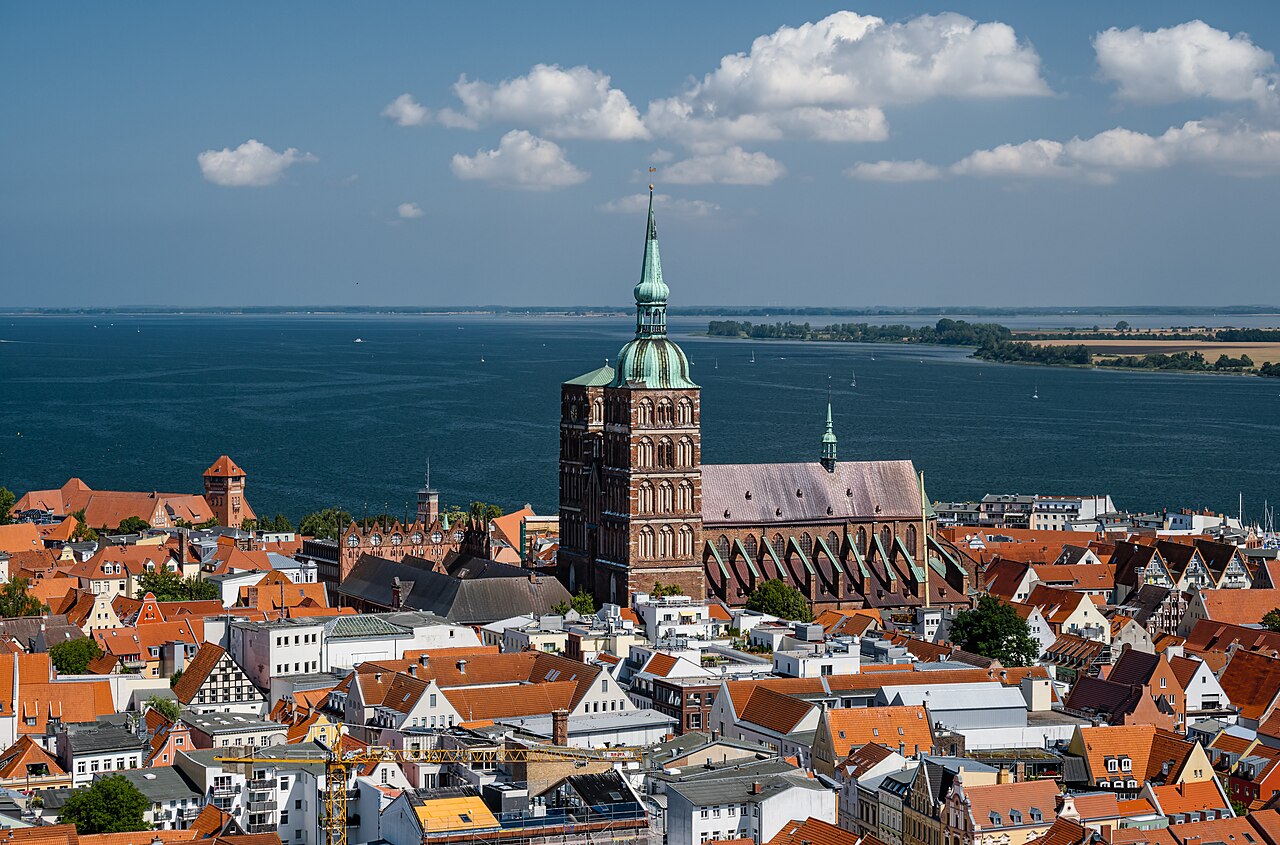
The dominant monument is the Nikolaikirche (St Nicholas Church), begun around 1270. It is a Brick Gothic hall church — a form in which nave and aisles rise to roughly the same height, filling the interior with diffused light — and one of the grandest examples of this building type anywhere in northern Europe. The nave reaches 37 metres internally. The furnishings accumulated over six centuries: a 14th-century high altar, astronomical clock from 1394, and a pulpit and choir stalls added in subsequent periods, giving the interior a layered density unusual in northern Protestant churches, since Stralsund converted to Lutheranism in 1525 but retained much of its Catholic furnishing. The Rathaus on the market square is equally important to the cityscape. Its north façade, the Schauseite or decorative screen, is a wall of blind arcading, tracery, and niched figures built in the 14th and 15th centuries not to enclose space but purely to display civic wealth — one of the most theatrical examples of secular Brick Gothic in Germany. Behind it the actual town hall functions in a far more modest structure; the screen was architecture as advertisement, legible from the market where merchants gathered to trade.
Walking the old town, the scale of the medieval ambition is clear in the three great churches — the Nikolaikirche, the Marienkirche, and the Jakobikirche — each serving a different social constituency of the medieval city. The grid of streets between them preserves gabled merchants’ houses and the occasional warehouse facade, and the Stralsund harbour front still faces the strait as it did when Hanseatic cogs loaded herring barrels for the markets of Flanders and England. The Ozeaneum, the German oceanography museum opened in 2008, occupies a contemporary building at the harbour and brings a large international visitor flow that helps sustain the smaller historic attractions.
Wismar: Swedish Heads, a Rebuilt Cathedral, and a Harbour Where Dracula Arrived 60 km west of Stralsund, Baltic coast
Wismar lies 60 kilometres west of Stralsund along the Baltic coast, its old harbour sheltered by the island of Poel. Like Stralsund, it was a major Hanseatic city in the 13th and 14th centuries, and its market square — one of the largest in northern Germany — is still framed by the gabled brick facades of the Hanseatic merchant tradition. The Alter Schwede (Old Swede) building on the market square, dated to around 1380, is considered one of the oldest preserved burgher houses in the region and gives an immediate sense of the scale and solidity of Hanseatic domestic architecture.
The Georgenkirche (St George’s Church) tells a compressed version of the 20th century’s violence and the 21st century’s capacity for reconstruction. Built between 1295 and 1450, it was one of the largest Brick Gothic hall churches in the Baltic. Allied bombing in 1945 left the nave a roofless ruin. The tower and outer walls survived, but the interior remained open to the sky for decades while Wismar was part of East Germany and resources for restoration were not available. After reunification, a major international campaign funded the rebuilding: the nave was restored between 1993 and 2010, and the church now functions again as a cultural and worship space. The reconstruction is unambiguous about its nature — it does not fake age — and the result is a building that holds both the historic shell and the contemporary repair in an instructive tension.
The Marienkirche presents a different fate. Its tower, a 14th-century landmark visible from the sea that served as a navigational marker for Baltic sailors, still stands. But the nave was demolished in 1960 by East German authorities who deemed the war-damaged structure too expensive to maintain. The stump of the nave walls and the surviving tower now form a ruin in the city centre, preserved rather than reconstructed. At the harbour, the two Schwedenköpfe (Swedish Heads) — carved wooden sculptures of turbaned figures, dating to the 17th century — mark the entry to the old port. Their exact origin is debated; they are thought to have served as mooring posts or bollard decoration.
Wismar’s connection to film history is specific and vivid. In 1921, the director Friedrich Wilhelm Murnau came to Wismar to film Nosferatu, his unauthorised adaptation of Bram Stoker’s Dracula. Unable to obtain the rights, Murnau changed all the names — Transylvania became the Carpathians, Dracula became Count Orlok, and the harbour city of Wismar became “Wisborg.” The Wassertor (Water Gate), a 15th-century brick gate at the harbour, appears in the film as the gate through which Nosferatu’s plague ship enters the fictional city. The gate still stands, and the shot that Murnau composed looking through its arch towards the water remains recognisable today.
Practical information Getting there and around
Stralsund is served by direct regional trains from Berlin (approximately 2 hours 30 minutes) and from Rostock (approximately 1 hour). Wismar is connected by train to Rostock (approximately 45 minutes) and to Schwerin (approximately 45 minutes), with connections onward to Hamburg. The two cities are 60 kilometres apart by road; direct bus services exist but journey times vary. Driving the coastal road between them on the B105 takes approximately one hour and passes through the Mecklenburg coastal landscape with views of the Wismarer Bucht bay.
Both historic centres are compact and best explored on foot. In Stralsund, the Nikolaikirche and the Rathaus are within two minutes of each other on the market square; the harbour front is a five-minute walk. In Wismar, the market square, the Georgenkirche, and the harbour with the Wassertor form a circuit of approximately 800 metres. The Ozeaneum in Stralsund is a half-day visit. The nearest major UNESCO site is Lübeck, approximately 60 kilometres west of Wismar, inscribed for its own Hanseatic brick architecture in 1987.
Frequently Asked Questions
Why were Stralsund and Wismar under Swedish rule for so long?
The Peace of Westphalia in 1648 ended the Thirty Years War and redistributed significant territories across the Holy Roman Empire. Sweden, which had intervened militarily on the Protestant side from 1630 onward, received as compensation the Swedish Pomerania — a strip of Baltic coastline that included Stralsund — and the city of Wismar, which was assigned to the Duchy of Mecklenburg under Swedish overlordship. These were strategically important Baltic ports, and Swedish control gave Sweden a firm foothold on the southern Baltic coast, useful for projecting power across the sea lanes that connected Stockholm to its German possessions. Both cities retained their German character, their Lutheran faith, and their local civic institutions; Swedish administration sat above the existing urban structure without fundamentally transforming it. Wismar was returned to the Duchy of Mecklenburg in 1803 under a pawn arrangement that was never redeemed. Stralsund remained Swedish until 1815, when it passed to Prussia following Napoleon’s defeat, which reshuffled the political map of northern Germany. The Swedish period left few visible traces in the townscape but is documented in the city archives and explains certain administrative peculiarities in both cities’ legal history that persisted into the 19th century.
What makes Brick Gothic different from the stone Gothic of France and England?
Gothic architecture as developed in the Île-de-France from the mid-12th century relied on limestone and other fine-grained stones that could be cut into the intricate mouldings, tracery, and figurative sculpture that characterise the great cathedrals of Chartres, Reims, and Salisbury. The North German plain and the Baltic coast have almost no local building stone — the glacial landscape produces sand, clay, and erratic boulders, but no quarried ashlar. Builders adapted by developing a sophisticated brick tradition, firing clay bricks in a range of standard formats and using corbelling, blind arcading, and stepped gable profiles to achieve decorative effects that stone buildings achieved through carving. The result is architecturally distinct: Brick Gothic has a heavier, more planar quality than its stone counterparts, its decoration operating through rhythm and pattern rather than intricate carving. The hall church form — in which nave and aisles are of equal height — became characteristic of the Baltic region, creating wide, light-filled interiors suited to civic preaching and merchant assemblies. The Nikolaikirche in Stralsund and the Georgenkirche in Wismar are two of the finest examples of this regional tradition, which extends along the Baltic coast from Lübeck through Greifswald to Gdansk and beyond.
Where exactly in Wismar was Nosferatu filmed, and can visitors see the locations today?
Friedrich Wilhelm Murnau filmed Nosferatu eine Symphonie des Grauens in 1921 and 1922, using locations in Wismar, Lübeck, and the Carpathians of Slovakia. In Wismar, the primary identifiable location is the Wassertor (Water Gate), a 15th-century brick harbour gate that appears in the film as the gateway to the fictional city of “Wisborg” through which Count Orlok’s plague ship passes. The gate survives in good condition at the harbour end of the Wasserstraße and is accessible to visitors at all times. Murnau also filmed in the streets of the old town, though some of the specific buildings have changed or been damaged since. The film itself exists in the public domain and can be viewed freely online; a number of frame comparisons have been published by local historians that overlay 1922 film stills with contemporary photographs of the same locations. Wismar’s tourist office has produced a Nosferatu walking route map available at the information centre on the market square, marking the principal filming locations with historical photographs. Lübeck, 60 kilometres west, was used for the interior plague sequences and for the house where Orlok’s victims live — the Holstentor city gate in Lübeck also appears briefly in the film.