In 1652, Habsburg Emperor Ferdinand III granted the Lutheran population of Silesia the right to build three new churches — under conditions designed to ensure they would be temporary, unimpressive, and clearly subordinate to Catholic architecture. They had to be built outside the city walls, without towers, without bells, using only wood, clay, sand, and straw, and completed within one year. Two of the three survive: the Church of Peace (Kościół Pokoju) in Świdnica and the one in Jawor, both in Lower Silesia. The Świdnica church holds 7,500 people across three tiers of galleries. They were inscribed on the UNESCO World Heritage List in 2001 and are, today, the largest timber-framed sacred buildings in Europe.
The Peace of Westphalia and its Silesian consequence Lower Silesia, southwestern Poland — 60 km south of Wrocław
The Peace of Westphalia in 1648 ended the Thirty Years’ War, the catastrophic conflict that had devastated much of Central Europe since 1618. Among its provisions was the establishment of a 1624 “normative year” for religious matters: territories were to return to the religious configuration they held in that year, which for the Habsburg lands of Silesia meant a restoration of Catholic dominance. Silesia had been substantially Lutheran since the Reformation, and the Protestant population faced the reimposition of Catholic control over churches, schools, and public religious life.
The compromise that produced the Churches of Peace was a negotiated exception. Ferdinand III agreed to permit three Lutheran churches in Silesia — at Świdnica, Jawor, and Głogów (the Głogów church no longer stands) — subject to restrictions evidently intended to limit their permanence and visibility. The churches had to be built outside the city walls, denying them the protection and prestige of an urban site. They could have no stone or brick in their construction — only wood, clay, sand, and straw, materials associated with vernacular and agricultural buildings rather than sacred architecture. They could have no towers and no bells, removing the acoustic and visual markers that announced a church’s presence and status across a landscape. And they had to be completed within a year.
The restrictions failed in their apparent purpose. Lutheran craftsmen, architects, and their patrons responded to the limitations with an ingenuity born partly of necessity and partly of the competitive desire to produce buildings that were self-evidently dignified and worthy, whatever their materials. The structural solution was the timber frame: a system of posts, beams, and bracing that could enclose an enormous volume without using stone, distribute loads efficiently, and be erected quickly. The Jawor church was built in 1652 to 1654; the Świdnica church in 1656 to 1657. Both are rectangular hall structures encased in the half-timbered framework visible on the exterior. Inside, the designers stacked tier upon tier of wooden galleries around the nave, maximising the number of worshippers who could be present at a single service — a priority for communities that had been deprived of regular Protestant worship for decades.
The name “Churches of Peace” (Friedenskirchen in German, Kościoły Pokoju in Polish) derives directly from the Peace of Westphalia that made their construction possible. The name carries a meaning beyond its historical reference: these buildings exist because of a peace agreement, and they served communities for whom worship itself had been a contested right. The Swedish army, present in Silesia during and after the Thirty Years’ War, played a role in guaranteeing the Lutherans’ rights against later Counter-Reformation pressure to close the churches, which adds another layer to their political history.
Inside the Świdnica church: 7,500 people and 2,000 paintings Świdnica — 55 km south of Wrocław by road or rail (approx. 1 hour)
The interior of the Church of Peace in Świdnica is one of the most unexpected spatial experiences in Polish architecture. From the outside, the building reads as a large timber structure set in a churchyard south of the old town — the position outside the walls, as required — with a later baroque bell tower added nearby when the Habsburg restrictions were relaxed under Charles VI in 1707. Inside, the nave opens into a volume that rises through three complete tiers of wooden galleries wrapping around all four sides, supported on slender posts and fronted with continuous railings decorated in painted panels. The galleries were the primary seating for most of the congregation; the nave floor below was also densely occupied. The total capacity of 7,500 people is not a modern estimate but a figure that reflects the building’s original purpose: it was designed to hold the entire Lutheran population of Świdnica and its surrounding villages at once.
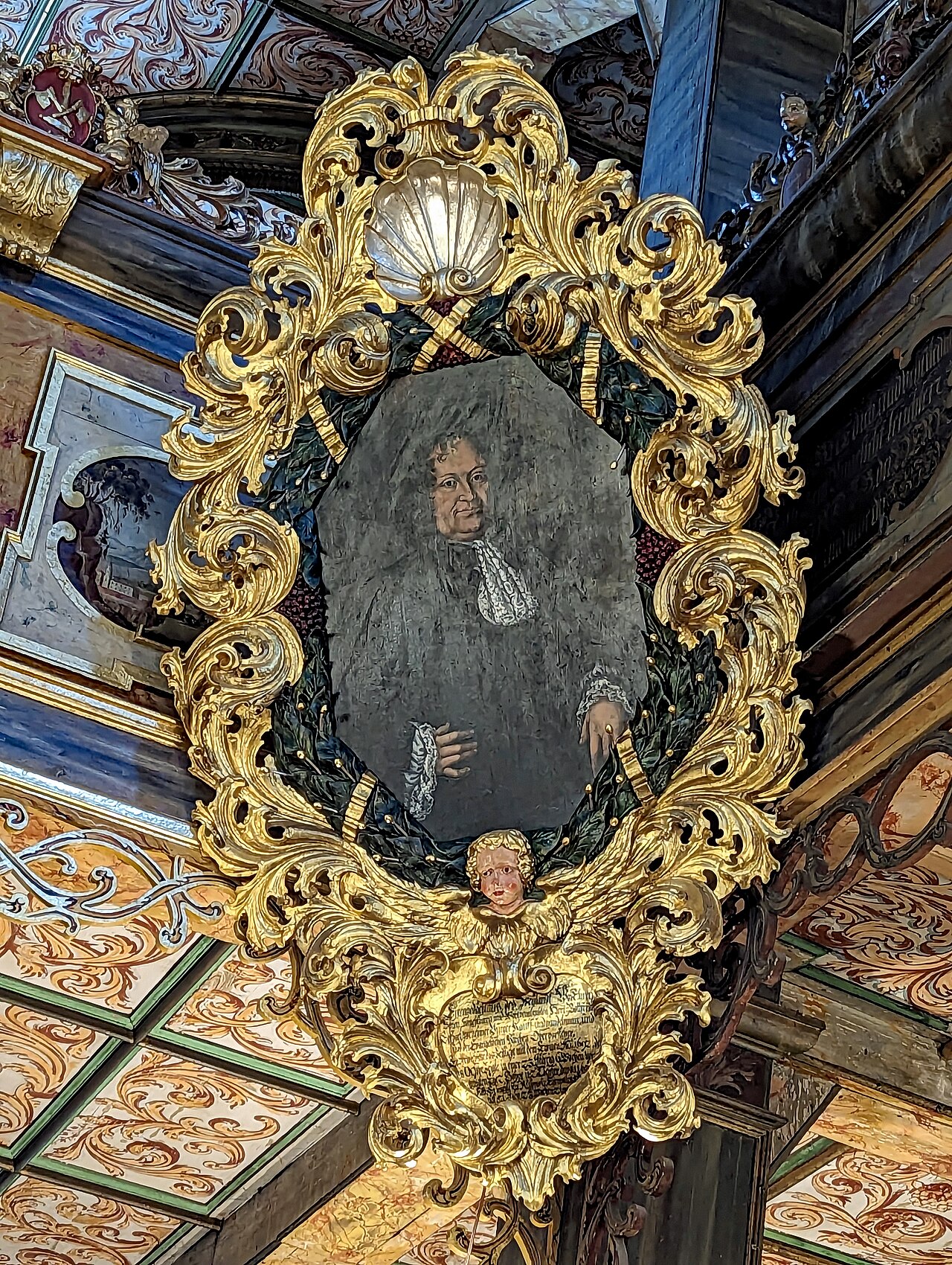
The painted decoration is overwhelming in quantity and consistent in quality. Over 2,000 oil paintings cover the gallery panels, the ceiling compartments, the triumphal arch, and the pulpit. The subjects are drawn from the Old and New Testaments, from Lutheran devotional imagery, and from portraits of Silesian and regional notables who contributed to the building or its maintenance. The ceiling above the nave is divided into compartments, each containing a scene — a technique that creates a visual encyclopedia of biblical narrative spread across the structural geometry of the roof. The effect is of an interior where every surface carries information, every painted figure participates in a theological programme, and the accumulated colour and imagery create an atmosphere of devotional intensity that overrides the building’s modest exterior and its impermanent materials.
The Jawor church is somewhat smaller — capacity 6,000 — but architecturally similar in principle and equally complete as a decorative programme. Jawor is less frequently visited than Świdnica, partly because it is less well connected to the Wrocław tourist circuit, and the interior rewards the extra effort. The two churches form a pair in UNESCO terms and in any serious itinerary: they represent the same historical moment, the same building constraints, and the same architectural response, but each has a slightly different character in scale and decorative detail.
The Centennial Hall in Wrocław, inscribed in 2006, lies about 60 kilometres north — close enough for a comfortable day trip in either direction. Muskauer Park, 100 kilometres to the northeast, completes a Silesian UNESCO circuit for visitors spending several days in the region. Wrocław itself, while not individually inscribed, is a major city with medieval and Baroque architecture, a university district, and the rebuilt Old Town.
Practical information
Świdnica is connected to Wrocław by regular train (approximately 1 hour, several departures daily) and by road (55 km, about 50 minutes). The Church of Peace is a short walk south from Świdnica’s main railway station and town centre. Jawor is about 35 kilometres west of Świdnica — reachable by regional bus or by car — making a combined visit to both churches in a single day straightforward.
Both churches are open to visitors throughout the year, with slightly reduced hours in winter. Admission charges apply (currently in the range of 10–20 PLN for adults at each church; check current prices on the churches’ official websites). Guided tours are available in Polish and German; English-language audio guides or printed guides are available at both sites. Photography is permitted inside both churches.
Wrocław is the natural base for a visit. It has a full range of accommodation, direct rail connections from Warsaw, Berlin, and Prague, and its own substantial heritage of medieval, Baroque, and modernist architecture. The Centennial Hall (Hala Stulecia) UNESCO site is in Wrocław’s Exhibition Grounds on the east bank of the Oder — a 1913 reinforced concrete building by Max Berg that is a landmark of early 20th-century architecture. A Silesian UNESCO circuit of two or three days — Wrocław, Świdnica, Jawor, and if time allows, Muskauer Park — is one of the most rewarding heritage itineraries in this part of Central Europe.
Frequently Asked Questions
Why were the Habsburg restrictions designed the way they were?
The specific restrictions imposed on the Churches of Peace — no stone, no brick, outside the walls, no tower, no bells, completed within a year — reflect a coherent strategy for subordinating Protestant religious expression to Catholic dominance within the framework of a negotiated political settlement. The Peace of Westphalia required the Habsburgs to permit Lutheran worship in Silesia; the conditions on church construction were the mechanism for ensuring that the permission was as limited as possible in practical effect. Building in wood, clay, and straw marked the churches as temporary and impermanent in the material hierarchy of 17th-century European architecture, where stone and brick signified permanence and institutional legitimacy. Placing the churches outside the city walls removed them from the protected, socially prominent space of the urban core, where the Catholic churches with their stone towers and bells occupied the dominant positions. Prohibiting towers and bells removed the most visible and audible markers of ecclesiastical presence — a church without a tower and without bells does not announce itself across a landscape in the way that Catholic churches did. The one-year completion deadline was probably intended to make careful, durable construction difficult and perhaps to create additional barriers to the project’s success. That the Lutheran communities met all these conditions and produced architecturally remarkable buildings is a measure of the motivation and resources they brought to the project. The 7,500-person capacity of the Świdnica church indicates that the community did not interpret the constraints as limiting the building’s scale or ambition — only its materials and its location.
How did Lutheran communities in Silesia maintain their faith during the Counter-Reformation before the churches were built?
The decades before the construction of the Churches of Peace were a period of intense pressure on the Lutheran population of Silesia. The Counter-Reformation programme in Habsburg lands involved the systematic reassignment of Protestant churches to Catholic use, the expulsion of Protestant clergy, the closure of Lutheran schools, and the legal requirement that residents convert to Catholicism or emigrate. Many thousands of Silesian Lutherans emigrated to neighbouring Protestant territories — Saxony, Brandenburg, and further north — during this period, taking their capital and skills with them. Those who remained practised their faith in private, in gatherings that had no legal status, or crossed the border into neighbouring territories where Lutheran worship was permitted. The period produced a form of crypto-Lutheranism: communities that maintained Protestant belief and practice covertly while conforming publicly to Catholic requirements. The emotional and religious significance of the Churches of Peace, when they were finally permitted and built, is partly explained by this preceding period of suppression: the buildings represented the first legal, public expression of Lutheran identity for the remaining Silesian communities in decades. The galleries built to hold 6,000 and 7,500 people were not architectural excess — they reflected the accumulated demand of a large population for communal worship in a legally recognised space.
What happened to the third Church of Peace at Głogów?
Three Silesian towns were originally granted the right to build Churches of Peace under the 1652 agreement: Świdnica, Jawor, and Głogów (known in German as Glogau). Only the Świdnica and Jawor churches survive. The Głogów church was built in 1652 to 1654, on the same conditions as the others, in the town on the Oder River north of the other two sites. It was destroyed in 1758 during the Seven Years’ War, when Głogów was besieged and heavily damaged by Prussian forces. By that point Silesia had been annexed by Frederick the Great of Prussia in the War of the Austrian Succession (1742), and the political context for the Churches of Peace had changed substantially: under Prussian Protestant rule, Silesian Lutherans no longer needed special dispensations to build churches. The legal framework that had created the Churches of Peace — and that had also guaranteed their special status and protection — was irrelevant in a Protestant kingdom. The Głogów church was not rebuilt after its destruction, and the community built a new Lutheran church in the following decades. The two surviving churches at Świdnica and Jawor were inscribed by UNESCO as a pair representing the original group; the Głogów church is mentioned in the inscription documentation as the missing third member of the set.