The Wieliczka Salt Mine has been operating continuously since the 13th century, making it one of the oldest functioning industrial sites in the world. Inscribed on the UNESCO World Heritage List in 1978 among the very first twelve sites ever recognised, it extends 287 kilometres of tunnels across nine levels, dropping to 327 metres below the surface. At its heart is a cathedral-scale underground chapel carved entirely from salt by miners working in their spare time over 67 years.
One of the World’s First UNESCO Sites, 14 Kilometres from Kraków 14 km SE of Kraków · bus or train from Kraków Główny
When UNESCO convened its inaugural World Heritage Committee in 1978, the Wieliczka Salt Mine was among the twelve sites chosen to anchor the entire concept of universal cultural significance. That founding status is not incidental: the mine represents eight centuries of unbroken industrial activity, stretching from the early Piast dynasty through the Habsburg era and two world wars to its final commercial extraction in 2007. During its peak in the 19th century, salt produced at Wieliczka accounted for one third of the Polish crown’s income — a figure that explains why the mine attracted sustained royal investment and protection.
The geological conditions here are extraordinary. The Wieliczka deposit formed approximately 13.5 million years ago when an ancient sea evaporated during the Miocene epoch, leaving behind a salt layer up to 400 metres thick. Medieval miners began working it in the 13th century using methods that remained largely unchanged for five centuries: rock salt extracted by hand, hauled by horses stabled underground, crushed and dissolved in brine for transportation. At peak production, some 2,000 horses lived their entire working lives below ground, stabled in chambers carved from salt and never returning to the surface.
Today the mine operates as a museum and health resort, but the scale of what visitors enter is genuinely disorienting. The nine levels of tunnels — each a different geological stratum — contain over 2,000 chambers excavated over the centuries. Wooden infrastructure dating from the 17th and 18th centuries survives in remarkable condition, preserved by the stable microclimate: a constant temperature of 14°C and humidity between 70 and 82 percent. The salt environment has also proved hostile to bacteria and fungi, which explains why organic materials — rope, timber, leather — have lasted centuries underground.
The broader UNESCO landscape in this corner of southern Poland is unusually dense. The Historic Centre of Kraków, just 14 kilometres to the north, was inscribed on the same inaugural 1978 list alongside Wieliczka. Kraków’s Wawel Castle, the Gothic cathedral, and the medieval market square form a complementary counterpart to the industrial heritage underground at Wieliczka — royal Poland above ground, working Poland below. Thirty-five kilometres south lies Kalwaria Zebrzydowska, a Mannerist pilgrimage complex inscribed in 1999 that brings the total number of UNESCO sites within a one-hour drive to three. Fifty kilometres west, Auschwitz-Birkenau (inscribed 1979) adds a fourth layer of World Heritage density that makes this region among the most concentrated in Central Europe.
The Chapel Carved Over 67 Years — and the Legend of the Princess’s Ring 135 metres below ground · included in standard mine tour
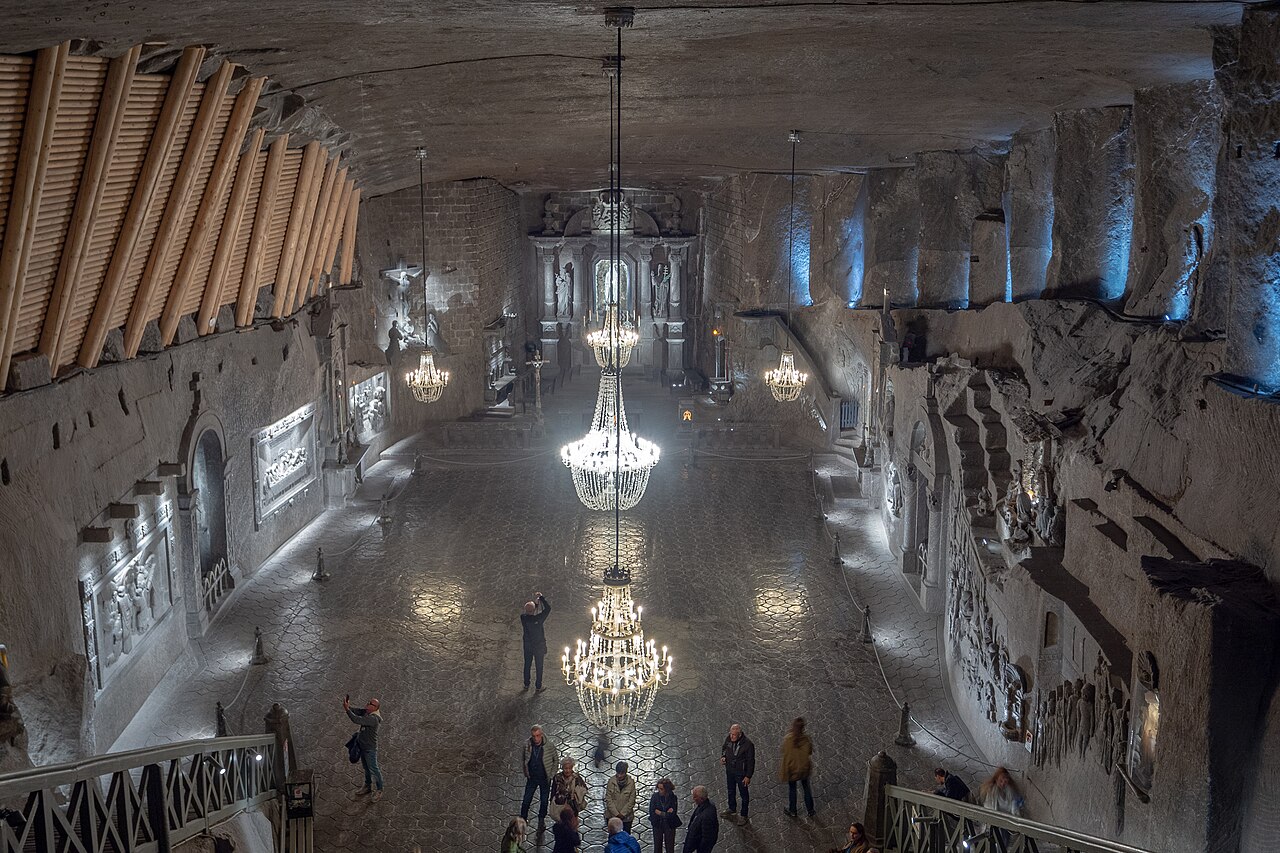
The mine contains dozens of chambers shaped into chapels, statues, and bas-reliefs over the centuries, but the Chapel of Saint Kinga — Kaplica Świętej Kingi — occupies a category of its own. Located 135 metres below the surface on level three, it measures 54 metres long, 17 metres wide, and 12 metres high, making it the largest underground place of worship in the world. The floor, the walls, the altar, the pews, the chandeliers, and the sculptural reliefs are all carved from or constructed with salt. No imported stone, no plaster, no paint: every visible surface is halite.
The chapel’s construction began in 1895, when the miner Józef Markowski started carving the first chamber by hand. It was not a commissioned project. Markowski and successive generations of miners undertook the work voluntarily, chiselling the walls and ceiling during rest periods and after shifts. The project continued under Tomasz Markowski and then Józef Pychowski, who completed the final sculptures in 1963 — sixty-seven years of cumulative labour. The chandeliers overhead, which appear to be crystal, are constructed from salt: chunks of rock salt dissolved in brine and then allowed to re-crystallise around metal frames, producing forms that catch light like glass.
The chapel is dedicated to Princess Kinga, patron saint of Poland and Lithuania, whose legend is inseparable from the mine’s foundation story. According to the account, Kinga was a Hungarian princess engaged to the Polish prince Bolesław V. Before leaving Hungary, she threw her engagement ring into a salt mine at Máramaros. When she arrived in Poland and ordered miners to dig at what would become Wieliczka, the first salt block brought to the surface contained the ring. The legend functions as a founding myth connecting the mine to royal patronage, and Kinga was canonised in 1999 by Pope John Paul II — himself a native of the region.
Beyond the chapel, the tourist route through Wieliczka passes chambers used for different purposes across the centuries: a ballroom carved in 1748 that hosted the Habsburg emperor Franz Joseph in 1880, underground lakes of brine in crystalline blue-green hues, and galleries of wooden mining equipment showing how salt was transported from the deepest levels. The mine also operates an underground sanatorium, where patients with asthma and chronic respiratory conditions spend extended periods in the salt-saturated air. Clinical studies have documented measurable improvements in lung function; the microclimate remains stable regardless of surface weather conditions, and the absence of allergens makes the environment particularly effective for allergy treatment.
Practical information
Wieliczka is accessible from Kraków by local bus (lines 304 or 304N from Kraków’s main bus station, journey time approximately 30 minutes) or by train from Kraków Główny station (journey time 15 minutes, departures frequent throughout the day). By car, the mine is a 20-minute drive southeast of the city centre via the A4 motorway. The mine entrance is on Daniłowicza Street in central Wieliczka town, a short walk from both the bus stop and the train station.
Adult entrance tickets for the standard Tourist Route cost approximately 110 PLN (around 25 USD at current rates); the Miner’s Route, a more physically demanding alternative through less-visited sections, costs around 145 PLN. Tickets should be booked online in advance, particularly between June and August, when the mine receives up to 10,000 visitors daily. Tours are conducted in multiple languages including English, Polish, German, and French, and groups are escorted — independent exploration is not permitted.
The mine maintains a constant 14°C year-round; bring a layer regardless of surface conditions. The standard tour lasts approximately two and a half hours and involves descending 378 wooden steps to begin. The deepest point on the tourist route is 135 metres below ground. Lighting throughout is electric, installed in the early 20th century.
Accommodation in Wieliczka itself is limited; most visitors stay in Kraków and travel out for the day. The historic centre of Kraków offers lodging at all price points, from budget hostels in the Kazimierz district to upmarket hotels near Wawel Castle.
Frequently Asked Questions
Why was the Wieliczka Salt Mine among the very first UNESCO World Heritage Sites?
The 1978 inaugural list of World Heritage Sites was selected to demonstrate the breadth of what the newly created convention could protect: natural landscapes, ancient ruins, industrial heritage, and living urban centres. Wieliczka was chosen because it combined exceptional historical continuity — over seven centuries of unbroken salt extraction — with cultural significance that had shaped an entire region’s economy and identity. The mine also represented a category that had no parallel on the list: an underground industrial complex of medieval origin still intact and operational. UNESCO’s criteria at the time emphasised sites that were outstanding examples of a type of building or technological ensemble representing human creative genius, and the mine’s nine levels, thousands of chambers, and sculptural legacy made a compelling case. The fact that it was still producing salt in 1978 (extraction continued until 2007) reinforced its status as a living heritage rather than a ruin.
How were the chandeliers in the Chapel of Saint Kinga made from salt?
The chandeliers in the Kaplica Świętej Kingi are not made from raw rock salt but from salt crystals grown through a controlled dissolution and re-crystallisation process. Miners dissolved chunks of rock salt in brine to create a saturated solution, then suspended metal armatures in the liquid and allowed the salt to crystallise slowly around them over weeks or months. The resulting crystals — cubic and transparent in the right conditions — refract light in a way that resembles glass or crystal. The chandeliers were built in sections, with the largest spanning approximately four metres in diameter. They are periodically removed, cleaned, and restored by specialist conservators who use the same crystallisation techniques. The process is time-consuming but produces results that no synthetic substitute has convincingly matched; the irregular growth patterns of the salt crystals give the chandeliers a texture that manufactured glass cannot replicate.
What is the underground sanatorium at Wieliczka and who can use it?
The Wieliczka Salt Mine operates an underground health resort in chambers on level four, approximately 135 metres below the surface. The microclimate there combines a stable temperature of 14°C with humidity levels between 70 and 82 percent and air saturated with sodium chloride, magnesium, and calcium ions. The absence of surface allergens, mould spores, and air pollution creates conditions that have been used therapeutically since the late 19th century. Contemporary programmes target patients with bronchial asthma, chronic obstructive pulmonary disease, hay fever, and skin conditions including psoriasis. Treatment courses typically run for twelve to fourteen days, with patients spending six to eight hours per day underground in a combination of rest, mild exercise, and inhalation therapy. The sanatorium is available both to Polish nationals through the national health system (with referral) and to international visitors booking privately. Accommodation is provided in chambers fitted out as basic dormitories. The therapeutic outcomes are documented in Polish and German clinical literature, though the evidence base remains smaller than for conventional pharmaceutical treatments.