
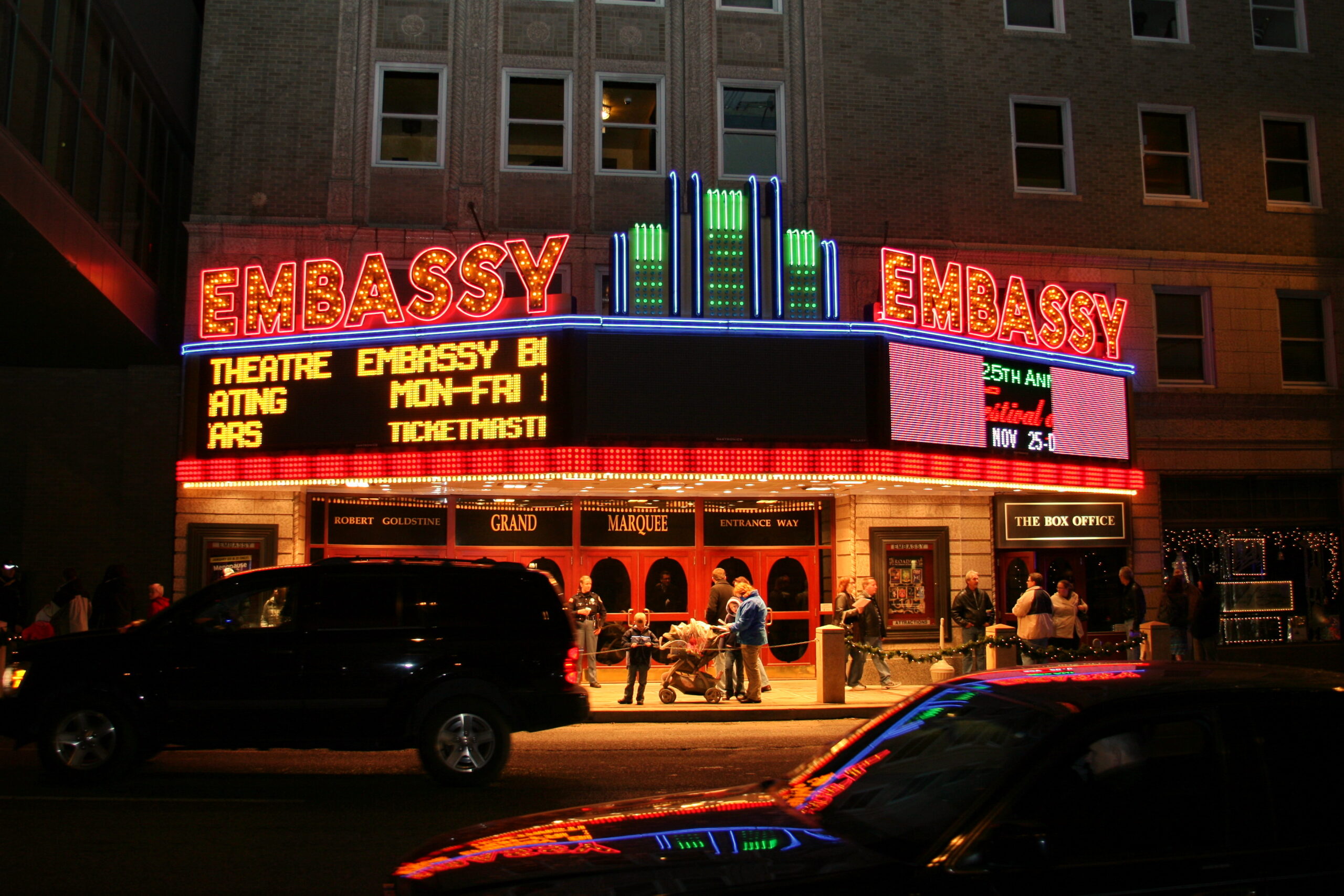
Fort Wayne’s grand atmospheric movie palace opened in 1928 as the Emboyd Theatre and has outlasted its era to become Indiana’s best-preserved great movie house, now home of the Fort Wayne Philharmonic.
At a glance
The Embassy Theatre opened on 14 January 1928 on West Jefferson Boulevard in downtown Fort Wayne, commissioned by theatre operators Bob and Lou Boyd, who gave it their surname — Emboyd — before it was renamed the Embassy in 1952. The building’s designers gave it a French Baroque interior of extravagant richness: gilded plasterwork, painted murals, crystal chandeliers and an atmospheric ceiling that simulates a Mediterranean sky above the 2,471-seat auditorium. Despite the Depression, a postwar decline in movie-palace attendance, and a brush with demolition in the 1970s, the Embassy survived through the advocacy of a local preservation coalition and is now operated by the Embassy Theatre Foundation as Fort Wayne’s premier venue for the performing arts.
Key facts
- Opened: 14 January 1928 as the Emboyd Theatre; renamed Embassy Theatre 1952
- Style: French Baroque atmospheric — gilded plasterwork, painted murals, atmospheric sky ceiling
- Capacity: 2,471 seats
- Address: 125 W Jefferson Blvd, Fort Wayne, IN 46802
- GPS: 41.0793°N, 85.1419°W
- Status: National Register of Historic Places (1979); home of Fort Wayne Philharmonic
- Organ: original Robert Morton theatre pipe organ, restored and still in use
History
Fort Wayne in the mid-1920s was one of Indiana’s largest cities, a manufacturing and commercial centre where the trunk lines of the Pennsylvania, Wabash and New York Central railroads converged. Bob and Lou Boyd, who operated a circuit of Indiana theatres, chose the city’s most prominent commercial street for a venue intended to rival anything in Indianapolis or Chicago. The building they commissioned — French Baroque in its interior decoration, with a street facade that mixed classical and Renaissance elements — opened to considerable local fanfare in January 1928.
The theatre’s great Wurlitzer organ had already been installed for the silent-film era when the talkies arrived in the following months. The Embassy adapted, presenting films alongside stage shows through the 1930s and 1940s. The decline of downtown movie palaces accelerated through the 1950s and 1960s as suburban cinemas spread across the region, and by the early 1970s the building’s future was uncertain. A group of Fort Wayne citizens formed a preservation organisation that successfully campaigned for National Register status in 1979 and later acquired the building outright. Today the Embassy Theatre Foundation operates it as the city’s primary live-performance venue.
Major restorations in the 1990s and 2000s returned the auditorium’s plasterwork and murals to their 1928 condition, and the Robert Morton pipe organ — which had been partially decommissioned — was fully restored and is now played at film screenings and special events.
What you see
The Jefferson Boulevard facade is a French Renaissance composition in buff brick and terra cotta, with a projecting entrance canopy of ornamental ironwork above which an illuminated vertical sign once announced the Emboyd and now reads EMBASSY. The lobby is dominated by crystal chandeliers and a painted barrel vault in ivory and gold. Stairs leading to the mezzanine are flanked by large oil paintings in gilded frames — allegorical scenes in the European tradition of grand public decoration.
The auditorium ceiling is painted to suggest a clouded Mediterranean sky at twilight, in the atmospheric tradition that John Eberson had established a few years earlier. Side walls are articulated as Baroque facades with painted windows and Corinthian pilasters; crystal wall sconces provide the supplementary illumination that gives the room its warm, intimate quality even at full 2,471-seat capacity. The stage proscenium is a deep arch of gilded plaster with flanking organ grilles in decorative metalwork — behind each grille, the pipes of the Robert Morton organ.
Practical information
- Access: 125 W Jefferson Blvd, Fort Wayne IN 46802 — downtown, between Harrison and Calhoun Streets
- Tours: Embassy Theatre Foundation offers guided tours; check the website for current schedule
- Events: Fort Wayne Philharmonic concerts, touring Broadway productions, classic film screenings with live organ accompaniment
- Parking: city parking garages on Harrison and Clinton Streets; metered street parking on Jefferson
- Time needed: 45 minutes–1 hour for lobby visit; 2.5–3 hours for an evening concert or show
Getting there
The Embassy sits at the heart of Fort Wayne’s downtown grid, two blocks east of the Historic Wells Street corridor. Fort Wayne International Airport (FWA) is approximately 9 miles southwest — 15 minutes by car or rideshare. By car, Fort Wayne is at the intersection of I-69 and US-30, the latter being one of the original transcontinental US routes. Indianapolis is 120 miles south via I-69; Chicago is 140 miles northwest via I-69 and I-94. The building is walkable from the Allen County Courthouse, the Fort Wayne Museum of Art and the Grand Wayne Convention Center.
Nearby
- Fort Wayne Museum of Art — Comprehensive regional art museum on Main Street, two blocks north of the Embassy, with a strong collection of American paintings.
- Allen County Courthouse (1902) — Beaux-Arts courthouse with a copper dome, one block east — the architectural counterpart to the Embassy on Fort Wayne’s civic skyline.
- Madam C.J. Walker Theatre Center (1927), Indianapolis — Another Indiana atmospheric theatre of the same era, 120 miles south. See the CHO guide.
- Science Central — Hands-on science museum for families, three blocks north on Spring Street in a converted 1898 power plant.
Sources
- Embassy Theatre Foundation official site — history, tours and events
- National Register of Historic Places nomination, Embassy Theatre, Fort Wayne, 1979
- Fort Wayne Journal-Gazette archives — opening week coverage, January 1928
- American Theatre Architecture Archive (ATAA) — Emboyd / Embassy Theatre documentation
- Historic American Buildings Survey (HABS) documentation
Find it on the map
See this place and what’s around it →📷 Become a Cultural Heritage Online photographer
Share your photos of places: they stay published under your name as the author. The more they're seen, the more you get noticed — and soon a contest will reward the most appreciated photos.
Log in or sign up free to add a photoIs this page about you?
This page is read by travellers and heritage enthusiasts who find it on Google. Tell us how you are connected to this place and we will take it from there.