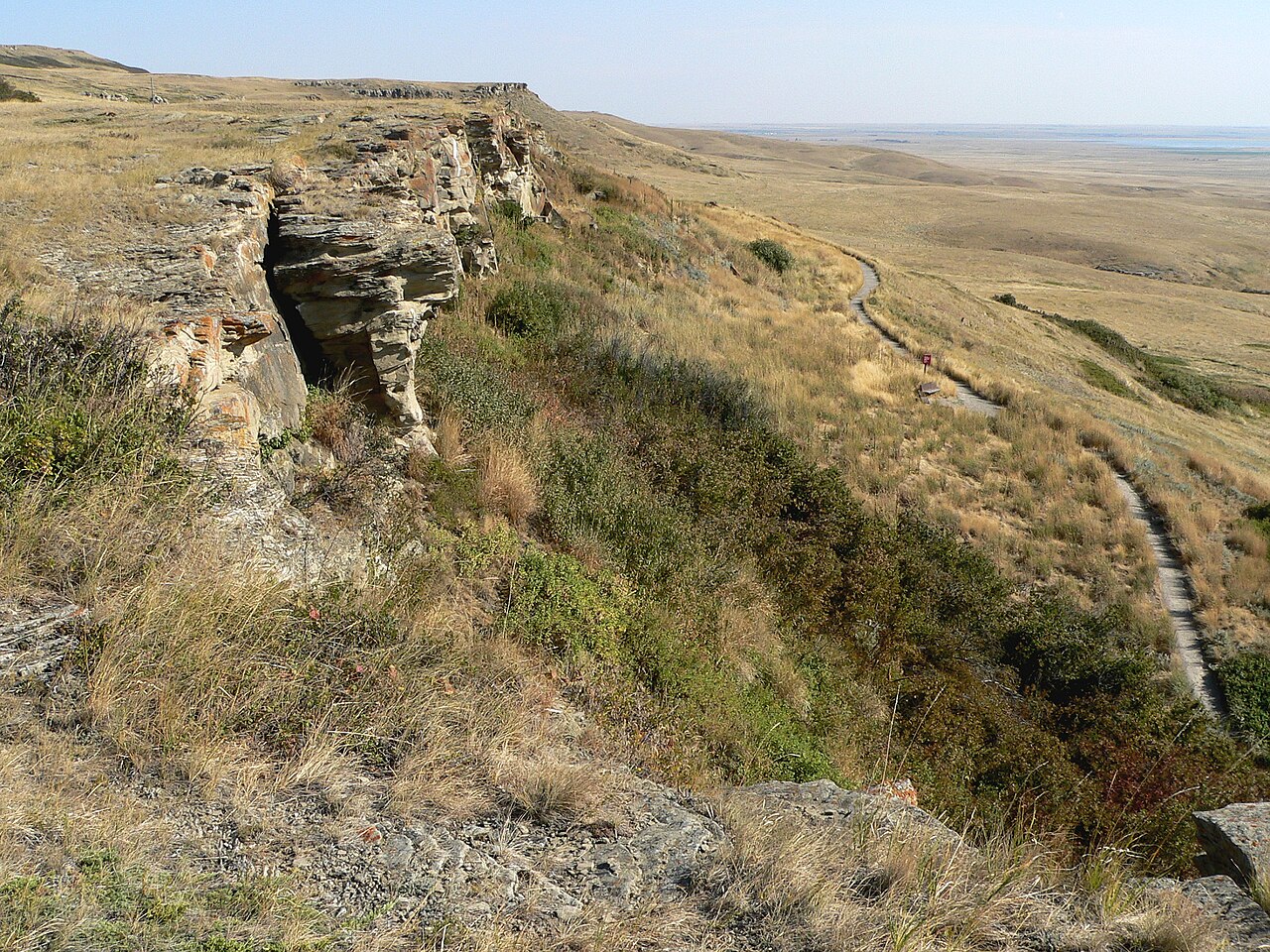
Head-Smashed-In Buffalo Jump, near Fort Macleod in southern Alberta, Canada, is the oldest, largest and best-preserved buffalo jump in North America, used continuously for approximately 5,800 years from around 3800 BCE to the 19th century. The site encompasses a 40-square-kilometre system of stone cairns and drive lanes across the Porcupine Hills prairie, a 10-metre sandstone cliff, and a bone bed at its base that is 12 metres deep and contains the remains of at least 123,000 individual bison. UNESCO inscribed it in 1981, among the first Canadian inscriptions on the World Heritage List.
The drive system and how it worked 165 km south of Calgary; 18 km from Fort Macleod on Secondary Road 785
A buffalo jump (called a pishkun in Blackfoot) is not simply a cliff from which bison were pushed. It is the termination point of an elaborate spatial system that begins many kilometres away and requires the coordinated effort of an entire community over several days. At Head-Smashed-In, that system extended across roughly 40 square kilometres of Porcupine Hills terrain to the west and north of the cliff face. Stone cairns — low piles of rock placed at intervals — mark the edges of funnel-shaped drive lanes that converge toward the cliff. Thousands of these cairns survive across the prairie surface, some deeply embedded in the sod after 5,800 years. They are not obstacles but visual markers: bison, with poor frontal vision but acute peripheral awareness, react to movement at the edges of their visual field. A human crouching behind a cairn, rising at the right moment, would push a bison slightly inward, away from the edge of its comfort zone. Multiply this by dozens of people spaced along converging lines stretching kilometres back into the hills, and you have a mechanism for directing a herd of several hundred animals with minimal noise or stress — until the final approach to the cliff, when the pace would quicken and the animals, now moving at speed within an increasingly narrow corridor, would not be able to stop before the edge.
The cliff at Head-Smashed-In drops approximately 10 metres onto the prairie below — not a spectacular height, but more than sufficient. Bison in the rear of a stampeding herd have no ability to stop or turn when those at the front go over. The animals that survive the fall are disoriented and injured. Hunters waiting below could dispatch them efficiently. The entire hunt — from scout location of a herd to the completion of processing — might take a week or more.
The Piikani (Peigan) Nation, one of the three nations of the Blackfoot Confederacy, are the primary custodians of Head-Smashed-In and its history. Their territory encompasses this part of southern Alberta and extends south across the current US-Canada border into Montana. The buffalo jump was central not only to subsistence but to social organisation: the hunt required collective coordination at a scale that reinforced community bonds, protocols of leadership and reciprocal obligation. Every part of the bison was used. Hide provided clothing, tipi covers and bags; sinew provided bowstrings and thread; bone provided tools, including the distinctive fleshing tools found in the bone bed at Head-Smashed-In; stomach and bladder linings provided water containers; dung provided fuel; tongue was a delicacy. The caloric yield of a successful jump — hundreds of bison processed in a matter of days — would sustain a community through winter. The jump was not used every year, and not every attempt succeeded; the logistical complexity meant that failures were common. Its 5,800-year continuity is testimony to the effectiveness of the method across a very long arc of time.
The bone bed: an archaeological archive 12 metres deep Oldman River basin, southwestern Alberta foothills
Twelve metres of compressed bison bone at the base of the cliff, representing at least 123,000 individual animals, constitutes one of the richest zooarchaeological deposits in North America. The bone bed is not static; it is stratigraphic. Each layer of bone corresponds to a particular phase of use, and the cultural materials — stone tools, projectile points, ceramic sherds — embedded within the bone have allowed archaeologists to sequence the site’s occupation across nearly six millennia. The transition from atlatl-launched darts to bow-and-arrow, dateable through changes in projectile point morphology, is documented in the Head-Smashed-In bone bed. Changes in the bison themselves — shifts in body size corresponding to climatic variations across the Holocene — are visible in the bone measurements. The site is simultaneously a monument to Blackfoot cultural continuity and a laboratory for understanding how humans and bison populations coexisted and influenced each other over long periods.
The name itself requires explanation. Estipah-skikikini-kots in Blackfoot translates as “where he got his head smashed in.” The story recorded by Blackfoot oral tradition and by early ethnographers describes a young man who positioned himself below the cliff to watch the cascade of bison during a jump. He misjudged the scale of the fall, was buried under the bodies, and was found with his skull crushed. The name is not romantic or metaphorical; it is a practical warning embedded in place nomenclature, of the kind common across Indigenous North American geography. The English translation retains its directness.
The interpretive centre, opened in 1987, was designed by Calgary architect Brant Gillmore with an explicit brief to make the building invisible from the cliff face. The building is embedded into the sandstone slope below the cliff edge, its roofline following the natural grade of the hillside. Seen from the jump face, the cliff appears unmodified. Seen from below or from the access road, the building emerges from the ground in stepped terraces of cast concrete coloured to match the local sandstone. Seven levels of exhibition follow the natural topography of the slope. The Piikani Nation was closely involved in the interpretive content and continues to provide cultural programming, with Piikani interpreters presenting oral history and traditional knowledge alongside the archaeological and geological displays. The collaboration was, at the time of the centre’s opening, among the more developed examples of Indigenous community involvement in a Canadian heritage interpretation project, and it has served as a reference model for subsequent developments elsewhere in the country.
Practical information
Head-Smashed-In Buffalo Jump is located approximately 165 kilometres south of Calgary and 18 kilometres west of Fort Macleod, accessible via Secondary Road 785. The drive from Calgary takes roughly two hours; from Lethbridge (50 km east), under 45 minutes. The interpretive centre is open year-round, though hours are reduced outside summer (May to September). Entry is charged; the province of Alberta manages the site. The centre’s seven floors of exhibits can occupy two to three hours. Self-guided walking trails on the cliff top and along the base of the cliff allow visitors to examine the drive lane cairns and the bone bed exposure. Guided cultural tours led by Piikani interpreters run on a seasonal schedule and are the most direct way to engage with the Blackfoot perspective on the site. Fort Macleod itself, 18 kilometres east, has the Fort Museum of the North West Mounted Police (occupying a reproduction of the original 1874 fort) and modest accommodation and restaurant options. Lethbridge is the main regional city with full services. Head-Smashed-In is most practically combined with the Lethbridge area and the Crowsnest Pass in a southwestern Alberta circuit; a separate day-trip from Calgary is also comfortable. Weather on the high prairie is variable; wind is a near-constant factor even in summer. The cliff-top trail is exposed; appropriate clothing layers are recommended year-round.
Frequently Asked Questions
How did the Piikani Blackfoot manage bison herds at this scale over thousands of years?
The management of bison hunts at Head-Smashed-In was not a simple matter of locating a herd and running it off a cliff. It required systematic knowledge accumulated across generations: understanding of bison seasonal movements and grazing patterns across the Porcupine Hills; knowledge of wind direction and how it affected the animals’ ability to scent humans; protocols for approaching and pre-positioning scouts without disturbing the herd; and detailed knowledge of the specific drive lane topography — which cairns to activate at which moment, which gullies and ridgelines could be used to funnel animals without triggering a panic that would scatter them. This knowledge was transmitted orally and through direct mentorship. The role of “buffalo runner” — the individual who initiated the drive, often dressed in wolf or bison calf skins — required specific training and was considered a position of high responsibility and spiritual weight. Ritual preparation preceded every major hunt: ceremonies to call the bison, to acknowledge the animals’ willing sacrifice, and to ensure the reciprocal obligations between humans and bison were maintained. This spiritual framework was not separate from the practical management system; it was part of it, encoding the rules (do not over-hunt; process every animal completely; waste nothing) that sustained the relationship between the Piikani and bison populations across 5,800 years of continuous use of this site.
What does the 1981 UNESCO inscription mean for a site with living Indigenous custodianship?
Head-Smashed-In was among the first group of Canadian sites inscribed on the UNESCO World Heritage List, in 1981. At that time, the frameworks for acknowledging Indigenous custodianship in World Heritage management were far less developed than they are today. The site was inscribed primarily for its outstanding archaeological value — the depth and continuity of the bone bed, the preservation of the drive lane system — without a fully articulated mechanism for Piikani co-governance. The interpretive centre opened in 1987 was, in its time, a genuine advance: the Piikani Nation was consulted in depth, Piikani knowledge holders contributed to the interpretive content, and Piikani community members were employed as interpreters from the outset. But the site remained provincially managed under Alberta’s Historical Resources Act rather than under a co-management agreement that would give the Piikani formal decision-making authority over heritage management decisions. The broader evolution of Canadian Indigenous rights law — particularly the recognition of Aboriginal title under the Constitution Act 1982 and subsequent Supreme Court decisions — has changed the context significantly since 1981. Current discussions about Head-Smashed-In’s governance reflect the wider Canadian conversation about moving from consultation models to genuine co-management. For visitors, the practical implication is that engaging with the Piikani interpretation programme — rather than only the archaeological displays — provides the more complete understanding of what the site is and what its continued significance means to the community whose ancestors built and used it.
Are there other buffalo jump sites in North America, and how do they compare?
Buffalo jumps are documented across the northern Great Plains from Montana and Wyoming north through Alberta and Saskatchewan, and a smaller number of sites have been identified in the Canadian prairie provinces. The distribution reflects the range overlap between bison herds and the cliff and coulee topography necessary for the drive method. Estimating the total number of jump sites is complicated by variable preservation and varying definitions of what constitutes a “jump” versus a simple cliff drive or impound; figures in the literature range from a few dozen well-documented sites to over 300 potential locations across the northern plains. Among these, Head-Smashed-In is exceptional on three counts: age (5,800 years of continuous use is the longest documented sequence anywhere), scale (the 40-square-kilometre drive lane system is the most extensive surviving example), and preservation (both the stone cairn network on the surface and the bone bed stratigraphy below are unusually intact). Other significant sites include Vore Buffalo Jump in northeastern Wyoming (used approximately 300 to 350 years ago and excavated to reveal extremely dense bone deposits from a shorter but intensive use period), and Old Women’s Buffalo Jump near Cayley, Alberta. None of the comparable sites combines the temporal depth, spatial extent and interpretive infrastructure of Head-Smashed-In. The UNESCO 1981 inscription recognised precisely this combination of superlatives within an already rare site type.