Babylon stands on the east bank of the Euphrates 85 kilometres south of Baghdad, and the gap between what the name means in human memory and what the physical site presents to visitors is wider than at almost any other archaeological site of comparable historical importance: a flat alluvial plain, earthen mounds covering the remains of what was once the largest city in the world, a 1980s-era Saddam Hussein reconstruction of the Nebuchadnezzar Palace in yellow brick, and amid it all the genuinely extraordinary Ishtar Gate and Processional Way, partly reconstructed on site, partly transported to Berlin’s Pergamon Museum in the early 20th century. Iraq’s most famous ancient city, inscribed on the UNESCO World Heritage List in 2019 and simultaneously placed on the List of World Heritage in Danger.
Nebuchadnezzar, the Ishtar Gate and the capital of the world’s first empire History & Archaeology
Babylon’s historical significance encompasses several millennia, but its defining moment — the period that lodged the city permanently in the memory of three Abrahamic religions — is the reign of Nebuchadnezzar II (605–562 BCE). Nebuchadnezzar rebuilt Babylon on a scale that had no precedent in the ancient world: a double-walled city encompassing approximately 850 hectares on both banks of the Euphrates, housing an estimated 200,000 inhabitants at its peak, crossed by the Processional Way — a paved avenue 20 metres wide, lined with glazed brick walls bearing images of lions in relief — leading from the southern palace complex through the Ishtar Gate to the temples of the city’s interior.
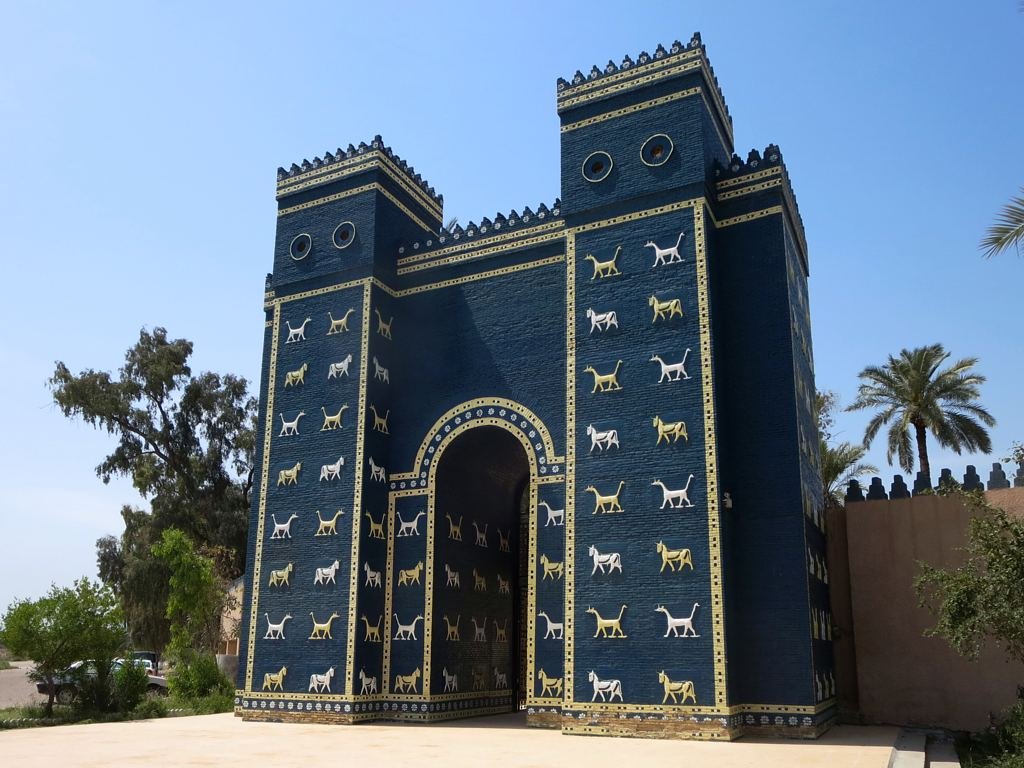
The Ishtar Gate, one of the eight gates in the inner city walls, was the most ceremonially important: dedicated to Ishtar, the Babylonian goddess of war and love, and decorated with alternating rows of dragons (mušḫuššu, the sacred animal of the city god Marduk) and aurochs (wild cattle, sacred to the weather god Adad) in glazed brick relief of a technical quality that astonished the German archaeological team that excavated and removed much of it between 1899 and 1914. The gate and approximately 150 metres of the Processional Way were shipped to Berlin and reconstructed in the Pergamon Museum, where they remain today as one of the most important displays of ancient Near Eastern art in the world. What survives at Babylon itself is a partial on-site reconstruction in glazed brick made in the early 20th century and, in the Archaeological Museum on the site, original fragments that were not removed to Berlin.
The Etemenanki ziggurat — the stepped temple tower dedicated to Marduk that occupied a large precinct in the city’s northern quarter — is the structure that most scholars identify as the historical basis for the Tower of Babel in Genesis. The biblical account (Genesis 11:1–9) describes the construction of a tower “whose top may reach into heaven” by a united humanity speaking a single language, which God disrupts by introducing linguistic diversity. The identification of Etemenanki with the Tower of Babel is supported by the fact that the Hebrew Bible’s accounts of Babylon were written during or shortly after the Babylonian captivity of the Jewish people (597–539 BCE) — the period when significant numbers of Judeans were deported to Babylon following Nebuchadnezzar’s conquest of Jerusalem in 597 and 587 BCE — and Etemenanki, the largest structure in the city, would have been the most visually dominant thing they encountered. The ziggurat itself no longer survives above ground; its foundations are visible in the excavated precinct.
The Hanging Gardens of Babylon — one of the Seven Wonders of the Ancient World — are the most enigmatic element of Nebuchadnezzar’s city, because no Babylonian text mentions them and no conclusive archaeological evidence of their physical structure has been identified at the Babylon site. The Greek and Roman sources that describe them — Diodorus Siculus, Quintus Curtius Rufus, Strabo — were writing centuries after their supposed construction, and some scholars have proposed that the Hanging Gardens may have been located at Nineveh (modern Mosul) rather than Babylon, or may be a conflation of several ancient garden traditions. The absence of archaeological evidence is not conclusive in a site as poorly preserved as Babylon, but it leaves the Hanging Gardens in a category of claimed wonders that are more historically influential as an idea than as a physical reality.
Alexander the Great, the Babylonian captivity and the longest shadow in history Classical Period & Legacy
Babylon outlasted the Nebuchadnezzar dynasty. The city fell to Cyrus the Great of Persia in 539 BCE — in circumstances that ancient sources present as remarkably bloodless, and which Persian propaganda presents as a liberation of the city’s population from Babylonian misrule — and Cyrus issued his famous Cylinder (now in the British Museum), which declares the restoration of displaced peoples to their homelands, including the Judean exiles. This edict is the basis for the biblical account of Cyrus as a divinely appointed liberator in the books of Ezra and Second Isaiah, and it makes the Persian conquest of Babylon one of the pivotal events in the formation of Jewish religious identity.
Alexander the Great captured Babylon in 331 BCE after his victory at the Battle of Gaugamela, and his entry was again reportedly peaceful — the city’s Babylonian priesthood chose to welcome him as a restorer of their sanctuaries damaged by the Persian king Xerxes. Alexander stayed in Babylon twice during his campaigns, and he died there in June 323 BCE, in Nebuchadnezzar’s palace, of a fever at age 32. The cause of his death — whether disease, poisoning, or the cumulative effects of his wounds and his extraordinary drinking — has been debated since antiquity without resolution. His death in Babylon left the Macedonian empire without an adult heir and triggered the wars of the Diadochi (Successors) that divided his conquests among his generals. Babylon remained a major city through the Seleucid period, declining gradually as the Seleucid foundation of Seleucia-on-the-Tigris drew population and commercial activity away from the old Euphrates capital. By the early centuries CE it was largely abandoned.
The modern archaeological history of Babylon begins with the German Oriental Society’s excavations led by Robert Koldewey from 1899 to 1917, which were the first systematic scientific excavation of the site and produced the material that went to Berlin. The 20th century brought further complexity: Saddam Hussein’s 1980s reconstruction programme overlaid parts of the archaeological stratigraphy with new construction in yellow brick stamped with his name — a decision that has permanently compromised the site’s scientific integrity in those areas and was explicitly noted in the UNESCO inscription as one of the primary threats to Outstanding Universal Value.
The nearest UNESCO sites from Babylon are Ashur (Qal’at Sherqat, UNESCO 2003) and Hatra (UNESCO 1985, currently on the Danger List following Islamic State destruction in 2015) in northern Iraq — both requiring a full day’s travel and, in the current security environment, significant logistical coordination. For travellers to Iraq, the circuit of Babylon, Ur (UNESCO tentative list) and the Sumerian heartland of the south is the most historically coherent and logistically accessible option from Baghdad.
Practical information
Getting there: Babylon is 85 km south of Baghdad on the road to Hillah (the nearest modern city, 8 km from the site). From Baghdad, shared taxis and buses run to Hillah from Al-Alia garage; the journey takes 1.5–2 hours. Taxis from Hillah to the site take 15 minutes. Baghdad International Airport (BGW) serves international flights. Security conditions in Iraq should be checked with your government’s travel advisory before planning a visit.
Entry: The site is managed by the Iraqi State Board of Antiquities and Heritage. Entry fees are nominal. The on-site museum holds original Babylonian artefacts not removed to Berlin. The Nebuchadnezzar Palace reconstruction (Saddam-era) and the Ishtar Gate reconstruction area are the main visitor circuits. A full visit takes 2–3 hours minimum.
When to go: October to April. Summers in the Mesopotamian plain are extreme — temperatures regularly exceed 50°C. Winter visits (December–February) are cool and the most comfortable season for archaeological walking.
Security: Iraq’s security situation has improved significantly since 2017 but remains complex. Check current Foreign Ministry advisories and consider local guide arrangements through established Iraqi tour operators. Most visitors to Babylon travel from Baghdad as a day trip.
Frequently Asked Questions
What happened to the Ishtar Gate and where can it be seen today?
The original Ishtar Gate of Babylon — built by Nebuchadnezzar II around 575 BCE as the main ceremonial entrance through Babylon’s inner city wall — was excavated by the German archaeologist Robert Koldewey and the German Oriental Society in a series of campaigns from 1899 to 1914. Koldewey’s team found the gate buried under several metres of soil, its glazed brick surfaces largely intact due to the exceptional preservation conditions of the Babylonian alluvial plain. The decision was made to remove the gate to Berlin for study, conservation and display — a decision entirely typical of the archaeological ethics of the period, which did not distinguish between excavation for study and removal for institutional collection. The dismantled bricks were shipped to the Vorderasiatisches Museum in Berlin (part of the Pergamon Museum complex on Museum Island), where they were reassembled in a reconstructed section approximately 14 metres high, accompanied by approximately 30 metres of the Processional Way’s glazed brick lion frieze. The Pergamon Museum’s Babylon hall, opened in 1930, remains one of the most impressive ancient Near Eastern displays in the world. At Babylon itself, there is a partial on-site reconstruction of the Ishtar Gate area in glazed brick made in the 1970s–80s (partly under Saddam Hussein’s reconstruction programme), which gives a sense of scale but is architecturally distinct from Koldewey’s original material. The Archaeological Museum at the Babylon site holds original glazed brick fragments and other artefacts. Iraq has formally requested the return of the Pergamon material; the request has not been fulfilled.
Why is Babylon on the UNESCO List of World Heritage in Danger?
Babylon received the dual distinction of being inscribed on the UNESCO World Heritage List and simultaneously placed on the List of World Heritage in Danger in 2019 — a situation that reflects the site’s acknowledged Outstanding Universal Value and the severity of the threats it faces. The danger listing cites several interconnected factors. First, the Saddam Hussein-era reconstruction (primarily 1982–1990): his government built a new palace on top of the archaeological mound and reconstructed or overlaid significant portions of the ancient city in yellow modern brick stamped with Saddam’s name — physically damaging the archaeological stratigraphy in those areas and compromising the scientific integrity of the site. Second, military use: the site was used as a military base by coalition forces (primarily US and Polish troops) from 2003 to 2004, during which period vehicles, sandbags and helipads damaged archaeological surfaces and disturbed unstratified material. A UNESCO report in 2004 documented approximately 400 square metres of damaged paving, crushed brick, and contaminated soil. Third, ongoing urban expansion: the modern city of Hillah is expanding toward the site’s boundaries, with groundwater extraction, modern construction and road building all threatening the shallow archaeological layers. Fourth, the broader instability of Iraq’s post-2003 institutional environment, which weakened the State Board of Antiquities’ capacity to enforce site protection. The danger listing is designed to mobilise international attention and funding for protection measures; it does not prohibit visits or indicate that the site is inaccessible.
Did Alexander the Great really die in Babylon and does it matter?
Alexander the Great died in Babylon in June 323 BCE — this is not seriously disputed by historians, even if the exact cause of death remains unresolved. The ancient sources (primarily the Vulgate tradition of Diodorus Siculus, Justin and Arrian) agree that he died in the palace of Nebuchadnezzar after a prolonged fever, following a banquet given by his Macedonian officer Medius of Larissa. The timing — he was 32 years old, had just completed the conquest of the Persian empire and the Punjab, and was planning an Arabian campaign — makes his death one of the most consequential single events in ancient history: his empire had no adult male heir, and its division among his generals (the Diadochi) resulted in three centuries of conflict that fundamentally shaped the Hellenistic world and, through it, the cultural matrix into which Christianity and Rabbinic Judaism were born. The cause of death has been debated since antiquity: typhoid fever complicated by alcohol is the most widely accepted modern diagnosis; poisoning (particularly by the compound of white hellebore used as a medicine, or by deliberate administration) has been argued repeatedly without decisive evidence. A 2019 paper in the journal The Ancient History Bulletin proposed that Alexander’s symptoms were consistent with Guillain-Barré syndrome and that he may have been in a state of ascending paralysis that was mistaken for death — potentially the origin of stories about his body showing no decomposition for six days after death. Whether or not this theory gains academic acceptance, Alexander’s death in Babylon means that the city appears in some form in the foundation myth of virtually every major Mediterranean culture of the following millennium.