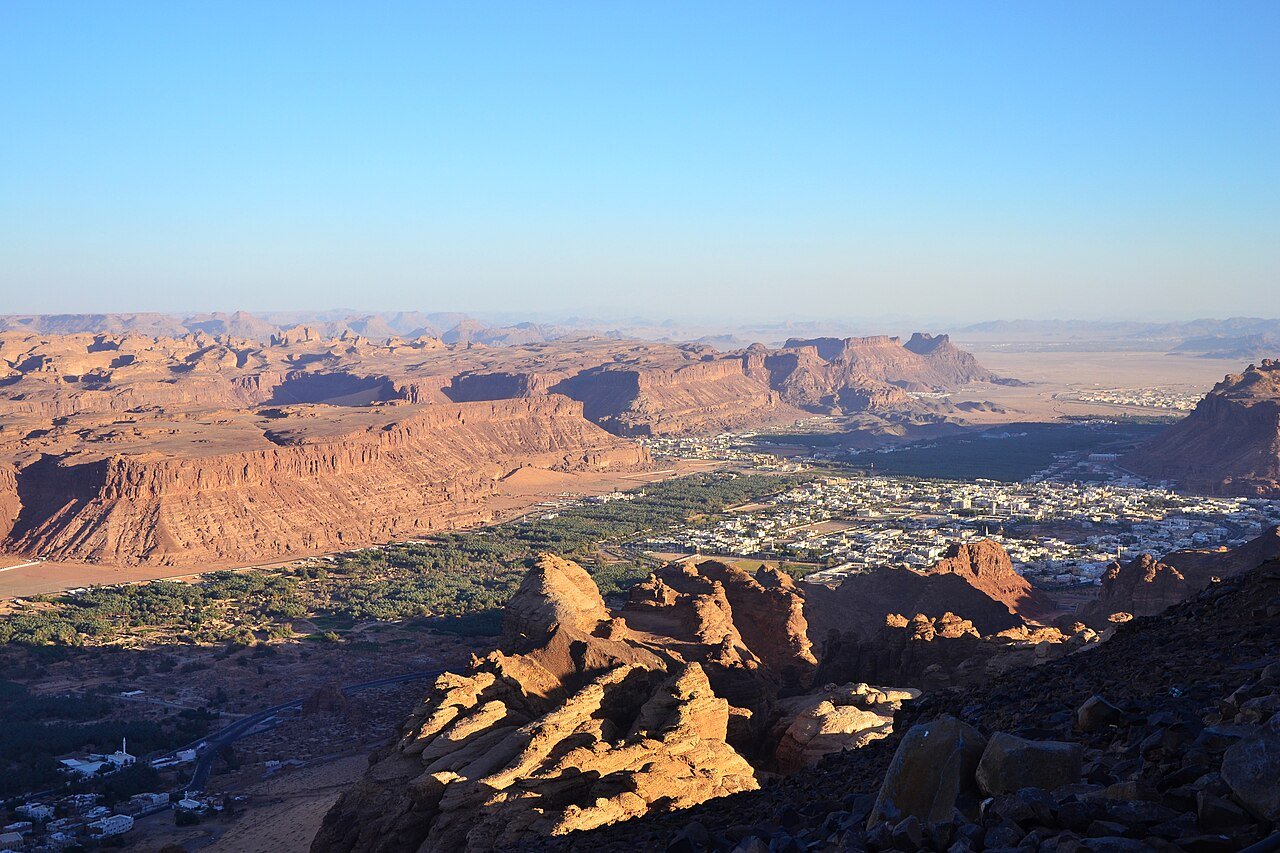
In a landscape of rose-red sandstone outcrops rising from the Hejaz plateau in northwestern Saudi Arabia, the Nabataean city of Hegra preserves 131 monumental rock-cut tombs from the 1st century BCE and 1st century CE — the southern extension of the same Nabataean civilisation that built Petra in Jordan 300 kilometres to the north, here in a more austere desert setting where the carved façades emerge directly from the stone hills with a precision and ambition that still commands the landscape after two millennia. Saudi Arabia’s first inscription on the UNESCO World Heritage List in 2008, Hegra has since become the centrepiece of the Kingdom’s most ambitious heritage tourism development under Vision 2030.
The Nabataeans at Hegra: southern frontier of the rose-red kingdom History & Archaeology
The Nabataeans were a civilisation that defies easy categorisation. They were Arab-speaking traders who controlled the incense routes from Arabia Felix (modern Yemen) and the Hejaz to the Mediterranean world, accumulating enormous commercial wealth that they translated into the construction of Petra — the rock-cut capital in what is now southern Jordan — and a network of fortified watering stations, agricultural settlements and trading posts stretching from the Negev desert to northwestern Arabia. Their engineering speciality was water management in arid environments: they built dams, cisterns, channels and sophisticated filtration systems that allowed permanent settlement in landscapes where water was otherwise seasonal or absent.
Hegra, which the Nabataeans called al-Hijr, was their most important southern city — a waypoint on the incense route between the production zones of southern Arabia and the consumption markets of the Mediterranean, and a centre of administration for the Nabataean presence in the Hejaz. Its most visible legacy is the 131 monumental rock-cut tombs that the city’s elite commissioned from the 1st century BCE through the 1st century CE, using the same combination of skilled sculptors, confident architectural vocabulary and Aramaic-inscribed dedicatory texts that the Nabataean builders used simultaneously at Petra.
The tombs vary significantly in scale and elaboration, from simple carved niches in the sandstone to massive multi-storey façades with engaged pilasters, Nabataean capitals (a distinctive variant of the Corinthian order with stepped acanthus leaves), elaborate moulded cornices, and eagle-crowned pediments. The largest, in the Qasr al-Bint and Jabal al-Ahmar outcrops, are directly comparable to the Royal Tombs of Petra in architectural sophistication, though the stone at Hegra — a fine-grained sandstone in ochre, buff and rose tones — weathers differently than Petra’s more dramatically coloured rock. The dedicatory inscriptions in Nabataean Aramaic, carved into many of the façades, record the names of the deceased, their family relationships, the penalties (in silver) for violating the tomb’s sanctity, and occasional references to the craftsmen who carved them — a body of epigraphic evidence that has allowed scholars to reconstruct significant amounts of Nabataean social and economic history.
The Roman annexation of the Nabataean kingdom in 106 CE — converting it into the province of Arabia Petraea — affected Hegra more acutely than Petra, because the commercial shift of the incense trade to maritime routes diminished the economic rationale for the inland overland network that had sustained Hegra. The city declined relatively quickly in the 2nd and 3rd centuries CE, which means there is no significant post-Nabataean built layer to confuse the archaeological picture. What survives at Hegra is almost entirely Nabataean, with the addition of an Ottoman-era Hejaz Railway station (1908) on the site’s eastern edge, which adds a second historical layer of considerable interest to visitors who are willing to walk the extra kilometre.
Al-Ula and the Vision 2030 heritage transformation Contemporary Access & Tourism Development
Hegra was virtually inaccessible to international tourists until the mid-2010s, when the Saudi government began a series of policy changes that culminated in the launch of Vision 2030 — the economic diversification programme that identified heritage tourism, and Hegra specifically, as a major revenue driver that could reduce Saudi Arabia’s dependence on oil income. The Royal Commission for AlUla (RCU), established in 2017, received a mandate and a budget of extraordinary scale to develop the Al-Ula valley — which contains Hegra and several other significant heritage sites, as well as the town of Al-Ula itself — into an international heritage tourism destination comparable to Petra or Machu Picchu in visitor experience quality.
The transformation has been rapid and, from a heritage management perspective, reasonably careful: the RCU engaged UNESCO, ARUP, and international archaeology teams to develop a visitor management plan that controls access to the most fragile tomb complexes, provides context through interpretation and guiding, and distributes visitors through the site to avoid concentration at single points. A new international airport — Prince Abdul Majeed bin Abdulaziz Airport (ULH) at Al-Ula — opened to regular service in 2020, replacing the previous need to fly to Medina or Jeddah and drive. A purpose-built visitor centre at the site entrance provides orientation and ticketed access to the various zones of the archaeological area.
The Hejaz Railway station at Hegra — built in 1908 as part of the Ottoman railway connecting Damascus to Medina, intended to serve Muslim pilgrims on the Hajj route — is an additional site of significant historical interest. The railway was largely destroyed during the Arab Revolt of 1916–1918 (in which T.E. Lawrence played a prominent military role in sabotaging the line), and the stations that survive are among the most complete physical remnants of the Ottoman presence in the Hejaz. Hegra’s station, with its original stone construction and some surviving equipment, is open to visitors.
The nearest comparable UNESCO site is Petra (UNESCO 1985), in Jordan, approximately 300 kilometres to the north — not driveable across the border without specific visa arrangements, but the site that most directly illuminates the Nabataean civilisation that built Hegra. Within Saudi Arabia, the Historic Jeddah (UNESCO 2014) is accessible by domestic flight or a 6-hour drive south, while the At-Turaif District in Dir’iyah (UNESCO 2010) near Riyadh offers a contrast as the founding site of the Saudi state.
Practical information
Getting there: Fly to Prince Abdul Majeed bin Abdulaziz Airport (ULH) at Al-Ula — direct flights from Riyadh, Jeddah, and some international routes. Alternatively, fly to Prince Mohammad Bin Abdulaziz Airport (MED) in Medina (about 4 hours south by road) or to King Abdulaziz International Airport (JED) in Jeddah (about 5 hours). The site is approximately 22 km from Al-Ula town.
Entry: Tickets purchased through the Royal Commission for AlUla website or at the visitor centre. Guided tours are required for many tomb zones; self-guided access is permitted in designated open zones. Check current requirements at experiencealula.com. Women travelling without a male guardian no longer require special permission (regulations updated 2019).
When to go: October to March. Summer temperatures in Al-Ula regularly exceed 45°C; the site is partially accessible year-round but the heat is genuinely dangerous outside cool-season months. The annual Winter at Tantora festival (December–February) brings additional cultural programming and easier accommodation availability.
Practical notes: Accommodation in Al-Ula ranges from luxury resort camps to standard hotels; book well in advance for the winter season. The site requires a full day minimum; the combination of Hegra, the Hejaz Railway station and the Dadan archaeological site nearby makes two days the optimal allocation.
Frequently Asked Questions
How do the tombs at Hegra compare to those at Petra in Jordan?
Hegra and Petra were built by the same civilisation — the Nabataeans — at roughly the same period (1st century BCE to 1st century CE), using the same architectural vocabulary, the same epigraphic conventions, and presumably related groups of craftsmen. The comparison is instructive precisely because of what the differences reveal. Petra’s tombs are carved into Nubian sandstone of extremely dramatic coloration — deep reds, purples, ochres and whites in layered bands — and the site’s combination of narrow canyon entrance (the Siq), dramatic cliff faces and sheer scale of the city’s archaeological extent makes it one of the most viscerally impressive heritage experiences anywhere in the world. Hegra’s tombs are carved into more uniformly coloured buff-and-rose sandstone outcrops rising from a flat desert plain, and the setting is more austere — there is no theatrical entrance, no narrow canyon, no equivalent of the Treasury appearing at the Siq’s end. What Hegra offers instead is a more distributed encounter: 131 tombs spread across multiple outcrops in a landscape where the sky and the desert floor are as prominent as the carved stone, and where the Nabataean Aramaic inscriptions on the façades are often more readable and more extensively documented than their Petra equivalents. Scholars of Nabataean civilisation sometimes argue that Hegra’s epigraphy is actually the more valuable body of evidence, because the inscriptions were less systematically looted, defaced or eroded than those at the more visited Petra. For visitors, both sites are essential to understanding the Nabataean world; neither substitutes for the other.
What is the Hejaz Railway and why is its presence at Hegra historically significant?
The Hejaz Railway was an Ottoman-era infrastructure project conceived in the late 19th century and built between 1900 and 1908, connecting Damascus in what is now Syria to Medina in the Hejaz — the holy city that was the southern terminus of the line. Its primary stated purpose was to facilitate Muslim pilgrimage on the Hajj route, reducing the journey from Damascus to Medina from 40 days by camel to 72 hours by train. It was also, less publicly, a tool of Ottoman strategic consolidation in the Arabian Peninsula at a moment when the empire’s control of the Hejaz was under pressure from both external powers and internal Arab nationalist movements. The railway was built using German engineering expertise, financed partly by subscriptions from Muslim communities around the world who were encouraged to contribute as a religious duty, and constructed largely by Ottoman military labour under conditions that were in many places extremely harsh. The line reached Medina in 1908 and operated successfully for eight years before the Arab Revolt of 1916–1918, coordinated by Sharif Hussein of Mecca with British military support (including T.E. Lawrence), systematically destroyed sections of the track and rolling stock to disrupt Ottoman communications. The stations survived better than the line itself: Hegra’s station, built in the characteristically solid Ottoman-Hejaz stone construction style, is one of the most complete surviving examples and includes the original platform, some surviving wagons, and the station building’s domestic spaces. It is accessible as part of the Hegra site visit.
Is Hegra safe and accessible for independent international travellers?
Saudi Arabia substantially liberalised its tourist visa regime in September 2019, introducing e-visas available to citizens of 49 countries (including most Western nations, Japan, and several South American countries) online or on arrival. Women no longer require a male guardian (mahram) to travel in the country, and the specific restrictions on women’s dress and movement that characterised earlier periods have been significantly relaxed. Hegra is now fully accessible to independent international tourists, with the qualification that access to the archaeological site requires tickets and, for certain tomb zones, guided tours — these are managed by the Royal Commission for AlUla and are bookable online in advance. The site infrastructure (visitor centre, toilets, café, parking) is to a high standard by international heritage tourism benchmarks. Al-Ula town has a range of accommodation from budget to very high-end. The main practical challenges for independent travellers are the remoteness of the location (Al-Ula is a long way from any major international hub outside Saudi Arabia), the summer heat (which genuinely limits comfortable outdoor activity to early morning from roughly May to September), and the absence of alcohol, which is uniformly enforced. The site is generally considered safe by international travel standards, and most visitors report that the experience of a still-relatively-uncrowded major archaeological site of world significance — without the tour bus infrastructure of Petra — is one of its major attractions.