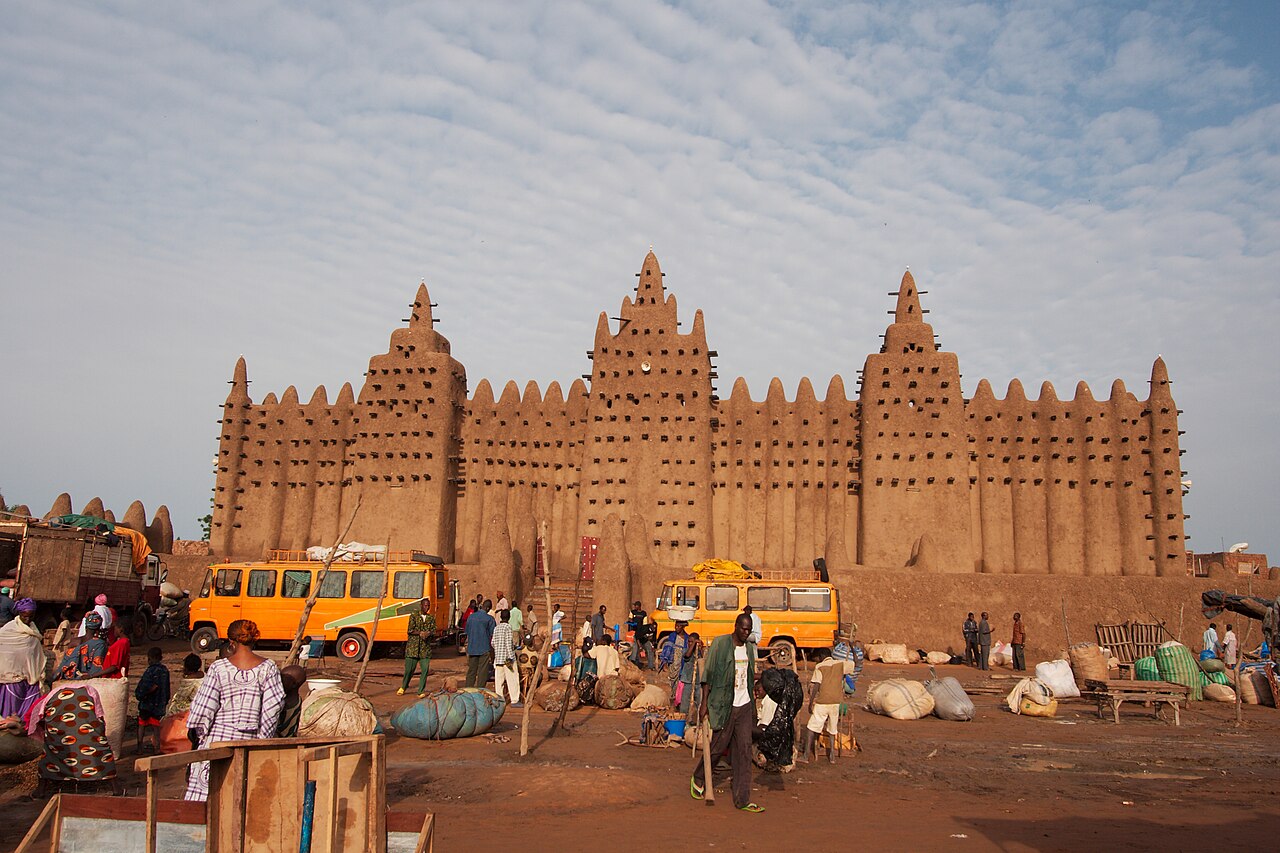
The Old Towns of Djenné, inscribed in 1988 and placed on the World Heritage in Danger list in 2016, is one of the oldest cities in sub-Saharan Africa and the site of the world’s largest mud-brick building — the Great Mosque of Djenné (rebuilt 1907), whose three towers and forest of wooden armatures rise above the Monday market square and require the annual collective re-plastering of the entire community in the crépissage festival.
Djenné: The Great Mosque and the Architecture of the Sahel Mopti Region, central Mali, on an island in the Bani River floodplain
The Old Towns of Djenné (inscribed in 1988 under criteria (iii) and (iv), placed on the World Heritage in Danger list in 2016 due to Mali’s ongoing security situation) are the urban core of the city of Djenné — a settlement on an island (formed by the Bani River and a branch of the Niger River) in the Inner Niger Delta of Mali, 570 km northeast of Bamako, that has been continuously inhabited since approximately 250 BCE and was one of the most important commercial and Islamic scholarly cities of West Africa from the fourteenth to the seventeenth centuries. The Great Mosque of Djenné (Mosquée de Djenné, Djingareyber) is the central monument of the site — the world’s largest mud-brick (adobe) building, 75 metres wide × 70 metres deep, with three towers (minarets) of 16 metres height, its facade bristling with torons (wooden armature poles projecting from the wall surface, used as scaffolding pegs for the annual replastering). The current mosque was built in 1907 by the French colonial administration on the foundation of an earlier mosque that the French governor had demolished in 1830 (having been told, incorrectly, that the original mosque had been converted to a palace by the eighteenth-century Bambara king who conquered Djenné); the 1907 reconstruction was based on descriptions of the original mosque and is the building that has become one of the most photographed architectural monuments in Africa. The mosque is typically closed to non-Muslims (a policy implemented in 1996 after complaints from Muslim worshippers about tourist disruption), but the exterior and the Monday market that spreads around the mosque’s base are accessible.
The Crépissage: Annual Collective Replastering Festival Djenné city, during the dry season (April–June)
The most distinctive aspect of Djenné’s architectural heritage is the crépissage — the annual collective replastering of the Great Mosque by the entire male community of Djenné, a festival-like event that takes place in April or May (at the end of the dry season, before the first rains of the year). The mosque’s mud-plaster exterior requires annual re-application because the Sahelian climate (intense sun and heat from November to April, intense rain from June to October) degrades the mud surface continuously; without the crépissage, the mosque would begin to dissolve within 5–10 years. The event is organized by the guilds of male craft workers (each guild responsible for a section of the mosque’s surface); young men compete to carry the most mud in the shortest time from the mixing pits (where the mud is prepared by combining clay, rice husks, shea butter, and water) to the mosque walls; music, food, and celebration accompany the work; and the task of replastering the three towers — accessible only via the toron scaffolding poles, which require considerable agility — is reserved for specialist craftsmen. The crépissage has been documented since at least the eighteenth century and is one of the most significant examples of living intangible heritage in West Africa.
Djenné-Djenno: The Ancient City Beneath the Flood 3 km south of Djenné
Djenné-Djenno (Djenné-Djeno), 3 km south of the current city of Djenné on an adjacent island in the Bani floodplain, is the archaeological site of the original Djenné — one of the oldest known cities in sub-Saharan Africa, dated by radiocarbon to approximately 250 BCE and continuously occupied to approximately 900 CE (when the city may have been abandoned in favour of the present island of Djenné). Excavations by Roderick and Susan McIntosh (University of Rice, 1977–1981) revealed an urban site of approximately 33 hectares with evidence of iron smelting, long-distance trade (copper from Saharan mines, glass beads from the Mediterranean), and a large population — overturning the assumption that urban complexity in sub-Saharan Africa developed only in the context of trans-Saharan trade and Islamic influence after the eighth century CE. Djenné-Djenno is included in the UNESCO inscription (as one of the “Old Towns of Djenné”) but is not excavated for tourists; it appears as a low mound in the floodplain.
Practical information
Djenné is approximately 570 km northeast of Bamako by road (8–10 hours) or 130 km south of Mopti (3 hours). Mopti Airport (MZI) has connections to Bamako (Air Mali and smaller regional carriers). Djenné is on a river island; the road crosses the Bani River on a seasonal ferry (the causeway floods during the rainy season, July–September). The Monday market (market day is Monday, around the mosque) is the principal tourist draw outside the crépissage season; the market sells vegetables, fish, livestock, pottery, and cloth from across the Inner Niger Delta. Mali’s security situation (Tuareg rebellion, Jihadist insurgency in the north and centre since 2012, military coup in 2021) has severely restricted travel to Djenné; most Western governments issue “do not travel” or “reconsider travel” advisories for the Mopti Region. The crépissage (April–May) is the best reason to visit but requires advance travel safety assessment.
Frequently Asked Questions
Is Djenné a UNESCO World Heritage Site?
Yes. The Old Towns of Djenné were inscribed in 1988 under criteria (iii) and (iv), covering the historic town of Djenné (Great Mosque, traditional earthen architecture townscape) and the archaeological site of Djenné-Djenno. In 2016, UNESCO placed the Old Towns of Djenné on the World Heritage in Danger list, citing the insecurity in central Mali following the 2012 rebellion and subsequent armed conflict. Mali has 4 UNESCO World Heritage Sites: Old Towns of Djenné (1988, In Danger 2016), Timbuktu (1988, In Danger 2012), Cliff of Bandiagara — Land of the Dogons (1989), and Tomb of Askia (2004, In Danger 2012).
What is Sudano-Sahelian architecture?
Sudano-Sahelian architecture is the regional building tradition of the Sahel and Sudan zone of West Africa — the semi-arid band between the Sahara Desert to the north and the tropical rainforest to the south — characterized by the use of banco (mud mixed with organic matter such as rice husks, straw, or animal dung) as the primary construction material, flat roofs with upturned parapets, wooden toron (armature poles) projecting from wall surfaces for replastering scaffolding, and tapering minarets (if mosques) or protruding wooden beams at building corners and eaves (used as ladders and work platforms). The style is found across the Sahel from Mauritania to Nigeria, with the most significant surviving examples at Djenné (Great Mosque), Timbuktu (Djingareyber, Sankore, and Sidi Yahia mosques), Agadez (Niger), Bobo-Dioulasso (Burkina Faso), and Zaria (Nigeria). The tradition is an indigenous development (not an import from North Africa), though it absorbed Arabic calligraphic and geometric decoration after the adoption of Islam in the region (ninth to eleventh centuries CE).
When did Islam arrive in Djenné and why did the city become a centre of Islamic scholarship?
Islam arrived in Djenné in approximately 1250–1300 CE, when the ruling Djenné-fari (king of Djenné) converted and transformed his palace into the first mosque on the island — an act that aligned Djenné with the larger Islamic commercial network of the Sahara and opened the city to the North African and Middle Eastern trade in gold, kola nuts, and enslaved people that made the city wealthy. By the fourteenth century CE, Djenné had approximately 4,000 Islamic scholars and teachers, and its mosque and Quranic schools attracted students from across the Sahel. The city’s strategic position at the southern edge of the Sahara — where gold and agricultural products from the tropical south met the caravan routes to North Africa — made it one of the wealthiest cities in West Africa for approximately 300 years (1350–1650). The Moroccan invasion of 1591 CE (the Saadian Sultan Ahmad al-Mansur’s expeditionary force that crossed the Sahara and destroyed the Songhai Empire) disrupted the trans-Saharan trade routes and began Djenné’s long decline.
Sources
- S1 — Marchand, Trevor H. J. The Masons of Djenné. Indiana University Press, 2009. ISBN 978-0-253-22072-1.
- S2 — McIntosh, Susan Keech, and Roderick J. McIntosh. Prehistoric Investigations in the Region of Jenne, Mali. BAR Publishing, 1980. ISBN 978-0-86054-099-1.
Spotted an error? Write to editorial@culturalheritageonline.com and we correct it the same day.