Shiraz is the gateway to the most important archaeological sites in Iran — Persepolis (inscribed 1979), the ceremonial capital of the Achaemenid Persian Empire under Darius and Xerxes; Pasargadae (inscribed 2004), the tomb of Cyrus the Great; and Naqsh-e Rostam, the Achaemenid royal cliff necropolis — while the city itself is Iran’s cultural capital, the city of Persian poetry and the Persian garden tradition.
Persepolis: The Achaemenid Ceremonial Capital 🚗 ~60 km northeast
Persepolis (Takht-e Jamshid, “Throne of Jamshid”), inscribed in 1979 under criteria (i), (ii), (iii), and (vi), is the most important archaeological site in Iran and the greatest surviving monument of the Achaemenid Persian Empire (c. 550–330 BCE). Founded c. 518 BCE by Darius I the Great (r. 522–486 BCE) on a terrace of 125,000 sq metres cut from the rock of the Kuh-e Rahmat (Mountain of Mercy) near the earlier Achaemenid capital of Pasargadae, Persepolis was the ceremonial centre of the Achaemenid Empire — used primarily for the Nowruz (Persian New Year) celebrations, when delegations from all 28 subject nations of the empire brought tribute to the Great King. The site was not a permanent royal residence (the kings lived at Susa, Ecbatana, and Babylon) but a ritual stage for the performance of imperial power. The Apadana (Audience Hall) of Darius and Xerxes, with its 36 fluted limestone columns (13 surviving, the tallest 20 metres), is the most imposing space at Persepolis; its staircase reliefs document the tribute-bearing delegations of the 28 subject peoples in the most detailed ethnographic document of the ancient Near East — Elamites, Babylonians, Egyptians, Ethiopians, Scythians, Indians, Arabians, and 21 other peoples identified by their costumes and gifts. The site was burned by Alexander the Great in 330 BCE — an act he later regretted, according to Diodorus of Sicily.
Pasargadae: The Tomb of Cyrus the Great 🚗 ~130 km northeast
Pasargadae, inscribed in 2004 under criteria (i), (ii), and (iii), is 130 km northeast of Shiraz — the first capital of the Achaemenid Empire, founded by Cyrus II the Great (r. 559–530 BCE), the conqueror of Babylon (539 BCE) and the founder of the most extensive empire the ancient world had known. The site contains the tomb of Cyrus the Great (Mausoleum of Cyrus, c. 530 BCE) — a six-stepped rectangular podium of white limestone supporting a gabled chamber, simple and severe, whose inscription (now lost but recorded in ancient sources) read: “Oh man, I am Cyrus, who founded the Persian Empire and was king of Asia. Do not be envious of my monument.” Alexander the Great visited the tomb after his conquest of Persia and ordered its restoration. Pasargadae also contains the remains of the Audience Hall (with the earliest Achaemenid column bases and gate figures), the Residential Palace, the sacred precinct with a fire altar, and the Zendan-e Soleyman tower — one of the most debated monuments of Achaemenid architecture, possibly a fire temple or a document repository. The site landscape, with its irrigated formal gardens (the prototype of the Persian chahar-bagh, or four-part garden), is the earliest documented example of the Persian garden tradition that would influence Islamic and Mughal garden design across Asia.
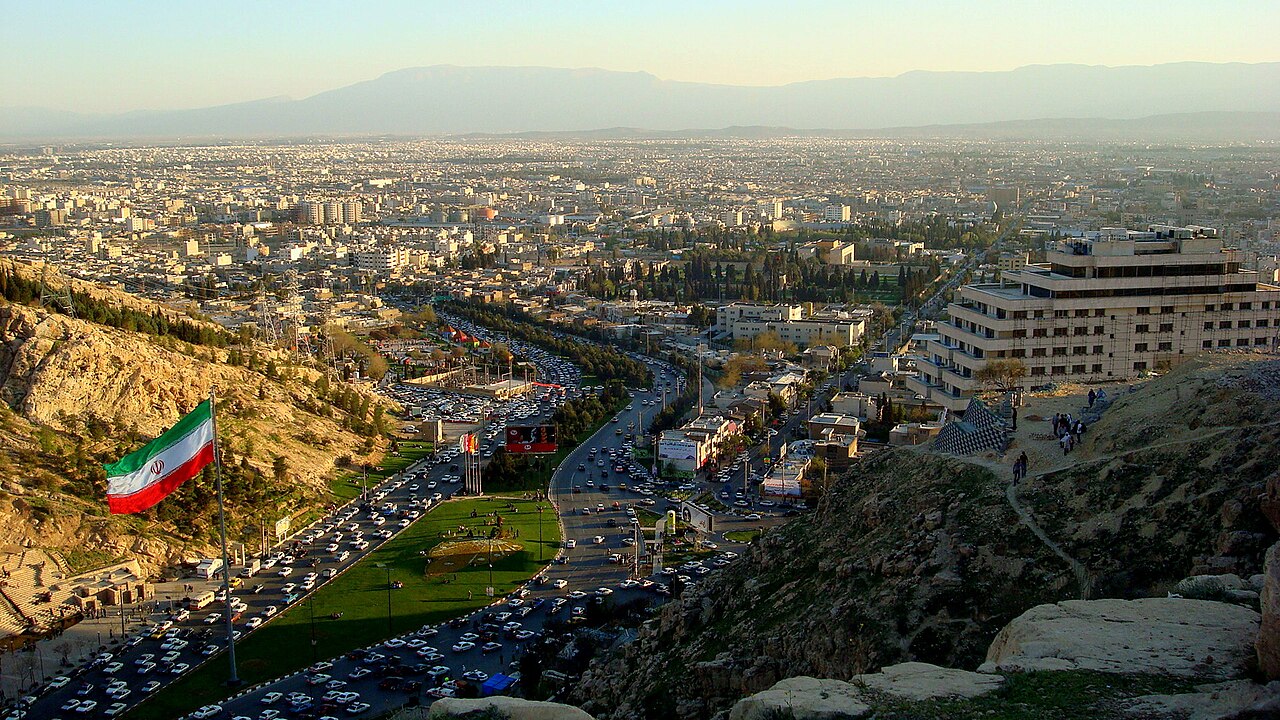
Shiraz: City of Poetry and the Persian Garden Shiraz city centre, Fars Province, Iran
Shiraz, the capital of the Fars Province, is the cultural capital of Iran — the city of the two greatest Persian lyric poets, Hafez (c. 1315–1390, whose tomb is one of the most visited pilgrimage sites in Iran) and Saadi (c. 1210–1291, whose Gulistan and Bustan are among the most translated books in Persian literature), and the city that gave the world the Shiraz grape variety (now grown in Australia and South Africa as Shiraz/Syrah). The city’s most significant monuments include the Vakil Mosque (1751–1773, built by Karim Khan Zand with a prayer hall of 48 columns), the Vakil Bazaar (the most complete eighteenth-century bazaar in Iran, running north–south for 700 metres, with arched brick vaults and caravanserais), the Arg-e Karim Khan (the residence of Karim Khan Zand, the founder of the Zand dynasty that made Shiraz the Iranian capital in the eighteenth century), the Nasir ol-Molk Mosque (1888, the “Pink Mosque,” whose stained-glass windows of extraordinary colour were installed in the 1950s and produce the most dramatic interior light effects of any mosque in Iran), and the Eram Garden (one of the nine Persian Gardens collectively inscribed as a UNESCO World Heritage Site in 2011).
Practical information
Shiraz is 930 km south of Tehran; domestic flights from Tehran’s Mehrabad airport take 1.5 hours (multiple daily). Shiraz International Airport also has flights from Dubai, Istanbul, Muscat, and Bahrain. Persepolis is 60 km northeast of Shiraz (1 hour by taxi or organised tour from Shiraz; no direct public transport). Pasargadae is 130 km northeast (2 hours by road; best combined with Persepolis in a one-day excursion). Naqsh-e Rostam (the Achaemenid cliff tombs of Darius, Xerxes, Artaxerxes, and Darius II, plus the Ka’ba-ye Zartosht Zoroastrian fire temple) is 4 km from Persepolis and included in most day-trip itineraries. Visa: Iranian visas require advance application (e-visa available to most nationalities except US, UK, and Canadian citizens, who require an in-person consular visit and travel agency sponsorship). The best season for Shiraz and Persepolis is March–May and October–November; summer (July–August) temperatures can reach 40°C at Persepolis.
Frequently Asked Questions
Is Persepolis a UNESCO World Heritage Site?
Yes. Persepolis was inscribed in 1979 — in the same year the Islamic Revolution occurred in Iran, making it one of the first UNESCO inscriptions of the post-revolutionary period. It was inscribed under criteria (i), (ii), (iii), and (vi) as the outstanding representative of Achaemenid architecture and as a document of the administrative organisation of the first world empire. Iran has 27 UNESCO World Heritage Sites (as of 2024), the most of any country in the Middle East.
Why did Alexander the Great burn Persepolis?
The burning of Persepolis in 330 BCE by Alexander the Great remains one of the most debated acts of deliberate cultural destruction in antiquity. The ancient sources (Diodorus of Sicily, Plutarch) give contradictory accounts: one tradition (Plutarch, Life of Alexander) says the burning was a spontaneous act committed during a drunken party at the suggestion of the Athenian hetaira Thais, who wanted revenge for Xerxes’s burning of Athens in 480 BCE; another tradition says it was a deliberate policy decision to signal the end of the Achaemenid dynasty. Archaeological evidence (the Throne Hall/Apadana shows fire damage concentrated on the cedar roof timbers and their organic contents, not on the stone sculpture) suggests a controlled burn of the palace complex rather than an uncontrolled fire. Alexander is recorded in several sources to have regretted the act later; he visited the tomb of Cyrus the Great at Pasargadae and restored it when he found it had been desecrated, an act interpreted by modern scholars as an attempt to align himself with the legitimate Achaemenid tradition rather than its destroyer.
Who was Hafez and why is his tomb in Shiraz a pilgrimage site?
Khwāja Shams-ud-Dīn Muḥammad Ḥāfeẓ-e Shīrāzī (c. 1315–1390), known as Hafez (“one who has memorised the Quran”), is the greatest Persian lyric poet — a poet of the ghazal form (a 5–12 couplet lyric poem on themes of love, wine, and mystical union with the divine) whose Divan (collected poems) is the most widely read Persian text after the Quran. Hafez spent his entire life in Shiraz, where he was patronised by a succession of rulers; his tomb (Hafezieh, built 1773, rebuilt 1935 in a garden setting north of the old city) is the most visited non-religious monument in Iran. His verses are used as omens and oracles (fāl-e Hafez, the practice of opening his Divan at random for a verse that answers a question), a practice still widely observed in Iran; on the eve of Nowruz (Persian New Year, March 21) and on the anniversary of his death, tens of thousands gather at his tomb.
Sources
- S1 — Curtis, John, and Nigel Tallis, eds. Forgotten Empire: The World of Ancient Persia. University of California Press, 2005. ISBN 978-0-520-24731-4.
- S2 — Stronach, David. Pasargadae: A Report on the Excavations. Oxford University Press, 1978. ISBN 978-0-19-813190-8.
Spotted an error? Write to editorial@culturalheritageonline.com and we correct it the same day.