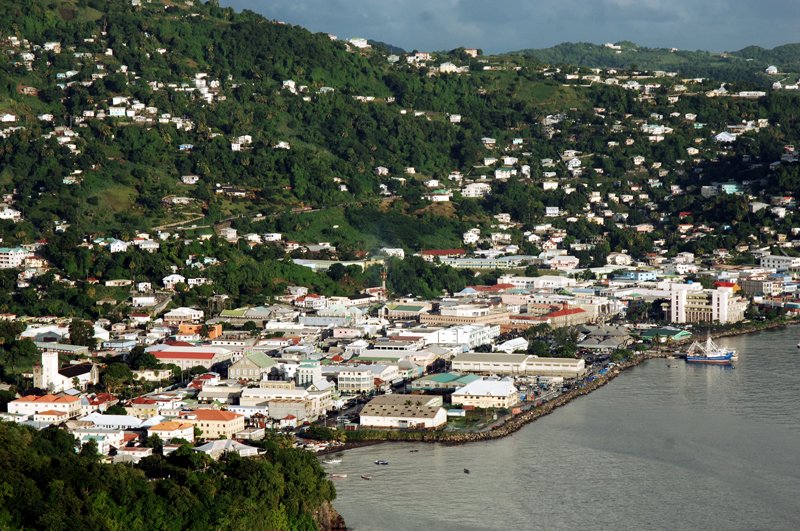
Saint Vincent and the Grenadines has no UNESCO World Heritage Sites. The island chain’s most significant heritage is the active La Soufrière volcano (which erupted in 2021), the botanical garden of Kingstown (the oldest in the Western Hemisphere), and the Grenadine reefs and seagrass beds that support globally important populations of hawksbill sea turtles. The nearest inscribed UNESCO site is the Pitons Management Area in Saint Lucia, approximately 130 km north. From Cultural Heritage Online.
La Soufrière Volcano
La Soufrière (1,234 m), the highest peak in Saint Vincent, is an active stratovolcano — one of the most active in the Eastern Caribbean — that has erupted in 1718, 1812, 1902–1903, 1979, and most recently in April 2021. The 2021 eruption was the most significant since 1902: a series of explosive eruptions beginning in April ejected a large volcanic plume that spread ash across the Eastern Caribbean, deposited pyroclastic material across the northern third of the island, and required the evacuation of approximately 20,000 people from the danger zone. The northern slopes of La Soufrière suffered significant damage; trails to the summit, previously a popular hike, were closed during and after the eruption and have been progressively reopening.
The 1902 eruption of La Soufrière killed approximately 1,600 people on Saint Vincent, occurring coincidentally within 48 hours of the far more deadly eruption of Mont Pelée on Martinique (which killed approximately 30,000 people). The 1902 La Soufrière eruption is one of the main reasons why the 1902 Martinique disaster, which attracted far more international attention, is comparatively well-documented: ships sent to investigate the Martinique disaster passed La Soufrière and documented both events.
Kingstown Botanical Garden
The Kingstown Botanical Garden, established in 1765, is the oldest botanical garden in the Western Hemisphere. Founded by the Royal Botanic Gardens at Kew in London as part of a network of colonial tropical gardens designed to introduce economically useful plants to British colonies, the Kingstown garden played a role in the introduction of breadfruit to the Caribbean — a project associated with Captain William Bligh, who brought breadfruit plants from Tahiti to St Vincent in 1793 on HMS Providence (a successful repeat of the voyage attempted on HMS Bounty in 1789, which ended in the famous mutiny). A breadfruit tree in the garden reputedly descends from the original Bligh introduction. The garden today covers approximately 6 hectares and contains collections of palms, cycads, tropical timber trees, and ornamental plants.
Getting there from Kingstown: The botanical garden is approximately 1 km from the Kingstown town centre (10-minute walk). La Soufrière volcano summit hike (if open): approximately 35 km north of Kingstown, accessible by road to Georgetown and then on foot (3–5 hours return to the crater rim, conditions permitting). Best for: Tropical botany; volcanic landscape; Caribbean ecological heritage.
Frequently Asked Questions
Does Saint Vincent and the Grenadines have any UNESCO World Heritage Sites?
No. Saint Vincent and the Grenadines has no inscribed UNESCO World Heritage Sites and has not submitted a Tentative List. The Kingstown Botanical Garden (the oldest in the Western Hemisphere), the La Soufrière volcano, and the Tobago Cays Marine Park (an extraordinarily rich reef and turtle nesting area in the southern Grenadines) have been discussed as potential candidates in conservation and heritage circles, but no formal nomination has been prepared.
What were the Grenadines before they were divided between St Vincent and Grenada?
The Grenadines are a chain of approximately 600 small islands and cays extending between Saint Vincent and Grenada, divided at the political boundary between the two countries: the northern Grenadines (Bequia, Mustique, Canouan, Union Island, Mayreau, the Tobago Cays) belong to Saint Vincent and the Grenadines; the southern Grenadines (Carriacou and Petite Martinique) belong to Grenada. The islands were settled by Arawak and Carib peoples before European contact, and passed between French and British control during the colonial period. They are now primarily dependent on tourism and offshore financial services. Mustique became famous as a private island retreat for British royalty and celebrities from the 1960s onward.
What is the Tobago Cays and why is it significant for sea turtles?
The Tobago Cays Marine Park, in the southern Grenadines approximately 90 km south of Kingstown, is a group of five uninhabited islands enclosed by the Horseshoe Reef — one of the most intact coral reef systems in the Eastern Caribbean. The park supports globally significant nesting populations of hawksbill sea turtles (Eretmochelys imbricata, Critically Endangered) and green turtles (Chelonia mydas, Endangered). The seagrass beds within the enclosed lagoon are a feeding ground for sea turtles that can be watched from a kayak or by snorkel at close range, making Tobago Cays one of the best accessible sea turtle viewing sites in the Caribbean.
What happened during the 2021 eruption of La Soufrière?
The 2021 eruption of La Soufrière began with a quiet effusive phase in December 2020, when a new lava dome began to grow in the summit crater. On 9 April 2021, the eruption turned explosive, sending a column of ash and volcanic gases approximately 8–10 km into the atmosphere. A series of further explosive eruptions followed over the next several weeks. Approximately 20,000 residents of the northern danger zone were evacuated, including the entire population of several villages that had been settled on the volcano’s upper slopes. The ash fall damaged crops, contaminated water supplies, and disrupted infrastructure across the northern part of the island. The recovery of the volcanic landscape and the restoration of agriculture and livelihoods in the affected communities has been an ongoing process since 2021.
Sources
- S1 — Gonzalez, Joseph. A History of St. Vincent and the Grenadines. Canoe Press, 2001. ISBN 978-976-8125-71-2.
- S2 — Rogozinski, Jan. A Brief History of the Caribbean. Facts on File, 1999. ISBN 978-0-8160-3811-4.
Spotted an error? Write to editorial@culturalheritageonline.com and we correct it the same day.