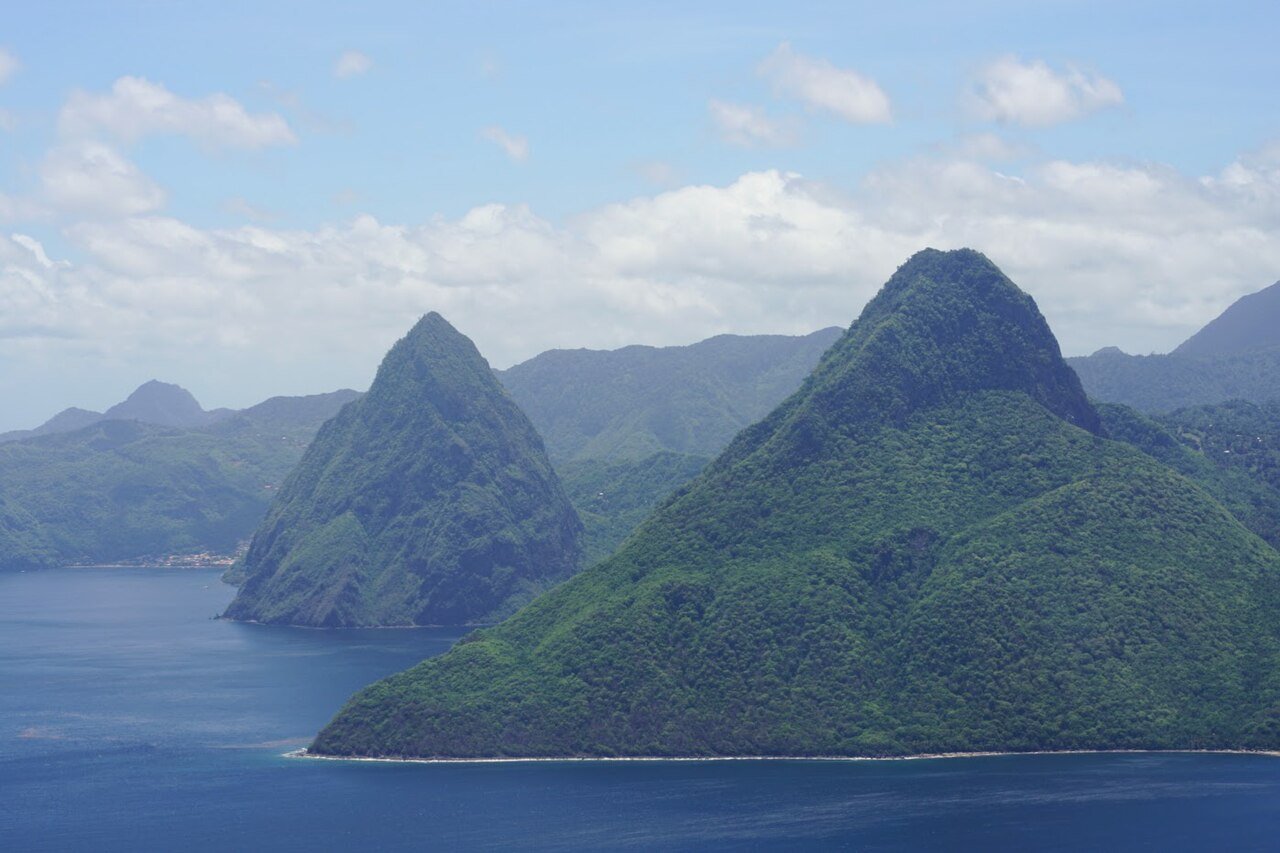
Saint Lucia has one UNESCO World Heritage Site: the Pitons Management Area — the twin volcanic peaks of Gros Piton (770 m) and Petit Piton (743 m), rising from the southwestern coast near the town of Soufrière, 65 km south of the capital Castries. The site includes the volcanic hotspring area of the Sulphur Springs (one of the world’s only “drive-in volcanoes”), the forested slopes, and the surrounding coral reef. From Cultural Heritage Online.
The Pitons Management Area 65 km south of Castries — 1.5–2 hr by road or 45 min by ferry
The Pitons Management Area, inscribed as a mixed natural and cultural UNESCO World Heritage Site in 2004, encompasses 2,909 hectares of the southwestern coastline of Saint Lucia including the twin volcanic plugs (lava domes) of Gros Piton and Petit Piton, the intervening Piton Mitan ridge, the Sulphur Springs volcanic complex, and the coral reef system surrounding the coastline. The two Pitons are among the most visually dramatic landscape features in the Caribbean: nearly vertical-sided volcanic plugs rising to 770 and 743 metres respectively directly from the sea, thickly forested, with the deep blue of the Caribbean around their bases.
The Sulphur Springs at Soufrière — sometimes marketed as the world’s only “drive-in volcano” — are a partially collapsed volcanic crater containing boiling sulphurous springs, hot mud pools, and fumarole vents accessible by road. The springs have been in continuous use for therapeutic bathing since Amerindian times. The Pitons are scalable on organised guided hikes: Gros Piton (typically 4–5 hours return) and Petit Piton (much more demanding, near-vertical in places, with ropes, not recommended for inexperienced hikers).
Castries and the North of the Island
Castries, the capital, has been rebuilt several times after major fires (most destructively in 1948) and retains limited colonial heritage architecture. The central market, the Cathedral of the Immaculate Conception (1894), and Derek Walcott Square (named after St Lucia’s Nobel Prize-winning poet, 1992) are the most visited heritage sites in the capital area. The Morne Fortune area above Castries contains the remains of British and French colonial fortifications from the period when Saint Lucia changed hands between the two colonial powers approximately 14 times.
Getting there from Castries: Soufrière (the nearest town to the Pitons) is approximately 65 km south by road (1.5–2 hours), or accessible by speedboat ferry from Castries in 45–50 minutes. Guided Gros Piton hikes depart from Fond Gens Libres village at the base of the mountain. Allow: Full day for Soufrière + Pitons; half day for the Sulphur Springs alone. Best for: Volcanic landscape; Caribbean scenic heritage; hiking.
Frequently Asked Questions
How many UNESCO World Heritage Sites does Saint Lucia have?
One: the Pitons Management Area, inscribed as a mixed (natural and cultural) World Heritage Site in 2004. It is one of three UNESCO World Heritage Sites in the Eastern Caribbean, alongside Morne Trois Pitons National Park in Dominica (1997) and Brimstone Hill Fortress in St Kitts and Nevis (1999).
What are the Pitons exactly — are they volcanoes?
Gros Piton and Petit Piton are volcanic plugs (also called lava domes) — masses of solidified lava that were pushed up through the vent of a now-dormant volcano. Unlike the classic cone-shaped stratovolcano, a volcanic plug forms when viscous lava solidifies within the vent and the softer surrounding rock subsequently erodes away, leaving the harder core standing as an isolated peak. The Pitons were formed approximately 300,000 years ago. They are part of the same volcanic arc as the Sulphur Springs of Soufrière — both features are expressions of the same magmatic activity beneath the island, which is still partially active (the Sulphur Springs continue to emit steam and sulphurous gases).
What is the cultural significance of the Pitons?
The Pitons have been used as landmarks by Amerindian peoples, European colonial navigators, and contemporary St Lucians as the defining landmarks of the island. The UNESCO inscription as a mixed site recognises both the natural values (geology, biodiversity, reef ecosystem) and the cultural values — specifically the long history of human settlement and use of the Piton slopes and Soufrière bay, from pre-Columbian Arawak and Carib settlements through the French and British colonial plantation era to the present. The town of Soufrière, at the foot of the Pitons, has a market square that dates from the eighteenth-century French colonial period.
Who was Derek Walcott and why is he significant to St Lucia?
Derek Walcott (1930–2017) was a Saint Lucian poet and playwright who received the Nobel Prize in Literature in 1992, becoming the first St Lucian and one of the first Caribbean writers to receive the prize. His best-known work is the epic poem Omeros (1990), a Caribbean reimagining of Homer’s Odyssey and Iliad set in and around Gros Islet and Castries in St Lucia. His poetry draws on the tension between his African, European (Dutch and English), and Amerindian heritage — the multilayered colonial and post-colonial identity of the Caribbean — and the landscapes of St Lucia are central to his work. Walcott Square in Castries is named in his honour.