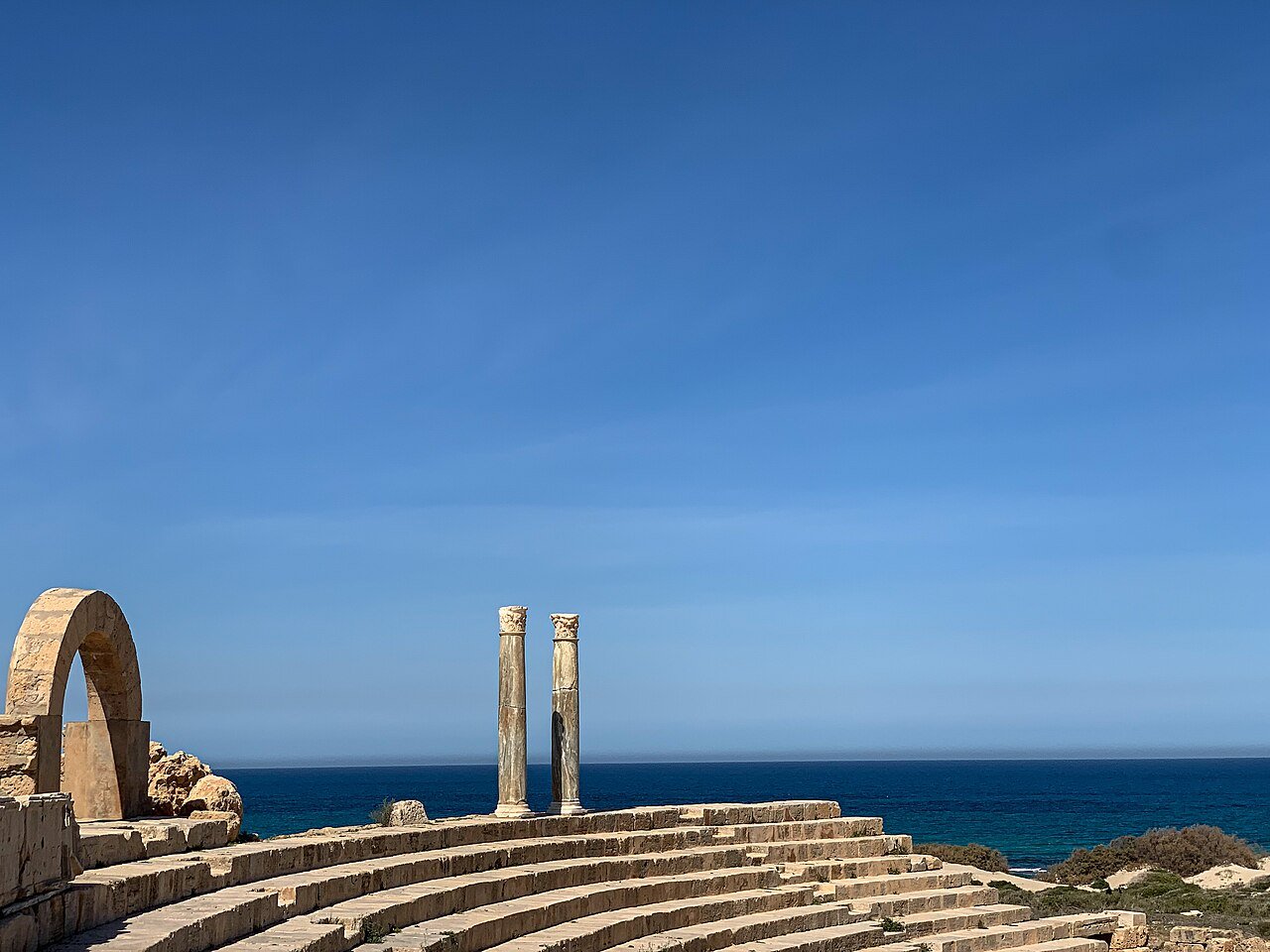
Libya has five UNESCO World Heritage Sites — all now on the UNESCO Danger List due to the ongoing conflict that began in 2011. The three most significant, reachable from Tripoli in peacetime conditions, are Leptis Magna (the best-preserved major Roman city in North Africa), Sabratha (a Roman-era port city), and the old city of Ghadamès (a Saharan oasis settlement). From Cultural Heritage Online.
Leptis Magna 130 km east of Tripoli — 1.5 hr by road (pre-conflict)
Leptis Magna was one of the most important cities of the Roman Empire and is today the best-preserved major Roman urban site in North Africa. Founded as a Phoenician trading post in the tenth century BCE, Leptis Magna rose to prominence under Rome and reached its apogee between approximately 100 CE and 300 CE — particularly during the reign of Emperor Septimius Severus (193–211 CE), who was born at Leptis Magna and lavished it with monumental construction. The Severan Forum, Basilica, Arch of Septimius Severus, and harbour works transformed Leptis into a city of extraordinary scale and architectural sophistication, rivalling Alexandria and Carthage.
The site covers approximately 400 hectares and includes the Hadrianic Baths (among the largest Roman bath complexes anywhere), the Old Forum with its temples to Rome and Augustus, the market (Macellum), the amphitheatre, the circus (for chariot racing), the Severan Forum, and the theatre — one of the most intact Roman theatre structures in the ancient world. The site has been buried under Saharan sand for significant periods, which has protected many structures to extraordinary height and detail. UNESCO inscribed Leptis Magna in 1982; it was placed on the Danger List in 2016.
Sabratha 70 km west of Tripoli — 1 hr by road (pre-conflict)
Sabratha is a smaller but spectacularly preserved Roman coastal city, 70 km west of Tripoli. Its most celebrated structure is the theatre — a semicircular performance space whose three-storey scaenae frons (stage backdrop) of Corinthian columns has been substantially reconstructed and stands to its full height, one of the most complete Roman theatre facades surviving anywhere. The city was founded as a Phoenician trading post in the fifth or fourth century BCE and flourished as part of Roman North Africa. UNESCO inscribed the site in 1982; it was placed on the Danger List in 2016.
Old Town of Ghadamès 600 km southwest — 8 hr by road via Nalut (pre-conflict)
Ghadamès, a Saharan oasis settlement approximately 600 km southwest of Tripoli near the Algerian and Tunisian borders, is one of the oldest pre-Saharan cities and a remarkable example of traditional desert urban architecture. The city’s old town consists of multi-storey earthen houses connected by a network of covered alleys that allow movement through the settlement in shade even in the desert summer. The rooftops form a second street network used by women (Berber custom required women and men to use separate routes through the city). UNESCO inscribed the old town in 1986; it was placed on the Danger List in 2016.
Access: All five Libyan UNESCO sites are currently on the Danger List and access depends entirely on the security situation on the ground. Travel to Libya requires careful assessment of current conditions; government travel advisories should be checked. When security permits, organised tours connect Tripoli with both Leptis Magna and Sabratha in day trips. Best for: Roman archaeology specialists; North African heritage researchers.
Frequently Asked Questions
How many UNESCO World Heritage Sites does Libya have?
Five: Leptis Magna (1982), Sabratha (1982), Cyrene (1982), Tadrart Acacus (1985), and the Old Town of Ghadamès (1986). All five are currently on the UNESCO Danger List (placed there in 2016), due to the security crisis following the 2011 conflict that toppled Muammar Gaddafi, and the subsequent armed conflict between competing Libyan governments and factions.
Why is Leptis Magna so well preserved compared to other Roman cities?
Leptis Magna was progressively buried by Saharan sand after the decline of Roman administration in the fourth to fifth centuries CE. This burial, while it caused the city’s abandonment, also protected its structures from the spoliation (robbing of building materials) that reduced most Roman cities in the Mediterranean to foundations over the medieval period. The sand acted as a preservative: columns, pavements, inscriptions, and architectural decoration were protected from weather and human removal. When European archaeologists began systematic excavation in the early twentieth century, they found structures standing to unusual height and detail.
Who was Septimius Severus and why did he rebuild Leptis Magna?
Lucius Septimius Severus (born 145 CE at Leptis Magna, died 211 CE at Eboracum/York, England) was the first Roman emperor of African origin. After becoming emperor in 193 CE following the civil war of the Year of the Five Emperors, he undertook a massive programme of construction at his birthplace. The Severan additions to Leptis Magna — the new forum (larger than the Forum of Trajan in Rome), the basilica, the colonnaded street to the harbour, the arch, and the harbour renovation — were built between approximately 200 and 216 CE and transformed Leptis into one of the grandest cities in the empire. The construction also brought the Carrara marble, granite, and yellow Numidian marble now visible throughout the site.
What is the significance of Ghadamès as a desert city?
Ghadamès is one of the oldest continuously inhabited settlements in the Sahara, with occupation documented from at least the first century BCE (a Roman garrison, Cydamus, is recorded here). The old town’s architecture is a sophisticated adaptation to the desert environment: thick earthen walls provide thermal mass that moderates temperature extremes; covered alleys eliminate direct sun exposure at street level; the rooftop network provides ventilation and a second level of social space. The separation of male and female circulation routes through separate ground-level streets and rooftop paths is unique to Ghadamès among known Saharan settlements and reflects the deep integration of social custom into the built fabric of the city.
Sources
- S1 — Ward-Perkins, J. B. The Severan Buildings of Lepcis Magna. Society for Libyan Studies, 1993. ISBN 978-0-9508363-6-2.
- S2 — Mattingly, David J. Tripolitania. University of Michigan Press, 1994. ISBN 978-0-472-10658-5.
Spotted an error? Write to editorial@culturalheritageonline.com and we correct it the same day.