
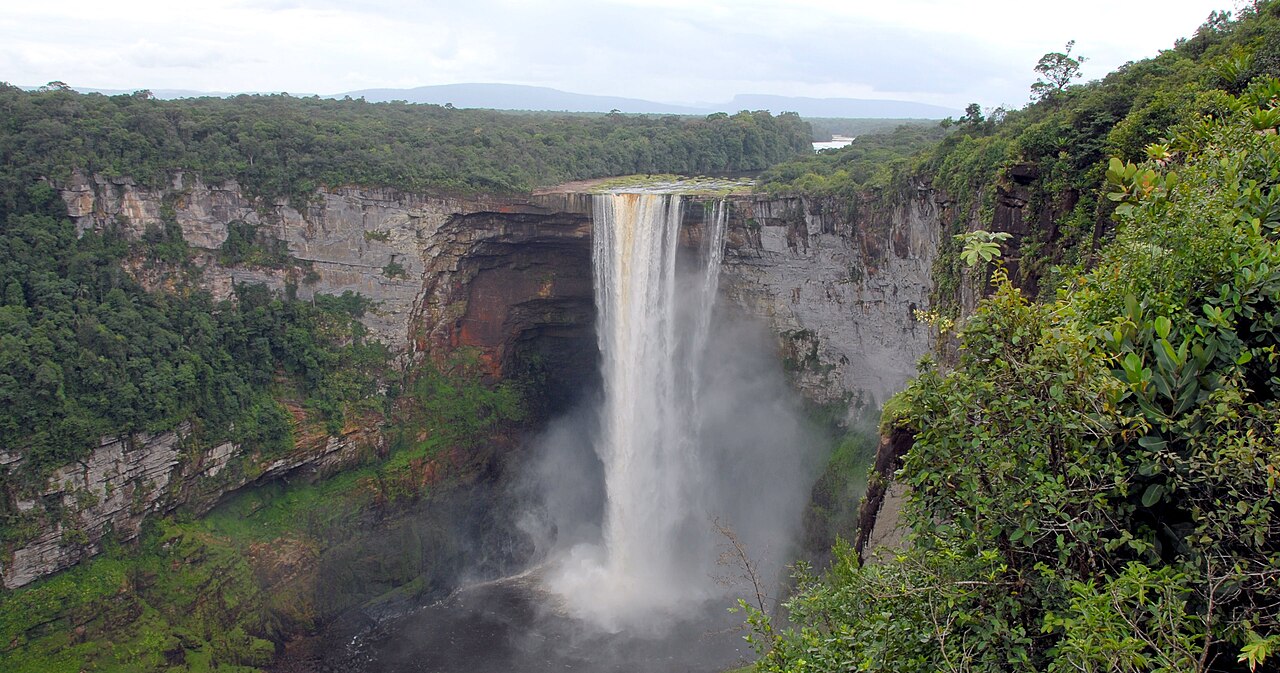
Guyana has no inscribed UNESCO World Heritage Sites, but it holds Kaieteur Falls — the largest single-drop waterfall by volume anywhere on Earth — set within one of the most pristine wilderness areas in South America, accessible only by light aircraft. From Cultural Heritage Online.
Kaieteur Falls and Kaieteur National Park 240 km southwest — 1.5 hr by light aircraft, no road access
The Potaro River drops 226 metres in a single unbroken plunge over the Pakaraima Plateau escarpment — roughly four times the height of Niagara Falls. At average flow, approximately 663 cubic metres of water per second crosses the lip of the falls, making Kaieteur the most powerful single-drop waterfall in the world by combined height and volume. No road reaches the site. The falls can only be accessed by light aircraft from Ogle Airport near Georgetown (approximately 90 minutes), landing on a short airstrip carved into the tepui surface above the falls. The walk from the airstrip to the main viewpoint takes approximately 15 minutes along a maintained trail through low woodland.
The falls are surrounded by Kaieteur National Park, a 627-square-kilometre protected area established in 1929 and covering a section of the Pakaraima tepui (sandstone table-top mountain) landscape. The park harbours several endemic species, including the golden rocket frog (Anomaloglossus beebei), found only in the giant tank bromeliads at Kaieteur and nowhere else in the world. The bromeliad pools at the edge of the gorge, each containing standing water throughout the year, serve as breeding sites for these 2-centimetre frogs, which carry their tadpoles on their backs to the water-filled leaf axils.
Guyana submitted a Tentative List to UNESCO that includes Kaieteur National Park and associated tepui landscapes, but no formal nomination has been submitted as of 2026. The site has attracted increasing conservation attention as a result of Guyana’s offshore oil revenues, with new investment in both national park infrastructure and ecotourism development since 2020.
Getting there: Day-trip light aircraft tours from Ogle Airport (Georgetown) with Roraima Airways and other operators — 90 min each way, 2–3 hours at the site. Multi-day tours that include the Iwokrama Forest and Rupununi savannahs also available. Allow: Full day minimum for a day trip; 3–5 days for a combined rainforest itinerary. Best for: Wilderness and natural heritage travellers; birdwatchers.
Iwokrama Forest and Rainforest Reserve 450 km south — 6 hr road to Annai + 4WD access
The Iwokrama International Centre manages a 360,000-hectare protected forest in central Guyana, regarded as one of the best-managed tropical forest conservation areas in South America. The centre operates in partnership with the Makushi and Wapishana Amerindian communities and has pioneered a model of conservation that generates revenue through ecotourism while maintaining community land rights. The forest holds exceptional biodiversity: harpy eagle nesting sites, giant river otter, jaguar, giant anteater, tapir, and anaconda all present in confirmed populations. Bird diversity exceeds 500 species.
Getting there: Road from Georgetown to Lethem (approx. 10–12 hours on the improved road via Linden) or short domestic flight to Annai. 4WD essential in the wet season. Allow: Minimum 2 nights at the Iwokrama River Lodge. Best for: Dedicated wildlife and conservation travellers.
Frequently Asked Questions
Does Guyana have any UNESCO World Heritage Sites?
No. As of 2026, Guyana has no inscribed UNESCO World Heritage Sites, though it has submitted a Tentative List that includes Kaieteur National Park. The falls and surrounding tepui landscape are considered one of the most significant natural heritage sites in South America not yet under UNESCO inscription.
How does Kaieteur Falls compare to Niagara Falls?
Kaieteur Falls is approximately four times higher than Niagara (226 m vs 57 m), and its single unbroken plunge combined with the average water volume makes it the most powerful single-drop waterfall in the world. Niagara moves more total water per second, but that volume is split across a broad horseshoe and a series of cascades rather than a single drop. Victoria Falls in Zimbabwe is higher than Niagara but also broader and multi-plunge.
Can you visit Kaieteur Falls without a tour operator?
Practically, no. There is no road access to the falls — the only way in is by light aircraft to the airstrip above the falls. All flights are operated by tour companies that also provide guides at the site. Independent visitors can charter a plane, but the experience at the falls itself requires a guide to navigate the trails safely. Combination tours including Iwokrama are available for 3–5 day itineraries.
What is the golden rocket frog at Kaieteur?
The golden rocket frog (Anomaloglossus beebei) is a 2-centimetre frog found only in the giant tank bromeliads at Kaieteur Falls. The bromeliads, which collect standing water in their leaf axils, serve as breeding pools; the male frog carries its tadpoles on its back to deposit them individually into separate bromeliad pools. The species exists nowhere else in the world.
Sources
- S1 — Daly, Vere T. A Short History of The Guyanese People. Macmillan, 1975. ISBN 978-0-333-18304-5.
- S2 — Roopnarine, Lomarsh. The Indian Caribbean: Migration and Identity in the Diaspora. University Press of Mississippi, 2018. ISBN 978-1-4968-1588-0.
Spotted an error? Write to editorial@culturalheritageonline.com and we correct it the same day.

_2007.jpg)