
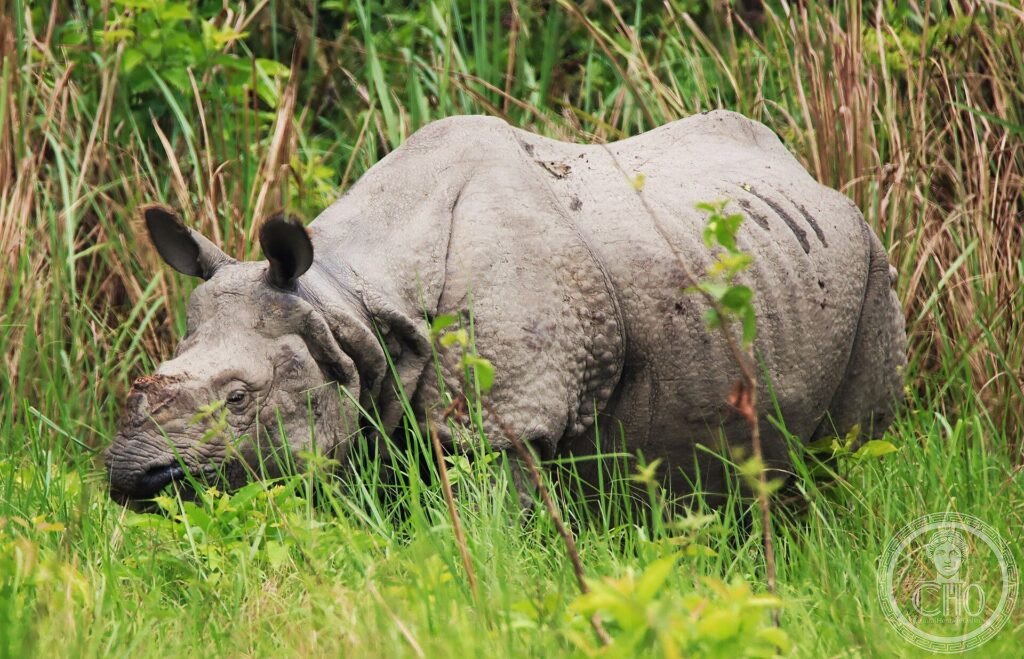
At the foot of the Himalaya, in the tropical plain of the Terai, one of the last great jungles of Nepal survives. Chitwan, the country’s first national park, is a refuge for the one-horned Indian rhinoceros and for the Bengal tiger, among sal forests, tall grassland and the rivers that come down from the mountains.
At a glance
Chitwan National Park, in the lowland Terai of southern Nepal at the foot of the Himalaya, protects one of the last great areas of jungle in the country. The first national park in Nepal, it is a stronghold of the greater one-horned rhinoceros and the Bengal tiger, amid a mosaic of sal forests, tall elephant-grass grasslands, oxbow lakes and rivers flowing down from the mountains. Rich in wildlife and birds, it was inscribed by UNESCO in 1984.
Key facts
- UNESCO: World Heritage since 1984 (Chitwan National Park)
- First in Nepal: the country’s first national park
- One-horned rhino: a major stronghold of the species
- Bengal tiger: a key tiger habitat
- Terai jungle: sal forest, tall grassland and rivers
- Rich wildlife: elephants, gharial crocodiles and many birds
History
The Terai lowlands were long a malarial jungle, a hunting ground of Nepal’s rulers and home to indigenous Tharu communities. In the mid-20th century, malaria control opened the region to settlement, and hunting and habitat loss brought the rhinoceros and tiger close to disappearing.
To save them, Nepal created Chitwan as its first national park in 1973, and conservation — including anti-poaching efforts and community involvement — brought the rhino population back from the brink. Inscribed by UNESCO in 1984, Chitwan is now a model of wildlife recovery and a leading destination for safaris in South Asia.
What you see
Visitors explore the park by jeep, on foot, by canoe on the rivers and (traditionally) on elephant-back, watching for rhinos grazing in the grasslands, deer, wild boar, crocodiles basking on the banks and, with luck, a tiger or leopard. The Tharu villages and culture around the park add a human dimension.
The thrill of seeing rhinos and other great animals in the jungle beneath the distant Himalaya is the draw of Chitwan.
Practical information
- Park: jeep, walking, canoe and (where offered) elephant safaris
- Best time: October–March, the cooler dry season
- Time needed: two or more days
- Note: base in Sauraha; book safaris and guides locally
Getting there
Chitwan National Park is in the southern Terai lowlands of Nepal, about 150 km south-west of Kathmandu. The usual base is Sauraha, reached by road or by air to Bharatpur. GPS: 27.50° N, 84.30° E.
Nearby
- Sauraha — the main tourist village at the park edge
- Tharu villages — the indigenous communities of the Terai
- Kathmandu — the Nepali capital, to the north-east
Sources
- UNESCO World Heritage Centre — “Chitwan National Park” (ref. 284)
- Department of National Parks and Wildlife Conservation (Nepal) — official body
- Encyclopaedia Britannica — Chitwan National Park
Find it on the map
See this place and what’s around it →📷 Become a Cultural Heritage Online photographer
Share your photos of places: they stay published under your name as the author. The more they're seen, the more you get noticed — and soon a contest will reward the most appreciated photos.
Log in or sign up free to add a photo