
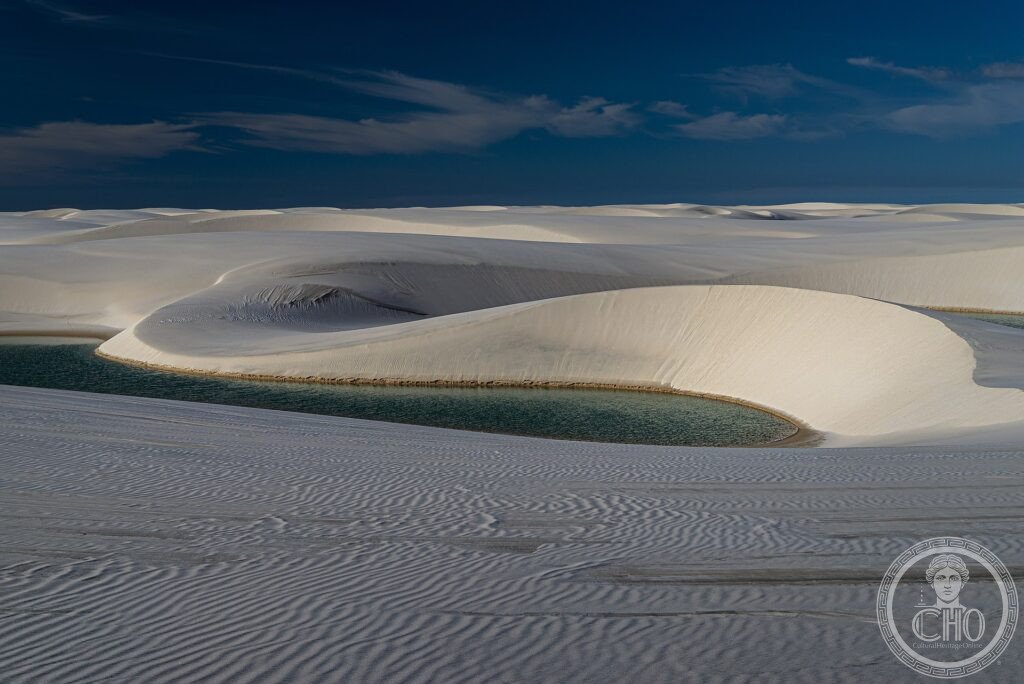
It looks like a desert, but it is not: every rainy season the immense white dunes of Maranhão fill with thousands of turquoise freshwater lagoons, in which even fish swim. The Lençóis Maranhenses — the bedsheets of Maranhão — are one of the most surprising landscapes in Brazil.
At a glance
Lençóis Maranhenses National Park, on the north-eastern coast of Brazil, is a vast field of brilliant white sand dunes that, despite looking like a desert, fills each rainy season with thousands of crystal-clear, turquoise freshwater lagoons trapped between the dunes. The name means “bed-sheets of Maranhão”, for the rippling expanse of white sand. This extraordinary and dynamic dune-and-lagoon landscape was inscribed by UNESCO in 2024.
Key facts
- UNESCO: World Heritage since 2024 (Lençóis Maranhenses National Park)
- White dunes: a vast field of brilliant white sand
- Seasonal lagoons: thousands of clear lagoons fill in the rains
- Not a true desert: high rainfall feeds the lagoons
- Surprising life: fish and other creatures live in the temporary pools
- Coastal setting: dunes meeting the Atlantic in Maranhão
History
Though it lies in the tropics and receives heavy seasonal rain, the constant wind off the Atlantic piles the river-borne sand into a great field of dunes that behaves like a desert in the dry months and a lake-land in the wet. Rain collects in the hollows between dunes, where the underlying rock keeps it from draining, forming the famous lagoons from around March to September.
Long known to the people of Maranhão, the dunes were protected as a national park in 1981 and, after recognition of their global value, inscribed by UNESCO in 2024. Their shifting sands and seasonal waters make them one of South America’s most striking and unusual natural sites.
What you see
From the gateway towns, four-wheel-drive vehicles cross to the edge of the dunes, from where visitors walk over the white sand to swim in the warm turquoise lagoons (in the wet season) or admire the rippling, empty dunes (in the dry). Sunrise and sunset turn the sand gold and pink, the lagoons mirroring the sky.
The unreal sight of clear blue pools scattered across a white sand desert is the wonder of Lençóis Maranhenses.
Practical information
- Park: reached by four-wheel-drive tours from Barreirinhas or Santo Amaro
- Best time: the lagoons are fullest roughly June–September
- Time needed: one to two days
- Note: bring sun protection; the white sand is dazzling
Getting there
Lençóis Maranhenses is on the coast of Maranhão, north-eastern Brazil. The main base is Barreirinhas, about 250 km from the state capital São Luís by road. GPS: 2.55° S, 43.13° W.
Nearby
- Barreirinhas — the main gateway town on the Preguiças river
- São Luís — the UNESCO historic capital of Maranhão
- Atins — a village where the dunes meet the sea
Sources
- UNESCO World Heritage Centre — “Lençóis Maranhenses National Park” (ref. 1611)
- ICMBio (Brazil) — official body
- Encyclopaedia Britannica — Maranhão
Find it on the map
See this place and what’s around it →📷 Become a Cultural Heritage Online photographer
Share your photos of places: they stay published under your name as the author. The more they're seen, the more you get noticed — and soon a contest will reward the most appreciated photos.
Log in or sign up free to add a photo