
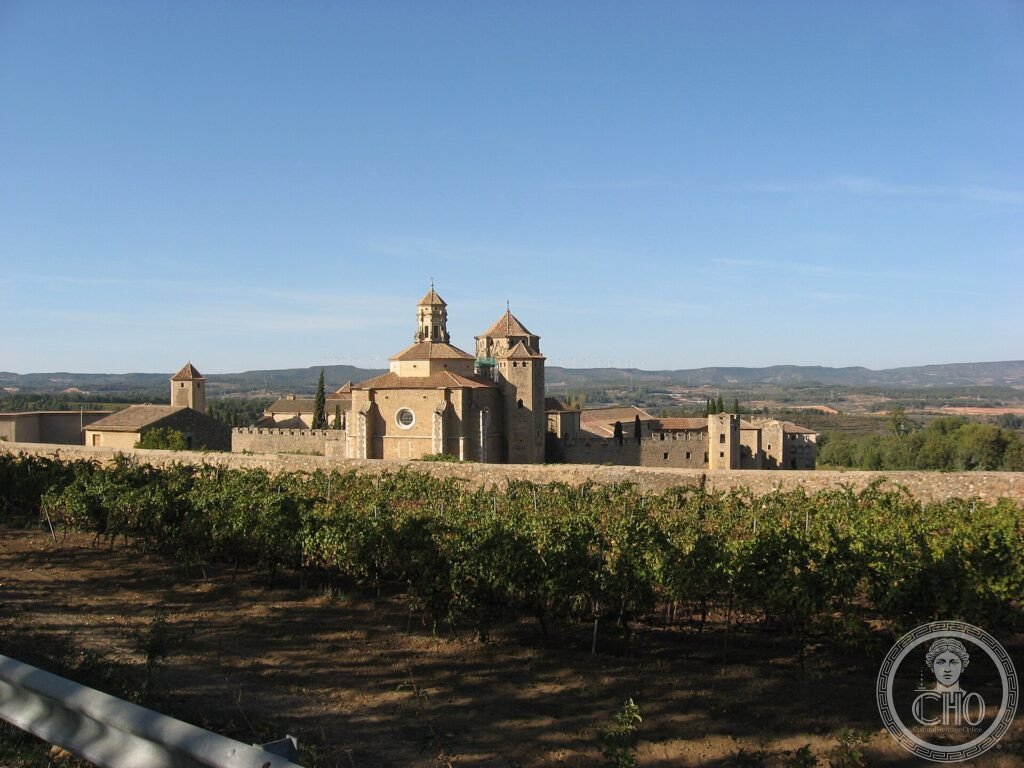
Founded in 1151 by Cistercian monks, Poblet became Catalonia’s most powerful monastery and the burial place of the kings of the Crown of Aragon. Behind its walls — one of Europe’s largest inhabited Cistercian complexes — monarchs rest beneath alabaster canopies, amid cloisters and silence.
At a glance
The Monastery of Poblet, in the Catalan countryside, was founded in 1151 and grew into the most important Cistercian abbey of the region. Royal patronage made it the pantheon of the kings of the Crown of Aragon, whose tombs lie beneath alabaster canopies in the church. A vast fortified complex of church, cloisters, chapter house, royal palace and working buildings, it is one of the largest inhabited Cistercian monasteries in Europe. It was inscribed by UNESCO in 1991.
Key facts
- UNESCO: World Heritage since 1991 (Poblet Monastery)
- Founded: 1151, by Cistercian monks
- Royal pantheon: burial place of the kings of the Crown of Aragon
- Fortified: ringed by walls and towers
- One of the largest: among the biggest inhabited Cistercian monasteries in Europe
- Cistercian Route: with Santes Creus and Vallbona, the three Catalan abbeys
History
Count Ramon Berenguer IV of Barcelona gave these lands to the Cistercians in 1151, soon after the Christian reconquest, and the monks built up a great abbey that became a centre of power, wealth and learning in medieval Catalonia. The kings of the Crown of Aragon took it under their protection and chose it as their burial place, raising the royal tombs that line the church.
Sacked and abandoned after the suppression of the monasteries in 1835, Poblet fell into ruin, its royal tombs broken. From the 1930s Cistercian monks returned and the monastery was painstakingly restored, the royal pantheon reassembled, so that it lives again as both a monument and a working abbey.
What you see
Within the triple ring of walls stand the great church, with the royal tombs raised on arches across the transept; the Gothic cloister with its fountain; the chapter house; the monks’ dormitory and the old royal palace. The scale and austerity are unmistakably Cistercian.
Vineyards and woods of the Conca de Barberà surround the monastery, which still follows the rhythm of monastic life.
Practical information
- Monastery: visited by guided or self-guided tour; an admission applies
- Time needed: 1.5–2 hours
- Note: an active monastery; quiet behaviour requested
- Wine: the surrounding Conca de Barberà is wine country
Getting there
Poblet is in the Conca de Barberà, inland Catalonia, about 50 km north of Tarragona and 120 km west of Barcelona. It is reached by road; the nearest station is L’Espluga de Francolí. GPS: 41.3806° N, 1.0844° E.
Nearby
- Santes Creus and Vallbona — the other two Cistercian abbeys of the route
- Tarragona — the Roman city on the coast, also UNESCO-listed
- Montblanc — a walled medieval town nearby
Sources
- UNESCO World Heritage Centre — “Poblet Monastery” (ref. 518)
- Monestir de Poblet — official monastery site
- Encyclopaedia Britannica — Cistercians; Catalonia
Find it on the map
See this place and what’s around it →📷 Become a Cultural Heritage Online photographer
Share your photos of places: they stay published under your name as the author. The more they're seen, the more you get noticed — and soon a contest will reward the most appreciated photos.
Log in or sign up free to add a photoIs this page about you?
This page is read by travellers and heritage enthusiasts who find it on Google. Tell us how you are connected to this place and we will take it from there.