
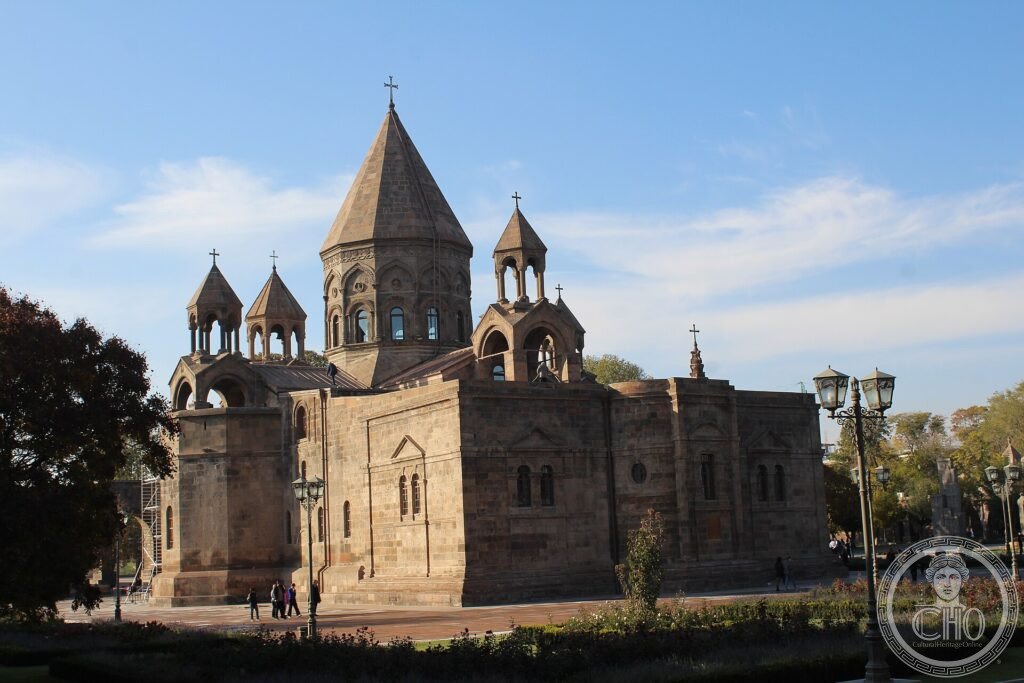
L’Armenia fu, nel 301, il primo Stato al mondo a fare del cristianesimo la propria religione. Il cuore di quella fede è Echmiatsin: la cattedrale madre della Chiesa armena, fondata all’inizio del IV secolo, sede del Catholicos. Insieme alle chiese vicine e alle rovine di Zvartnots racconta sedici secoli di architettura armena.
At a glance
Armenia was the first state in the world to adopt Christianity, traditionally in 301. Its spiritual heart is Echmiatsin (Vagharshapat), where the Mother Cathedral of the Armenian Apostolic Church was founded in the early 4th century — one of the oldest cathedrals in the world — and remains the seat of the Catholicos, the supreme head of the Church. The cathedral, the nearby churches of St Hripsime and St Gayane, and the ruins of the 7th-century Zvartnots cathedral together were inscribed by UNESCO in 2000.
Key facts
- UNESCO: World Heritage since 2000 (Cathedral and Churches of Echmiatsin and the Archaeological Site of Zvartnots)
- First Christian state: Armenia adopted Christianity, by tradition, in 301
- Mother Cathedral: founded in the early 4th century, among the oldest in the world
- Seat of the Catholicos: the supreme head of the Armenian Apostolic Church
- St Hripsime and St Gayane: classic 7th-century Armenian churches
- Zvartnots: the ruined 7th-century circular cathedral nearby
History
According to tradition, St Gregory the Illuminator converted King Tiridates III, and around 301 Armenia became the first nation to adopt Christianity as its state religion. Gregory had a vision of Christ descending to mark the site of the first cathedral, giving the place its name, Echmiatsin, “the descent of the Only-Begotten”. The Mother Cathedral was founded there in the early 4th century.
Rebuilt and enriched over the centuries, it remained the centre of Armenian Christianity and, since the 15th century, the residence of the Catholicos. Around it rose the elegant 7th-century churches of St Hripsime and St Gayane, while the great circular cathedral of Zvartnots, also of the 7th century, later collapsed, leaving evocative ruins that influenced Armenian architecture.
What you see
The Mother Cathedral, much rebuilt, rises in grey stone with a conical-domed crossing and a richly carved bell-tower, its treasury holding relics revered by Armenians worldwide. The nearby churches of St Hripsime and St Gayane show the pure, austere geometry of 7th-century Armenian design.
A short distance away, the carved columns and circular foundations of Zvartnots evoke the ambition of early medieval Armenian builders.
Practical information
- Cathedral: the spiritual centre of Armenian Christianity; freely open, modest dress
- Zvartnots: the ruins lie a few kilometres away, with a museum
- Time needed: half a day for the cathedral, churches and Zvartnots
- Note: easily visited from Yerevan
Getting there
Echmiatsin (officially Vagharshapat) is about 20 km west of Yerevan, the Armenian capital. It is reached by road or bus; Zvartnots lies between the two. GPS: 40.1622° N, 44.2914° E.
Nearby
- Zvartnots — the ruined 7th-century cathedral, part of the site
- Yerevan — the Armenian capital, about 20 km east
- Garni and Geghard — a Hellenistic temple and a cave monastery, also nearby
Sources
- UNESCO World Heritage Centre — “Cathedral and Churches of Echmiatsin and the Archaeological Site of Zvartnots” (ref. 1011)
- Mother See of Holy Etchmiadzin — official body
- Encyclopaedia Britannica — Echmiadzin; Armenian Apostolic Church
Find it on the map
See this place and what’s around it →📷 Become a Cultural Heritage Online photographer
Share your photos of places: they stay published under your name as the author. The more they're seen, the more you get noticed — and soon a contest will reward the most appreciated photos.
Log in or sign up free to add a photoIs this page about you?
This page is read by travellers and heritage enthusiasts who find it on Google. Tell us how you are connected to this place and we will take it from there.