
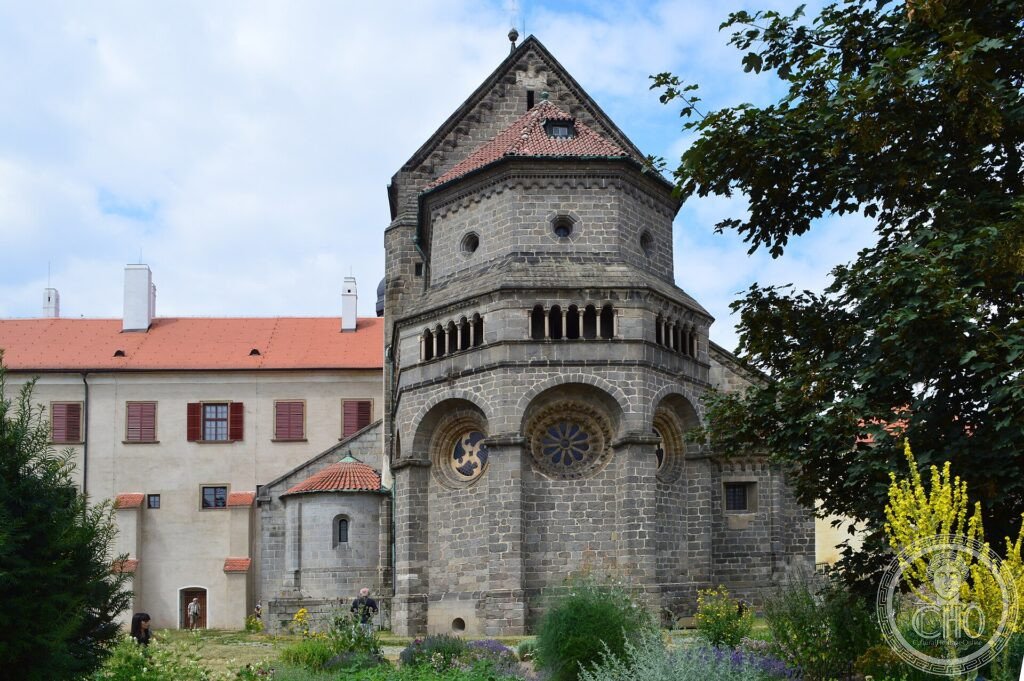
Two worlds meet at Třebíč: the great Basilica of St Procopius, a masterpiece of the passage from Romanesque to Gothic, and one of Europe’s best-preserved Jewish quarters, with its houses, synagogues and vast cemetery. A rare testimony to Christian and Jewish coexistence.
At a glance
Třebíč, in Moravia, is inscribed for two monuments that stand witness to the coexistence of Christian and Jewish cultures. The Basilica of St Procopius, built in the 13th century as part of a Benedictine monastery, is a remarkable building of the transition from Romanesque to Gothic. Beside the river lies one of the best-preserved Jewish quarters in Europe, with its houses, two synagogues and a large old cemetery. The basilica and Jewish quarter were inscribed by UNESCO in 2003.
Key facts
- UNESCO: World Heritage since 2003 (Jewish Quarter and St Procopius’ Basilica in Třebíč)
- St Procopius Basilica: 13th-century, a masterpiece of Romanesque-Gothic transition
- Jewish quarter: one of the most complete in Europe, with about 120 houses
- Synagogues: the Front and Rear synagogues survive
- Cemetery: a large old Jewish cemetery on the hillside
- Coexistence: a rare surviving record of Jewish and Christian communities side by side
History
Třebíč grew around a Benedictine monastery founded in 1101, whose church — the Basilica of St Procopius — was built in the 13th century in a style poised between Romanesque solidity and early Gothic lightness. A Jewish community settled by the river below, growing over the centuries into a dense quarter of houses, workshops and prayer houses.
Confined to their quarter for much of their history, the Jews of Třebíč built a self-contained town within the town. The community was destroyed in the Holocaust, but its physical fabric — houses, two synagogues, the cemetery — survived almost intact, making Třebíč an exceptional document of Jewish life in Central Europe.
What you see
The basilica crowns the town, its twin towers and rose window above a vaulted interior and an unusual crypt. Below, the lanes of the Jewish quarter wind between tall narrow houses; the Rear Synagogue keeps its painted interior, and steep paths climb to the old cemetery with its weathered stones among the trees.
The contrast of the great Christian church above and the dense Jewish town below is the heart of the site.
Practical information
- Basilica: visited by guided tour
- Jewish quarter: freely walkable; the synagogue and a museum house charge entry
- Time needed: half a day for both monuments
- Note: the cemetery is a short uphill walk
Getting there
Třebíč is in the Vysočina region of the Czech Republic, between Brno and Jihlava. It is reached by road or train. GPS: 49.215° N, 15.878° E.
Nearby
- Telč — the UNESCO Renaissance square, to the west
- Brno — the Moravian capital with the UNESCO Villa Tugendhat
- Jaroměřice nad Rokytnou — a vast Baroque chateau nearby
Sources
- UNESCO World Heritage Centre — “Jewish Quarter and St Procopius’ Basilica in Třebíč” (ref. 1078)
- Město Třebíč — official town authority
- Encyclopaedia Britannica — Czech Republic (history)
Find it on the map
See this place and what’s around it →📷 Become a Cultural Heritage Online photographer
Share your photos of places: they stay published under your name as the author. The more they're seen, the more you get noticed — and soon a contest will reward the most appreciated photos.
Log in or sign up free to add a photoIs this page about you?
This page is read by travellers and heritage enthusiasts who find it on Google. Tell us how you are connected to this place and we will take it from there.