
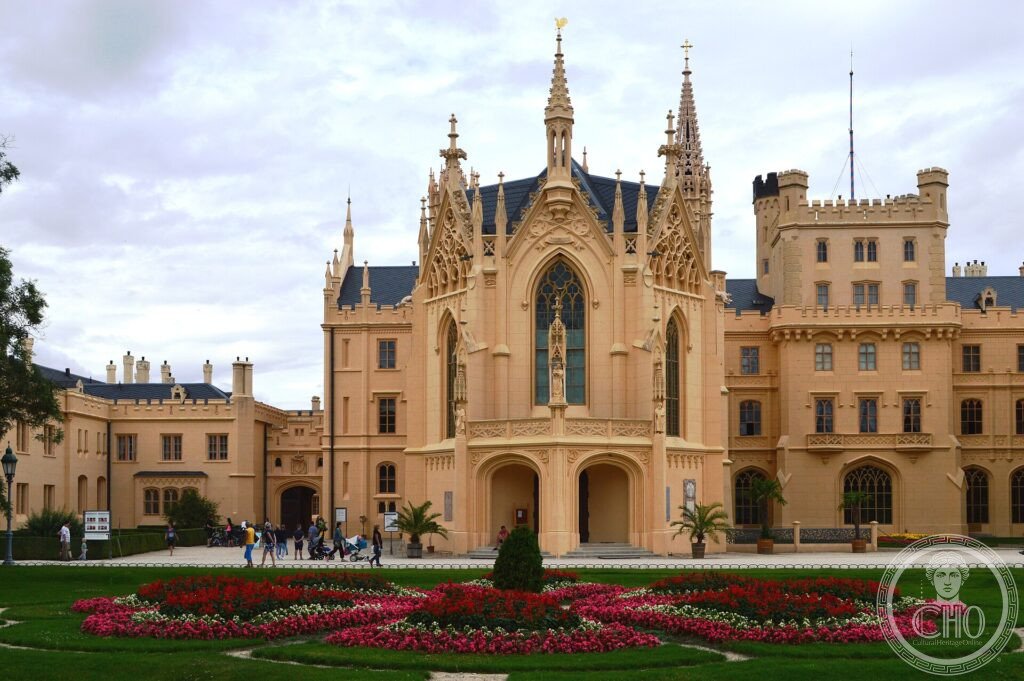
For generations the Liechtenstein family transformed an entire countryside into a garden: two residences — the baroque Valtice and the neo-Gothic Lednice — linked by avenues, lakes, temples and romantic pavilions. It is Europe’s largest designed landscape, a composition of architecture and nature.
At a glance
The Lednice-Valtice Cultural Landscape is the largest designed landscape in Europe, the work of the princely Liechtenstein family over several centuries. Around their two residences — the Baroque chateau of Valtice and the neo-Gothic palace of Lednice — they reshaped some 200 square kilometres of Moravian countryside into a single composition of avenues, lakes, woods and romantic follies. This fusion of Baroque, Classical and English-landscape ideas was inscribed by UNESCO in 1996.
Key facts
- UNESCO: World Heritage since 1996 (Lednice-Valtice Cultural Landscape)
- Largest in Europe: about 200 km² of designed landscape
- Two residences: Baroque Valtice and neo-Gothic Lednice
- The Liechtensteins: shaped over generations by the princely family
- Follies: classical temples, a minaret and romantic ruins dot the park
- Lednice greenhouse: a great 19th-century cast-iron palm house
History
The Liechtenstein family held these lands on the Moravian-Austrian border for centuries, and from the 17th to the 19th they pursued an extraordinary project: to turn the whole estate into a designed landscape. The Baroque chateau at Valtice served as the family seat, while Lednice became a summer residence, rebuilt in the 19th century in romantic neo-Gothic style.
Between and around them the family laid out avenues and planted woods, dammed the river Dyje to form lakes, and scattered the park with eye-catching structures — classical temples, a Triton fountain, a tall minaret and an artificial castle ruin — uniting two great houses in one immense garden.
What you see
Lednice presents a fairy-tale neo-Gothic palace beside formal flower parterres and a vast glasshouse of palms. From its park, paths and avenues lead through woodland and along lakes to the follies: the minaret rising above the trees, classical temples and the mock ruin of Janohrad.
Valtice, a Baroque chateau with grand state rooms, anchors the other end of the landscape, with vineyards and cellars nearby.
Practical information
- Chateaux: Lednice and Valtice are visited by guided tour
- Park: the grounds and follies are freely walkable; bicycles are ideal
- Time needed: a full day across the two residences and park
- Wine: the area is a centre of Moravian wine
Getting there
Lednice and Valtice are in South Moravia near the Austrian border, Czech Republic. They are reached by road or by train and bus via Břeclav. GPS (Lednice): 48.801° N, 16.805° E.
Nearby
- Valtice — the Baroque chateau at the other end of the landscape
- Mikulov — a wine town with a hilltop chateau
- Vienna — the Austrian capital, about an hour south
Sources
- UNESCO World Heritage Centre — “Lednice-Valtice Cultural Landscape” (ref. 763)
- Národní památkový ústav — Czech heritage institute
- Encyclopaedia Britannica — Liechtenstein (family)
Find it on the map
See this place and what’s around it →📷 Become a Cultural Heritage Online photographer
Share your photos of places: they stay published under your name as the author. The more they're seen, the more you get noticed — and soon a contest will reward the most appreciated photos.
Log in or sign up free to add a photo