
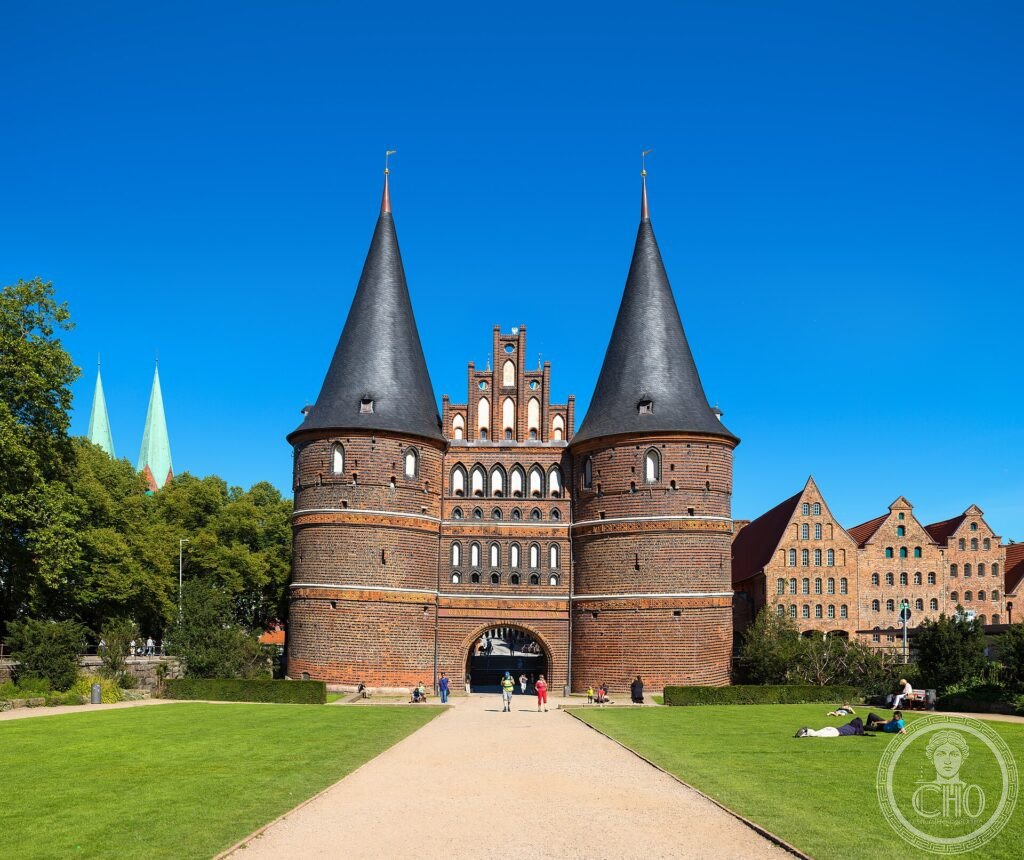
Capital of the Hanseatic League, Lübeck dictated the terms of Baltic trade for centuries. Its emblematic gate, the twin-towered Holstentor, is stamped into German memory. Within its walls, an island of churches and warehouses in red brick — and the house of Thomas Mann’s Buddenbrooks.
At a glance
Lübeck was the capital and “Queen” of the Hanseatic League, the merchant confederation that dominated Baltic trade from the 12th to the 16th centuries. Its old town, set on an island between two rivers, is a dense ensemble of Brick Gothic churches, merchants’ houses and warehouses, the model exported across the Baltic world. The Holstentor, its fortified western gate, is one of the most recognisable monuments in Germany. In 1987 Lübeck became the first old town in northern Europe to be inscribed by UNESCO.
Key facts
- UNESCO: World Heritage since 1987 — the first in northern Europe
- Hanseatic capital: the leading city of the Hanseatic League
- Holstentor: the western gate, built 1464–1478, leaning under its own weight
- Brick Gothic: the seven-spired skyline of churches in red brick
- Literature: birthplace of Thomas Mann, whose “Buddenbrooks” is set here
- Marzipan: the city is famous for it, above all the house of Niederegger
History
Founded in 1143 and refounded in 1159 by Henry the Lion, Lübeck became a free imperial city and the hub of the Hanseatic League, a network of trading towns that controlled commerce across the North and Baltic Seas. Its wealth built churches, a town hall and warehouses in brick — stone being scarce on the northern plain — creating the distinctive Backsteingotik that spread to Gdansk, Riga, Tallinn and beyond.
The decline of the Hanse from the 16th century left the medieval city remarkably preserved. Bombing in 1942 damaged several churches but the urban fabric survived and was restored. In the 20th century the city gave the world the novelist Thomas Mann and his brother Heinrich.
What you see
The Holstentor greets arrivals with its two squat round towers and stepped gable, tilting visibly where the marshy ground has shifted. Beyond it the salt warehouses line the river, then the old town rises to the brick churches: the Marienkirche, with its soaring vault and the bells that crashed down in 1942, left where they fell as a memorial.
The Buddenbrookhaus and the merchant courtyards (Gänge und Höfe), tucked behind the main streets, show how the trading families lived.
Practical information
- Holstentor: houses a city museum; old town streets are freely walkable
- Time needed: a full day for the churches, gate and waterfront
- Local speciality: Lübeck marzipan, sold throughout the old town
- Note: the old town is compact and best explored on foot
Getting there
Lübeck is in Schleswig-Holstein on the Baltic, about 40 minutes by train from Hamburg. From the main station the Holstentor and old town are a short walk across the river. GPS: 53.8662° N, 10.6797° E.
Nearby
- Travemünde — Lübeck’s Baltic seaside resort at the river mouth
- Hamburg — the great port city, under an hour away
- Wismar and Stralsund — fellow Brick Gothic UNESCO towns along the coast
Sources
- UNESCO World Heritage Centre — “Hanseatic City of Lübeck” (ref. 272)
- Hansestadt Lübeck — official city authority
- Encyclopaedia Britannica — Lübeck; Hanseatic League
Find it on the map
See this place and what’s around it →📷 Become a Cultural Heritage Online photographer
Share your photos of places: they stay published under your name as the author. The more they're seen, the more you get noticed — and soon a contest will reward the most appreciated photos.
Log in or sign up free to add a photo