
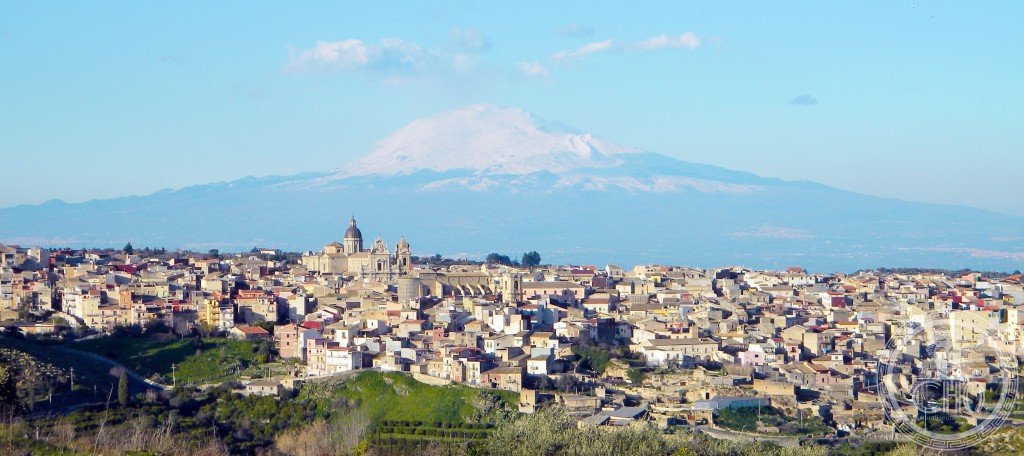
Militello in Val di Catania is the least visited of the eight Baroque towns of the Val di Noto, rebuilt in honey-coloured local stone after the 1693 earthquake and holding, in its parish church of San Nicolò, a painting attributed to Antonello da Messina.
At a glance
Militello in Val di Catania is a small town of around 7,000 people on the Iblean plateau, roughly midway between Catania and Ragusa. Its historic centre was rebuilt after the earthquake of 1693 in a local golden-yellow limestone known as pietra di Militello, a warm-toned calcarenite that sets it apart from the whiter stone of Noto or the grey lava stone used in Catania.
The town is one of the eight Late Baroque towns of the Val di Noto inscribed on the UNESCO World Heritage List in 2002 under reference 1024, and is generally considered one of the least visited and most unaltered of the group.
Key facts
- Region: Iblean plateau, province of Catania, Sicily
- Population: around 7,000
- UNESCO status: part of the Late Baroque Towns of the Val di Noto, inscribed 2002, reference 1024
- Key monument: the facade of Santa Maria dell’Elemosina, 1721, held to be the most elaborate in the Val di Noto
- Key artwork: a Madonna col Bambino in San Nicolò, attributed to Antonello da Messina, though some scholarship credits it to the artist’s workshop
History
The settlement’s name derives from an Arabic root combined with a Norman suffix, and the earliest documentary record of the territory is a charter of 1093 by Count Roger I of Sicily, granting Militello to the Bishop of Catania. From 1392 the Catalan-Aragonese Moncada family held Militello as a feudal fief, a lordship that lasted 474 years until 1866.
The church of Santa Maria della Stella, founded in 1506, is the only building in Militello to survive the earthquake of 11 January 1693, one of the most destructive events in Sicilian history. The reconstruction of the town was financed personally by the feudal lord Francesco Moncada e Aragona, whose estate covered fourteen villages and tens of thousands of hectares of farmland; contemporary estimates put his outlay at a sum equivalent to several decades of a wealthy noble’s annual income. Two architects are associated with the rebuilding: Giovan Battista Vaccarini, who also designed Catania Cathedral and its university and who is credited with San Nicolò of 1761, and an unnamed workshop, trained in the Palermo tradition, responsible for the facade of Santa Maria dell’Elemosina of 1721. The town’s Baroque centre was later included, alongside seven other Val di Noto towns, in the UNESCO World Heritage List in 2002.
What you see
The facade of Santa Maria dell’Elemosina is the town’s principal set piece, built across three levels with three portals, spiral-twisted columns carved directly into the stone, and a row of niches holding statues of saints in dramatic Baroque poses, with a belltower rising above the pediment. The interior has three naves, a painted wooden ceiling of 1724 with allegorical panels, and a marble altarpiece of 1740 made using inlaid coloured marble and semiprecious stone in a technique known as commesso di marmo.
San Nicolò, the town’s principal church, was designed by Vaccarini and completed in 1761. It houses an oil-on-panel Madonna col Bambino attributed to Antonello da Messina, though a 1983 catalogue of the work attributes it more cautiously to the painter or his workshop; the modelling of the face and hands has been compared to Antonello’s Vergine Annunziata in Palermo.
Santa Maria della Stella, the town’s only pre-earthquake church, holds a marble sculptural group of the Holy Family with Saint Anne attributed to Francesco Laurana, its four figures carved with the almond-eyed faces characteristic of his style. On the hill above the town stands the Castello Moncada, a fourteenth- to fifteenth-century feudal castle currently closed for restoration, whose terrace gives a view over the town towards Etna.
Practical information
- Opening times: the main churches keep set visiting hours that vary by day; check locally or with the town’s tourist office before visiting.
- Admission: access to Santa Maria dell’Elemosina is free; other sites should be checked in advance.
- Castello Moncada: closed for restoration at the time of writing; only the exterior can be seen.
- Combining a visit: Militello is often visited together with other Val di Noto towns such as Caltagirone or Palazzolo Acreide.
Getting there
Militello lies inland from Catania and can be reached by bus service from the city or by car via the A19 motorway and the SS288 towards Caltagirone. Travellers combining several Val di Noto towns typically use Catania as a base for day trips.
Nearby
- Caltagirone — a short drive away, another of the Val di Noto Baroque towns, known for its ceramics.
- Palazzolo Acreide — a nearby Val di Noto town, often paired with Militello on a wider itinerary.
- Catania — the nearest city, with its own Vaccarini-designed cathedral and university buildings.
- Mount Etna — visible from the Castello Moncada terrace, to the north-east.
Sources
- UNESCO
Find it on the map
See this place and what’s around it →📷 Become a Cultural Heritage Online photographer
Share your photos of places: they stay published under your name as the author. The more they're seen, the more you get noticed — and soon a contest will reward the most appreciated photos.
Log in or sign up free to add a photo