
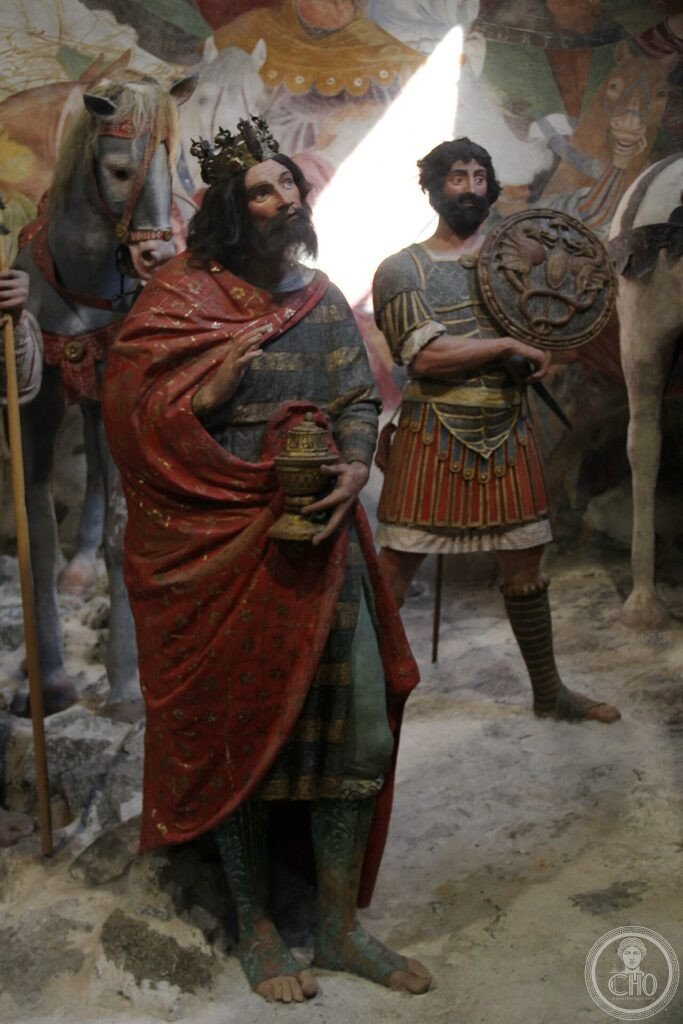
Above the town of Varallo, forty-five chapels climb a wooded hill above the Sesia valley, each one a life-size theatrical tableau of the life of Christ. Founded in 1493 as a substitute pilgrimage to a Jerusalem that had become unreachable, the site still blurs the line between painting, sculpture and stage set.
At a glance
The Sacro Monte di Varallo occupies a flat-topped hill above the town, its basilica and chapels visible from the valley floor. The idea behind it is simple and unusual: instead of a single church, a sequence of forty-five chapels, each containing a three-dimensional scene from the life of Christ or the Virgin, built with life-size terracotta or painted wood figures set against illusionistic painted backgrounds. Visitors move from chapel to chapel as though walking through the Holy Land itself, an experience that is at once pilgrimage and theatre.
The site’s best-known chapel, dedicated to the Crucifixion, was frescoed by Gaudenzio Ferrari, the leading Piedmontese painter of the early sixteenth century, who worked at Varallo for roughly two decades. He filled the room with more than seventy painted figures and placed two life-size sculpted figures, the Virgin and Saint John, at the foot of a painted cross, blending fresco and sculpture so closely that it is hard to see where one ends and the other begins.
Key facts
- Founded: 1493, by the Franciscan friar Bernardino Caimi, formerly Guardian of the Holy Sepulchre in Jerusalem
- Chapels: 45, built up gradually between the 1490s and 1600
- Key artist: Gaudenzio Ferrari, active at Varallo from around 1507 to 1528
- Recognition: UNESCO World Heritage Site since 2003, as part of a serial listing of nine Sacri Monti across Piemonte and Lombardia (reference 1068)
- Literary link: visited repeatedly by the English writer Samuel Butler from 1871, who wrote two books about the Piedmontese sacred mountains
History
The Sacro Monte was founded after Bernardino Caimi returned from Jerusalem carrying measurements of the key holy sites. With the eastern Mediterranean routes increasingly closed to Christian pilgrims following the Ottoman conquest of Constantinople, Caimi’s idea was to build a New Jerusalem in the Alps that reproduced the experience of the pilgrimage without the journey. The original plan called for fourteen chapels corresponding to the stations of the Via Dolorosa, but donations allowed rapid expansion: twenty chapels by Caimi’s death in 1500, thirty-five by 1550, and forty-five by 1600.
Carlo Borromeo, the Counter-Reformation Archbishop of Milan, visited in 1578 and became the project’s chief patron, commissioning the architect Pellegrino Tibaldi to regularise the chapel sequence and the pilgrimage path. Most of the surviving chapel architecture dates from this campaign. Borromeo saw the Sacro Monte as a tool of popular religious instruction, allowing the illiterate to experience the Gospel by walking through it, much as earlier generations had ‘read’ the stained glass of a Gothic cathedral.
In 2003 the site was inscribed on the UNESCO World Heritage List as part of a serial nomination covering nine Sacri Monti across Piemonte and Lombardia, including Orta, Oropa, Crea, Ghiffa, Ossuccio, Varese, Domodossola and Belmonte.
What you see
The Sacro Monte sits above the town of Varallo, reached either by a short funicular or by a walking path that climbs past a series of small outdoor shrines marking the Via Crucis, distinct from the forty-five numbered chapels on the plateau itself. Once on top, the chapels are arranged along a pilgrimage street known as the Via Sacra, a circuit of around one and a half kilometres. They stand open together, with no separate entry charge beyond a donation, though the doors are deliberately low, so that visitors must duck to enter, a small architectural gesture of humility before each scene.
Among the most significant chapels is the ninth, the Nativity, which holds a polychrome terracotta group by Gaudenzio Ferrari from 1513, the only early Ferrari sculptural work to survive in its original setting. The thirty-fourth chapel, the Last Supper, was carved by Jean de Wespin, known as Tabachetti, between 1598 and 1605, and is considered the most realistic treatment of the subject in the whole Sacro Monte tradition, with thirteen life-size figures around the table.
Practical information
- Access: reachable by funicular from the town or by a marked path on foot; both routes are described on the site’s own visitor pages
- Chapel visits: the forty-five chapels are open together along the Via Sacra, generally free to enter with a donation welcomed
- Current hours and fares: check the official Sacro Monte di Varallo channels before visiting, as these change seasonally
Getting there
The Sacro Monte stands on a hill directly above Varallo, in the Valsesia in the province of Vercelli. It can be reached from the town either by the funicular or on foot along the Via Sacro Monte, which climbs past the Via Crucis shrines before reaching the chapel complex.
Nearby
- Sacro Monte di Orta — part of the same serial UNESCO listing of nine Piedmontese and Lombard sacred mountains
- Sacro Monte di Oropa — another of the nine sites inscribed together with Varallo in 2003
- Sacro Monte di Crea — likewise part of the shared UNESCO inscription covering Piemonte and Lombardia
Sources
- UNESCO World Heritage List (reference 1068)
- Samuel Butler, Ex Voto (1888)
- Samuel Butler, Alps and Sanctuaries (1882)
- John Ruskin, Praeterita
Find it on the map
See this place and what’s around it →📷 Become a Cultural Heritage Online photographer
Share your photos of places: they stay published under your name as the author. The more they're seen, the more you get noticed — and soon a contest will reward the most appreciated photos.
Log in or sign up free to add a photoDo you manage this place?
This page is read by travellers and heritage enthusiasts who find it on Google. Keep it accurate — and make it work for you. Free for non-profit heritage institutions.