
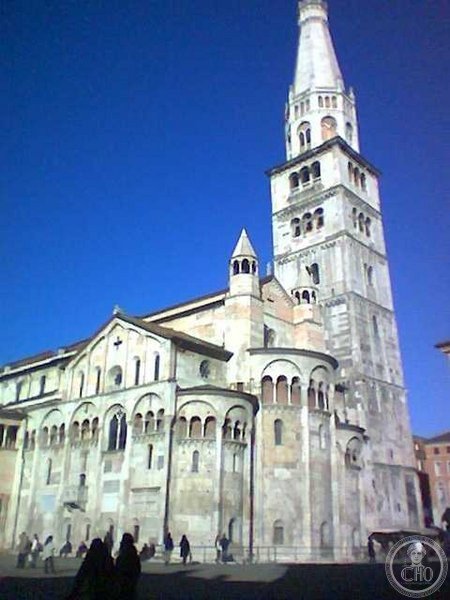
Modena Cathedral holds the earliest large-scale stone sculptural narrative made in Italy after antiquity: Wiligelmo’s Genesis reliefs, carved directly onto the west facade. Together with the Ghirlandina tower and the piazza it forms an unusually complete Romanesque urban ensemble, still standing much as it was built.
At a glance
Modena Cathedral was begun in 1099 over the tomb of San Geminiano, the city’s patron saint, at a moment when Modena was asserting its civic and religious standing against neighbouring Mantua and Bologna. Its west facade carries the Genesis reliefs signed by the sculptor Wiligelmo, whose name appears in a dedicatory inscription praising his genius, the first time an individual sculptor is named and celebrated on a major Italian building after the Roman era. The cathedral, the adjoining Ghirlandina tower and the Piazza Grande were inscribed together as a UNESCO World Heritage Site in 1997.
Key facts
- Founded: 1099, under Bishop Lanfranco, who commissioned both the building and its sculptural programme.
- Architect: Lanfranco, whose own written account of the foundation, the Relatio, survives as one of the earliest architect’s descriptions of a building project in medieval Italy.
- Sculptor: Wiligelmo, active around 1099–1110, creator of the four Genesis panels on the facade.
- Ghirlandina tower: begun with the cathedral in 1099 and completed, with its open marble crown, in 1319; it stands 87 metres high.
- UNESCO status: inscribed in 1997 (reference 827), jointly with the Ghirlandina and Piazza Grande, as an example of the Romanesque urban ensemble in Emilia-Romagna.
History
The cathedral was founded in January 1099 over the relics of San Geminiano, a fourth-century bishop and the city’s patron saint. Bishop Lanfranco initiated the project, and the architect of the same name directed the building work, leaving behind the Relatio, a written account of the foundation that is among the oldest surviving building descriptions by an architect in medieval Italy. Wiligelmo is thought to have begun carving the Genesis panels almost immediately, with the work likely complete by around 1110.
The Ghirlandina tower rose alongside the cathedral from 1099, its octagonal belfry added in the thirteenth century and its distinctive open marble crown, the ‘ghirlanda’ that gives it its name, completed in 1319. Gothic additions followed in the thirteenth and fourteenth centuries, including an extended south apse and nave and the rose window set above the central portal.
In 1997 UNESCO inscribed the cathedral together with the Ghirlandina and the Piazza Grande, treating the church, the civic tower and the public square as a single, unified example of Romanesque urban design.
What you see
The west facade faces directly onto the Piazza Grande, so the cathedral, tower and square are taken in together as one composition. Wiligelmo’s four Genesis panels, the Creation of Adam, the Fall, the Expulsion and the Works of Adam and Eve, sit at eye level between the lower blind arcades, each figure carved in high relief and set beneath its own small arch echoing the real architecture around it. In the Expulsion panel, the third from the left, Eve’s face is rendered with an individualised expression, one of the earliest instances of this in Italian sculpture of the period. The central portal is flanked by a Romanesque lion porch, with two marble lions bearing the weight of the columns on their backs.
Inside, the nave runs the length of the building and the crypt beneath the altar holds the tomb of San Geminiano. The best-preserved Romanesque furnishing in the interior is the raised ambo, carved by Anselmo da Campione, one of the Campionesi masters who continued Wiligelmo’s work at Modena. The adjoining Museo del Duomo holds original Wiligelmo fragments not displayed on the facade, including a series of carved hexagonal metopes, and a fragmentary stone relief depicting scenes from the Arthurian legend, found in the tower’s foundations and considered among the earliest surviving narrative depictions of the Arthurian cycle in Europe. The Ghirlandina can be climbed internally, and the change in stonework at different heights marks the successive building phases between 1099 and 1319.
Practical information
- Visit time: allow at least two hours to take in the cathedral, the Museo del Duomo and the Ghirlandina together.
- Access: the Ghirlandina is open to visitors as a climbable tower; check the cathedral’s own channels for current access arrangements.
- Combined visit: the cathedral, tower and Museo del Duomo can be seen as one itinerary in the Piazza Grande.
Getting there
Modena is served by regular train connections from Bologna and Parma, making the cathedral an easy day trip from either city. The Piazza Grande and cathedral sit in the historic centre, within walking distance of the railway station.
Nearby
- Museo Casa Enzo Ferrari (MEF) — a short walk from the cathedral, tracing Ferrari’s history from its early cars to the present.
- Museo Casa Enzo Ferrari, Maranello — around 15 km south, the Ferrari factory museum at the Maranello plant.
- Mercato Albinelli — the city’s covered municipal food market, among the largest indoor markets in Emilia-Romagna, selling local specialities including traditional balsamic vinegar of Modena.
- Acetaia Comunale — the municipal vinegar loft housed in the attic of the Palazzo Comunale on Piazza Grande.
Sources
- UNESCO World Heritage Centre
- Museo del Duomo, Modena
- Relatio (Lanfranco’s foundation account)
Find it on the map
See this place and what’s around it →📷 Become a Cultural Heritage Online photographer
Share your photos of places: they stay published under your name as the author. The more they're seen, the more you get noticed — and soon a contest will reward the most appreciated photos.
Log in or sign up free to add a photoDo you manage this place?
This page is read by travellers and heritage enthusiasts who find it on Google. Keep it accurate — and make it work for you. Free for non-profit heritage institutions.