

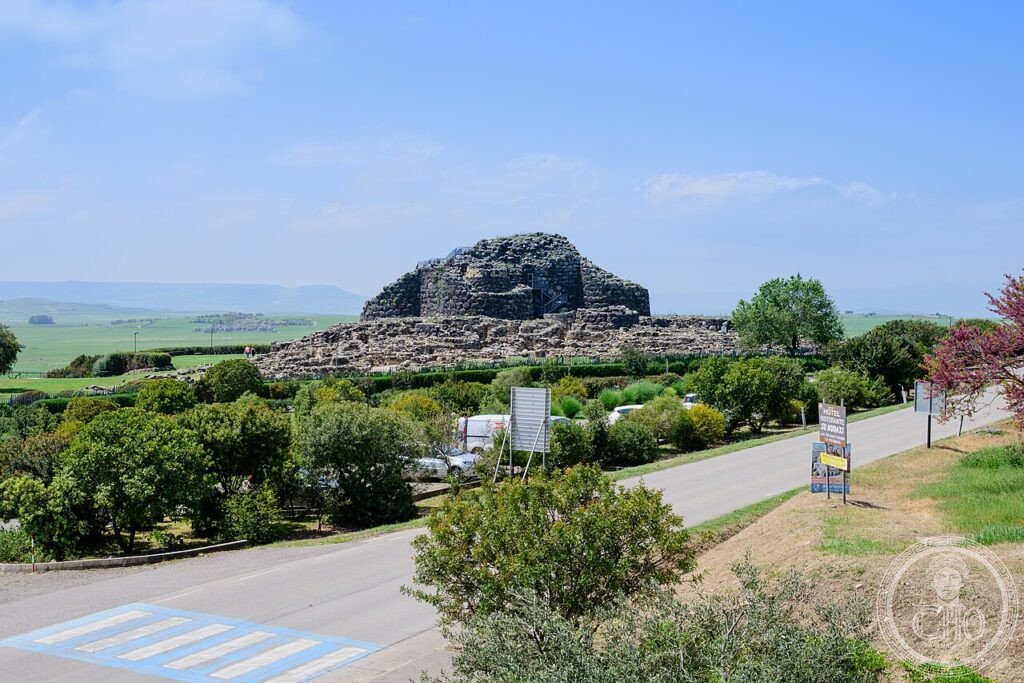
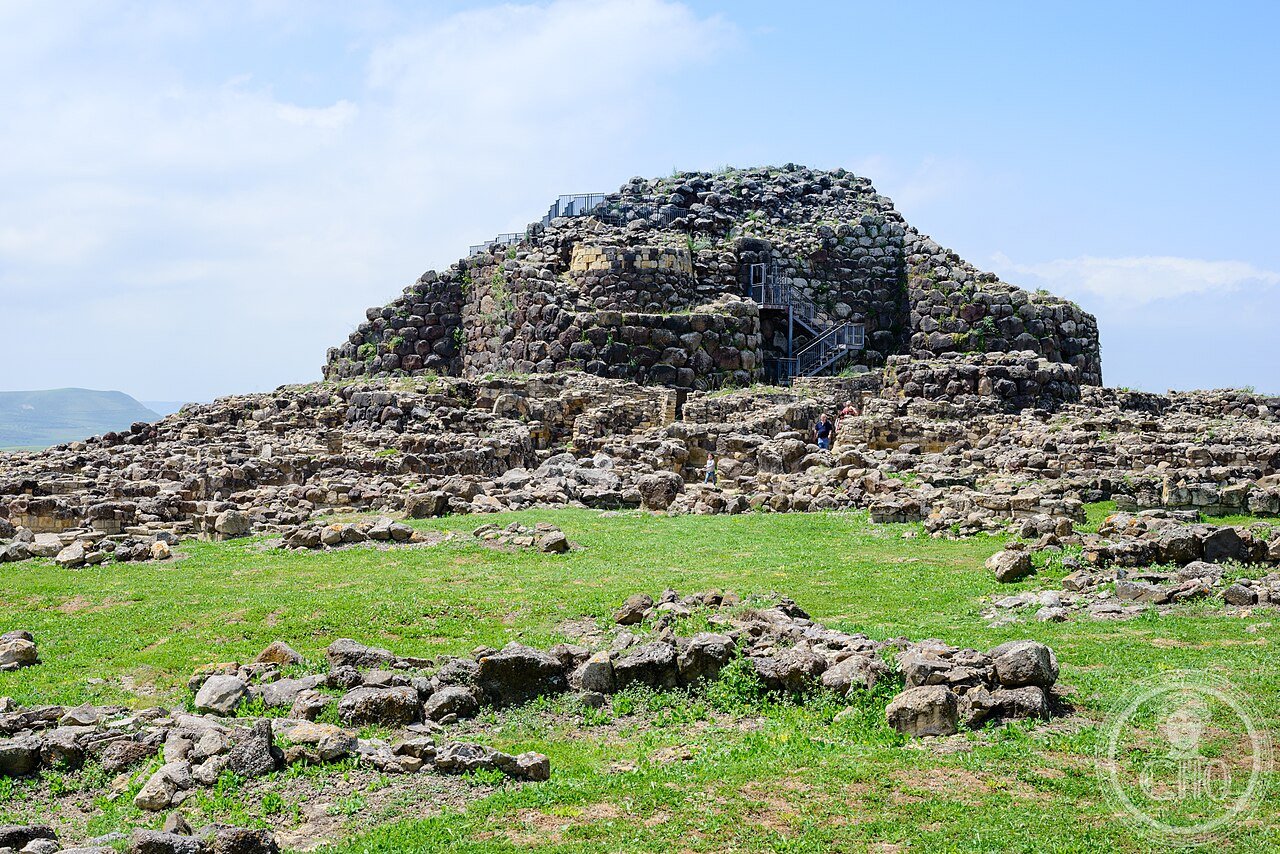
Su Nuraxi is the most complete nuraghe complex in Sardinia, a Bronze Age fortress of unmortared basalt towers surrounded by a village of stone huts. Buried under three metres of earth for centuries, it was uncovered by Giovanni Lilliu between 1950 and 1957 and remains the only nuraghe on the UNESCO World Heritage list.
At a glance
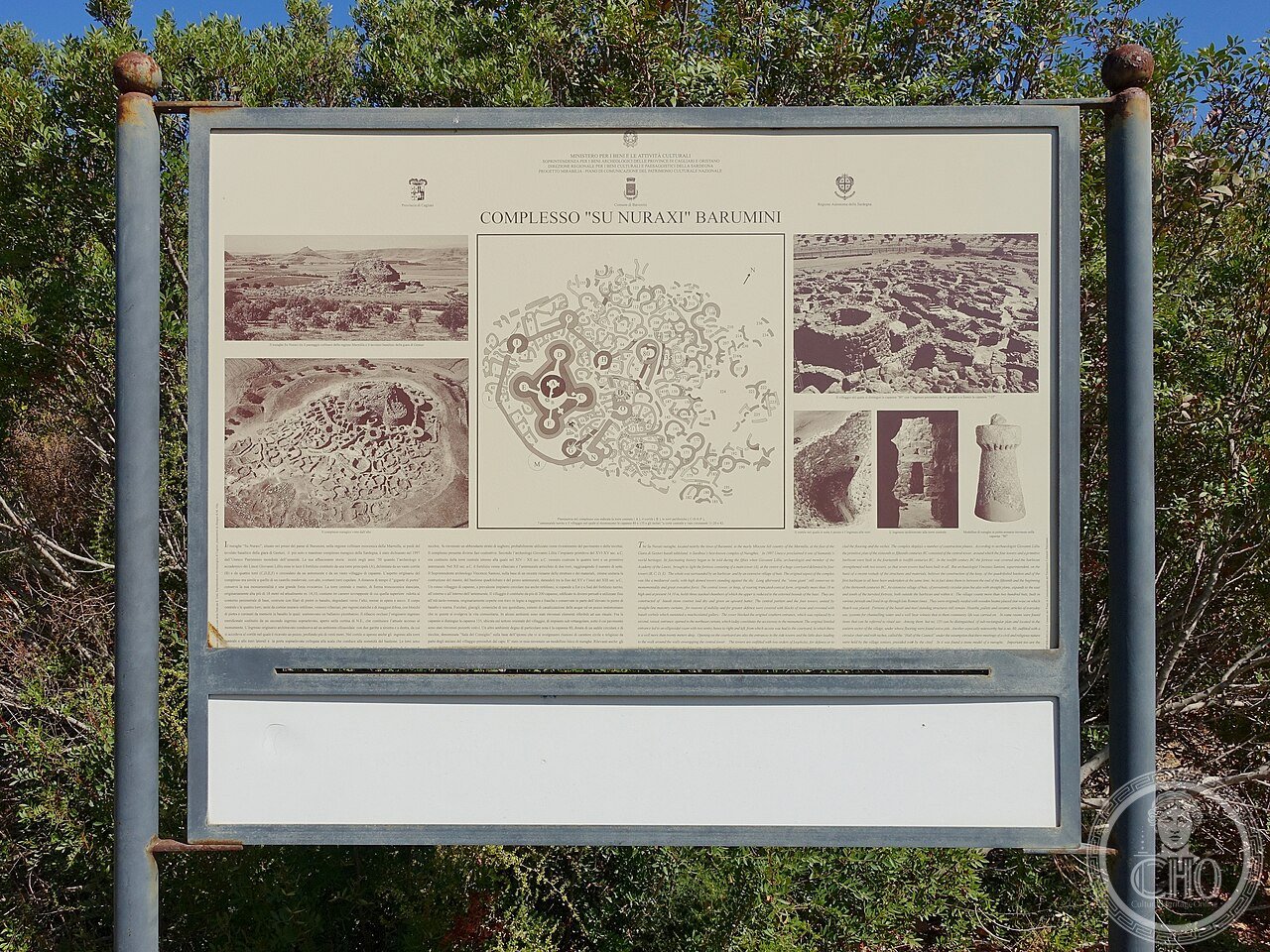
Su Nuraxi stands on the Marmilla plain near Barumini, at the centre of a nuragic landscape that once counted tens of thousands of these stone towers across Sardinia, of which around 7,000 survive. The complex grew in stages: a central tower raised around 1500 BCE, an outer rampart of four towers added around 1300 BCE, and a surrounding village of circular stone huts built around 900 BCE. The whole site covers about two hectares.
For centuries the complex lay hidden, buried under soil and stone fill that had accumulated after Sardinia became a Roman province. Giovanni Lilliu, an archaeologist from Cagliari, began excavating in 1950 after aerial photographs revealed an unusual shape in the field, and completed the work by 1957.
Key facts
- Type: nuraghe complex — central tower, outer rampart with four towers, and surrounding village
- Central tower: built around 1500 BCE, Bronze Age
- Outer rampart: added around 1300 BCE, giving the complex its quadrilobed plan
- Village: more than 50 circular stone huts, built around 900 BCE
- Excavation: led by Giovanni Lilliu, 1950–1957, after the site was found buried under some three metres of earth
- Recognition: inscribed on the UNESCO World Heritage list in 1997
History
The nuraghe is a form unique to Sardinia, a corbelled tower of dry-stone basalt blocks that first appeared on the island around 1800–1600 BCE. Su Nuraxi shows the type at its fullest development: a central tower from around 1500 BCE, an outer defensive rampart with four connected towers added around 1300 BCE, and a village of more than fifty huts built around 900 BCE, with areas identified for cooking, bronze-working and general habitation. By around 700 BCE the nuragic community here was in contact with Phoenician traders, and by the fifth century BCE the area came under Carthaginian influence; the site continued to be occupied and modified through this period.
Rome took Sardinia from Carthage in 238 BCE, and the site was gradually abandoned during the Roman period. At some point, whether through earthquake damage or deliberate infill, it was buried under soil, disappearing from view by the early medieval period. It stayed hidden until 1949, when Giovanni Lilliu identified an anomalous shape in aerial photographs and proposed excavation. Work began the following year and continued until 1957, uncovering the full village and complex. The Fondazione Barumini Sistema Cultura was established in 1990 to manage the site, and UNESCO inscribed it as a World Heritage Site in 1997.
The discovery reshaped Sardinian archaeology. Nineteenth-century scholarship had dismissed the nuraghi as Roman water towers or later shepherd constructions; Lilliu’s excavation, revealing a Bronze Age complex with an associated village, bronze foundry evidence and a clear ceramic sequence, forced the recognition of a distinct nuragic civilisation. Lilliu spent decades building the academic and museum framework around this discovery, and the nuraghe has since become a recurring symbol in Sardinian regional identity, appearing on local produce, tourism material and club crests.
What you see
Visitors can walk into the central tower, which rises through superimposed chambers reached by an internal spiral staircase. The outer rampart’s four towers are linked by a walkway that allows a circuit around the inner courtyard at the level of the second chamber, giving views over the Marmilla plain and the village of Barumini itself. Around the towers lie the foundations of more than fifty circular huts, mostly six to ten metres across, among which archaeologists have identified cooking areas marked by ash deposits and storage jars, a likely bronze foundry indicated by slag fragments, and huts used for general dwelling, storage or gathering.
The adjacent museum run by the Fondazione Barumini displays ceramics, bronze tools and a scale model of the site as it looked before excavation, still buried under its mound of earth, alongside a model of the complex as reconstructed. Original bronze figurines and finds are held in the museum in Cagliari, with copies shown on site.
Sardinian bronze-workers of the ninth to seventh centuries BCE produced small votive figurines known as bronzetti, and examples linked to this tradition have turned up as far afield as Etruscan sanctuaries in Tuscany, Delphi and Olympia in Greece, Phoenician Cyprus and Carthaginian North Africa, evidence that nuragic Sardinia, a major producer of copper, traded actively across the Bronze Age Mediterranean. The foundry evidence at Su Nuraxi connects the site directly to that wider network.
Practical information
- Visiting: access is by guided tour only, in Italian or English, taking visitors inside the central tower as far as the second chamber; groups are limited in size and English-language guiding can be arranged in advance
- Museum: the Fondazione Barumini museum stands near the site and is included in the same visit, with scale models and bronzetti copies on display
- Best time to visit: spring and autumn are recommended; August heat on the exposed plain can be intense, while winter mornings are sometimes foggy
- Official information: check the Fondazione Barumini’s own channels (barumini.it) for current tour times and booking
Getting there
Su Nuraxi lies near Barumini in the Marmilla area of Sardinia. A car is the most practical way to reach it from Cagliari, taking the road towards Sassari and exiting for Sanluri-Serri; public transport options are limited, with ARST buses running from Cagliari to Barumini village followed by a walk to the site, and organised tours also available from Cagliari. From Sassari the site is roughly two hours away by car.
Nearby
- Su Tempiesu spring sanctuary at Gremanu — about 20 km north, another nuragic water sanctuary with ritual wells used for ceremonial purposes from around the eleventh to ninth centuries BCE
- Cagliari — the Sardinian capital, home to the archaeological museum holding original ceramics, bronze tools and figurines from Su Nuraxi
- Barumini village — immediately adjacent to the site
Sources
- UNESCO
- Fondazione Barumini Sistema Cultura
- Giovanni Lilliu
Gallery
Find it on the map
See this place and what’s around it →📷 Become a Cultural Heritage Online photographer
Share your photos of places: they stay published under your name as the author. The more they're seen, the more you get noticed — and soon a contest will reward the most appreciated photos.
Log in or sign up free to add a photoIs this page about you?
This page is read by travellers and heritage enthusiasts who find it on Google. Tell us how you are connected to this place and we will take it from there.