
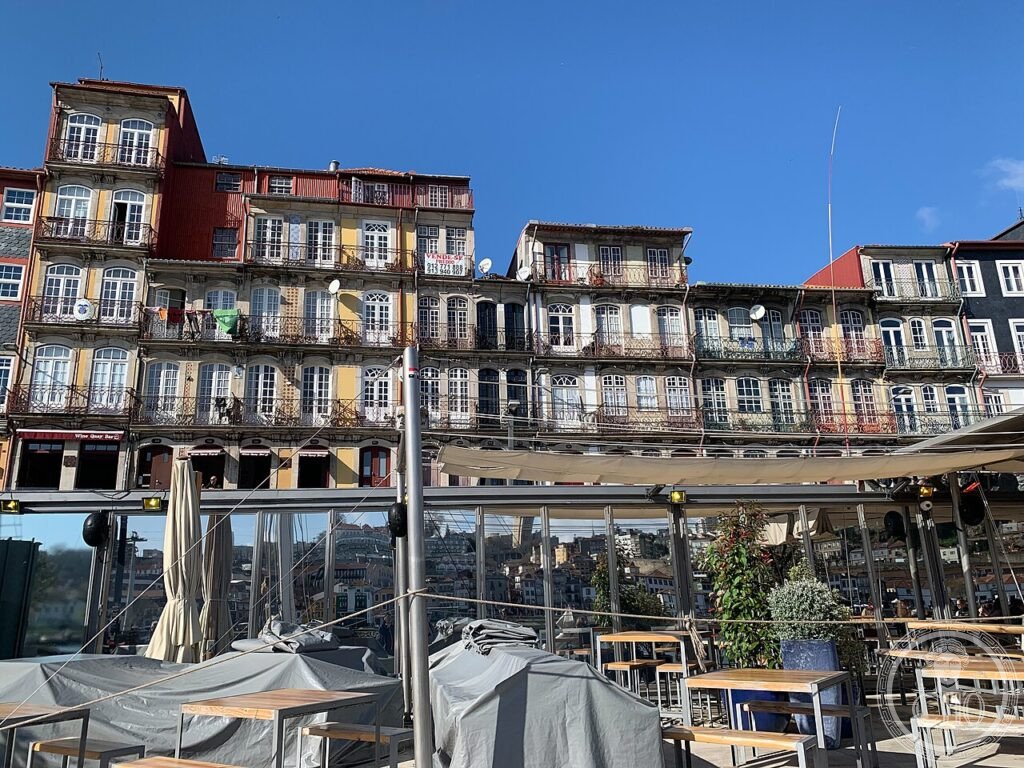
Porto’s historic centre climbs from the Douro waterfront on steep granite slopes, its houses faced in hand-painted azulejo tiles. A medieval cathedral, a Baroque church smothered in gold leaf, and the port wine trade across the river in Vila Nova de Gaia give the city its distinctive, layered character.
At a glance
The historic centre of Porto occupies roughly 100 hectares on the right bank of the Douro, taking in the hilltop cathedral area, the Ribeira waterfront, the São Bento station district and parts of Batalha and Bonfim. Its street pattern is largely medieval, and the buildings that line it span from the 14th to the 20th century. The single most recognisable feature is the azulejo tile facade: blue-and-white or polychrome ceramic tiles covering entire building fronts, a look that began as practical waterproofing against Atlantic rain and became the visual signature of the city.
Across the river, in Vila Nova de Gaia, stand the port wine lodges. Portuguese law from the eighteenth century required the wine trade to be based on that south bank, and the practice continues, so that port wine and Porto remain bound together in name and in commerce.
Key facts
- Designation: UNESCO World Heritage Site, inscribed 1996
- Cathedral: Sé do Porto, begun in the 12th century
- São Francisco Church: built 1383–1410, its Baroque interior later covered in carved and gilded woodwork, with a macabre bone-lined crypt below the floor
- Factory House: built 1790 on Rua do Infante Dom Henrique, still operating as a private club for the port wine trade
- Dom Luís I Bridge: completed 1886, designed with Gustave Eiffel’s collaborator Théophile Seyrig, a double-deck iron structure spanning 172 metres
- São Bento station: opened 1916, its interior lined with azulejo panels by Jorge Colaço depicting Portuguese history
History
Porto’s story begins with a Roman river crossing that gave Portugal its name, from Portucale. The County of Portugal was created around Porto in 1096, and when the Kingdom of Portugal was founded in 1143 under Afonso Henriques, Porto became its second city. Medieval walls went up through the 13th and 14th centuries, and in 1394 the city gave birth to Infante Dom Henrique, known as Henry the Navigator, who organised expeditions along the West African coast and into the Atlantic from Porto, part of the wider Portuguese Age of Discovery that followed the capture of Ceuta in 1415. The city’s modern character owes much to wine. From the seventeenth century English merchants based in Porto bought Douro valley wine and fortified it with brandy for shipping to England, a trade formalised by the Methuen Treaty of 1703. In 1756 the Marquês de Pombal established the Douro as a demarcated wine region, among the first such regions anywhere. The English and Scottish merchant families who ran this trade, among them Sandeman, Graham, Symington and Taylor, built the Factory House in 1790 as their exchange and social club; it still functions as a private club today, and the tradition of a Wednesday lunch with vintage port continues there. The historic centre was inscribed as a UNESCO World Heritage Site in 1996.What you see
The Ribeira waterfront is the heart of the historic centre: narrow lanes, known locally as vielas, drop steeply from the cathedral down to the Cais da Ribeira, lined with tall, narrow houses whose facades carry painted or tiled decoration. Flat-bottomed rabelo boats, once used to bring port wine barrels down the Douro from the vineyards, now sit on the river mainly as decoration.
Inland, the Igreja de São Francisco holds the most extravagant Baroque interior in the city, its walls, columns and altars carved in wood and covered in gold leaf, with an ossuary visible beneath the floor through glass panels. São Bento station, though a working railway terminus, is lined with a large programme of azulejo panels depicting scenes from Portuguese history. The Livraria Lello, a neo-Gothic bookshop from 1906 with a curved staircase and stained glass ceiling, draws attention partly through a disputed claim linking it to J.K. Rowling, who lived in Porto in the early 1990s.
The Dom Luís I Bridge carries pedestrians on its lower deck between the old town and Vila Nova de Gaia, and metro trains and pedestrians on its upper deck, offering a view over the port wine lodges on the south bank, where the wine trade has been based since a legal requirement of 1756.
Practical information
- Livraria Lello: entry involves a purchase; visitors should check current arrangements on the shop’s own channels before travelling.
- Walking: the historic centre is compact and best explored on foot from either São Bento or Campanhã station, though the terrain is steep in places.
- Vila Nova de Gaia: reached on foot across the Dom Luís I Bridge or by short ferry, for visits to the port wine lodges.
Getting there
Porto is served by Francisco Sá Carneiro Airport, with a metro line running directly into the city centre to Trindade station. Travellers from Lisbon can take the Alfa Pendular high-speed train to Porto Campanhã, from where the historic centre is within walking distance, as it is from São Bento station.
Nearby
- Vila Nova de Gaia — across the Douro, home to the port wine lodges of houses such as Sandeman, Graham, Taylor and Symington.
- Dom Luís I Bridge — links the two riverbanks and offers views over the Ribeira and the lodges opposite.
- São Bento Station — a short walk from the cathedral, notable for its tiled interior.
- Livraria Lello — a neo-Gothic bookshop within the historic centre.
Sources
- UNESCO
Find it on the map
See this place and what’s around it →📷 Become a Cultural Heritage Online photographer
Share your photos of places: they stay published under your name as the author. The more they're seen, the more you get noticed — and soon a contest will reward the most appreciated photos.
Log in or sign up free to add a photo