
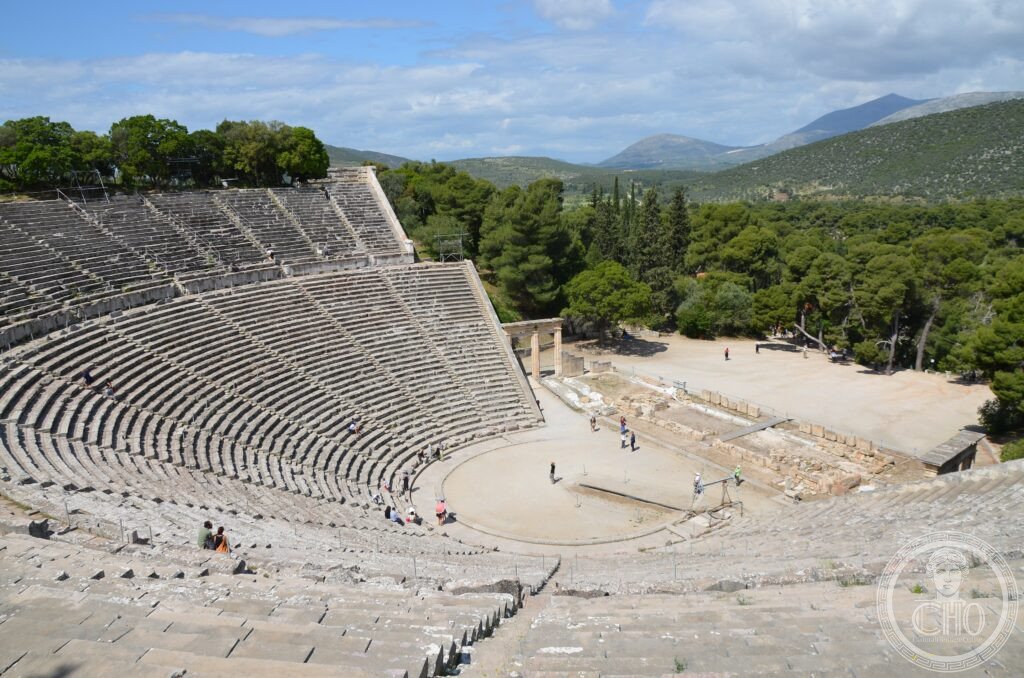
The ancient theatre at Epidaurus is famous for acoustics so precise that a whisper spoken in its stone orchestra carries to the topmost row without amplification. Built around 350 BCE within a sanctuary dedicated to the healing god Asclepius, it survives as one of the best preserved theatres from the Greek world and still hosts open-air performances of ancient drama each summer.
At a glance
Epidaurus, in the Argolis region of the Peloponnese, was one of the great healing sanctuaries of the ancient Greek world, dedicated to Asclepius, god of medicine. Pilgrims travelled here to sleep in the sanctuary’s incubation hall and receive dream-visions of their cure. The site’s theatre, built around 350 BCE and attributed to the architect Polykleitos the Younger, is renowned for acoustics that remained unexplained scientifically until the twenty-first century.
Alongside the theatre stand the remains of a circular rotunda, a temple to Asclepius, a large hostel for pilgrims, a stadium and an on-site museum. The theatre continues to host performances of ancient Greek tragedy and comedy through the Athens Epidaurus Festival, staged in Greek in the building for which the plays were originally written.
Key facts
- Theatre: built around 350 BCE, attributed to the architect Polykleitos the Younger, with seating for roughly 14,000 across 55 rows.
- Orchestra: the circular performance area is 20.28 metres in diameter and paved in limestone.
- Acoustics: in 2007 the Belgian researchers Nico Declercq and Cindy Dekeyser, working at Georgia Tech, proposed that the rough limestone seating filters sound, absorbing low-frequency noise while reflecting the higher frequencies of human speech back to the audience.
- Sanctuary: dedicated to Asclepius, it rivalled Pergamon and Kos as a centre of ancient healing, with pilgrims undergoing incubation, a ritual sleep intended to bring a divine dream and cure.
- Festival: the Athens Epidaurus Festival, established in 1954, stages ancient tragedy and comedy at the theatre each July and August.
History
The sanctuary developed from an earlier healing cult associated with Apollo Maleatas, with Asclepius emerging as the principal deity by the fifth and fourth centuries BCE. Epidaurus became a major Panhellenic healing centre, and its most substantial building programme, including the tholos and the theatre, dates to the fourth century BCE. The Hotel of the Pilgrims, a hostel of some 160 rooms arranged around four courtyards, is described as the largest such building complex surviving from the ancient Greek world.
The site was drawn into wider Greek history too: in 419 BCE it was attacked by Athenian forces under Alcibiades during the Peloponnesian War, and in 146 BCE it came under Roman control following the conquest of Greece by Lucius Mummius. With the spread of Christianity, the pagan sanctuary was closed, a process associated with the emperors Theodosius I and Theodosius II, and an earthquake in 585 CE damaged much of what remained. The site then lay largely forgotten through the medieval period.
Systematic excavation began in 1879 under the Greek Archaeological Society, led by Panagiotis Kavvadias, continuing to the end of the nineteenth century. Among the finds were stone stelae inscribed in the fourth century BCE with around seventy case histories of patients and their reported cures, now regarded as among the earliest surviving medical records anywhere, predating comparable Hippocratic case histories from Kos. Epidaurus was inscribed as a UNESCO World Heritage Site in 1988.
What you see
The theatre’s seating rises in a shallow bowl divided by a horizontal walkway, with the lower tiers and the steeper upper tiers each cut into wedge-shaped sections by radiating stairways. The circular orchestra at the centre, paved in limestone, is where the celebrated acoustic effect can still be tested. Above the top row, the pine-covered hills of the Argolid are visible over the rim of the theatre.
The tholos, a circular building of around 350 to 360 BCE also attributed to Polykleitos the Younger, is ringed by twenty-eight outer Doric columns and fourteen inner Corinthian columns, an early use of the Corinthian order internally. Beneath its floor lie three concentric stone foundations whose original purpose is not agreed, with suggestions ranging from a chamber for sacred snakes to a treasury. Nearby stood the temple of Asclepius, fronted by Doric columns, which once housed a cult statue in ivory and gold by the sculptor Thrasymedes of Paros.
Further across the sanctuary are the remains of the Hotel of the Pilgrims, the abaton or incubation hall where patients slept in hope of a healing dream, and a stadium with a 181-metre track. The on-site museum displays copies of the healing stelae, the originals of which are kept in Athens.
Practical information
- Visiting the theatre: the theatre and sanctuary can be visited as an archaeological site outside festival dates; current arrangements are best checked with the site’s official channels.
- Festival performances: tickets for the Athens Epidaurus Festival are released well ahead of the July–August season and are known to sell quickly; details are published by the festival itself.
- Museum: the site museum holds copies of the healing stelae and other finds from the sanctuary.
Getting there
Epidaurus lies in the Argolis region of the Peloponnese, within reach of the town of Nafplion. Most visitors travel by road, and the drive from Nafplion is described as a scenic one through the surrounding countryside.
Nearby
- Nafplion — around 20 kilometres away, a historic Peloponnesian town often used as a base for visiting Epidaurus.
Sources
- UNESCO
- Greek Archaeological Society
- Georgia Tech
- Athens Epidaurus Festival
- Epidaurus Museum
Find it on the map
See this place and what’s around it →
📷 Become a Cultural Heritage Online photographer
Share your photos of places: they stay published under your name as the author. The more they're seen, the more you get noticed — and soon a contest will reward the most appreciated photos.
Log in or sign up free to add a photo